
Recent from talks
Cherrapunji
Knowledge base stats:
Talk channels stats:
Members stats:
Cherrapunji
Cherrapunji (/ˌtʃɛrəˈpʌndʒi, -ˈpʊn-/ ⓘ), also known as Sohra - its original native and official name - is a sub-divisional town (Proposed District) in the East Khasi Hills district in the Indian state of Meghalaya. It was the traditional capital of ka hima Sohra (Khasi tribal kingdom).
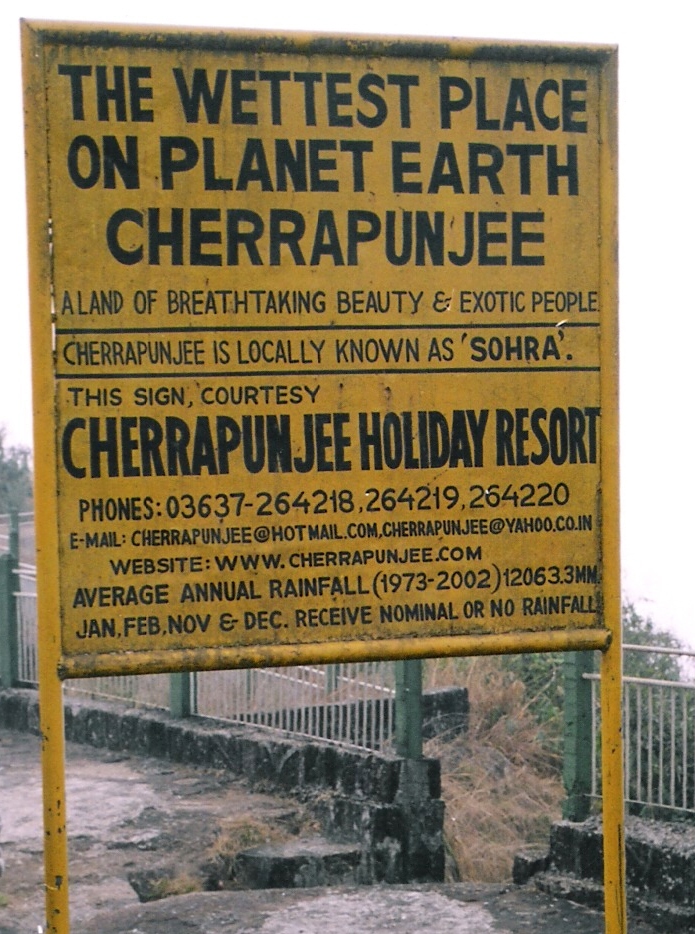
Sohra has often been credited as being the wettest place on Earth, but currently, nearby Mawsynram holds that distinction. Sohra still holds the all-time record for the most rainfall in a calendar month and in a year, however. It received 9,300 millimetres (370 in; 30.5 ft) in July 1861 and 26,461 millimetres (1,041.8 in; 86.814 ft) between 1 August 1860 and 31 July 1861.
The original native name for this town in Khasi language is Sohra (soh-ra), which was mispronounced "Cherra" by the 19th century British colonisers. Later, the suffix "punjee", a bengali term meaning "a cluster of villages", was added by people from the plains, and the name evolved into Cherrapunji, meaning "land of oranges" in some interpretations, popularized by tourists from other parts of India. It has again been officially renamed to its original form, Sohra.
The history of the Khasi people – native inhabitants of Sohra– may be traced from the early part of the 16th century. Between the 16th and 18th centuries, these people were ruled by their tribal 'Syiems (rajas or chiefs) of Khyriem' in the Khasi Hills.
The main pivot on which the entire superstructure of Khasi society rests is the matrilineal system.
The Khasi hills came under British authority in 1833 with the submission of the last of the important Syiem, Tirot Sing Syiem.[citation needed]
There is a monument to David Scott (British Administrator in NE India, 1802–31) in the town's cemetery.
Despite abundant rainfall, Sohra faces an acute water shortage and the inhabitants often have to trek very long distances to obtain potable water. Irrigation is hampered due to excessive rain washing away the topsoil as a result of human encroachment into the forests. Recent developments of rain-water harvesting techniques in the area have greatly helped the town and its neighbouring villages.
Hub AI
Cherrapunji AI simulator
(@Cherrapunji_simulator)
Cherrapunji
Cherrapunji (/ˌtʃɛrəˈpʌndʒi, -ˈpʊn-/ ⓘ), also known as Sohra - its original native and official name - is a sub-divisional town (Proposed District) in the East Khasi Hills district in the Indian state of Meghalaya. It was the traditional capital of ka hima Sohra (Khasi tribal kingdom).
Sohra has often been credited as being the wettest place on Earth, but currently, nearby Mawsynram holds that distinction. Sohra still holds the all-time record for the most rainfall in a calendar month and in a year, however. It received 9,300 millimetres (370 in; 30.5 ft) in July 1861 and 26,461 millimetres (1,041.8 in; 86.814 ft) between 1 August 1860 and 31 July 1861.
The original native name for this town in Khasi language is Sohra (soh-ra), which was mispronounced "Cherra" by the 19th century British colonisers. Later, the suffix "punjee", a bengali term meaning "a cluster of villages", was added by people from the plains, and the name evolved into Cherrapunji, meaning "land of oranges" in some interpretations, popularized by tourists from other parts of India. It has again been officially renamed to its original form, Sohra.
The history of the Khasi people – native inhabitants of Sohra– may be traced from the early part of the 16th century. Between the 16th and 18th centuries, these people were ruled by their tribal 'Syiems (rajas or chiefs) of Khyriem' in the Khasi Hills.
The main pivot on which the entire superstructure of Khasi society rests is the matrilineal system.
The Khasi hills came under British authority in 1833 with the submission of the last of the important Syiem, Tirot Sing Syiem.[citation needed]
There is a monument to David Scott (British Administrator in NE India, 1802–31) in the town's cemetery.
Despite abundant rainfall, Sohra faces an acute water shortage and the inhabitants often have to trek very long distances to obtain potable water. Irrigation is hampered due to excessive rain washing away the topsoil as a result of human encroachment into the forests. Recent developments of rain-water harvesting techniques in the area have greatly helped the town and its neighbouring villages.
Recent media