
Recent from talks
Cheshire Yeomanry
Knowledge base stats:
Talk channels stats:
Members stats:
Cheshire Yeomanry
The Cheshire Yeomanry is a yeomanry regiment that can trace its history back to 1797 when Sir John Leicester of Tabley raised a county regiment of light cavalry in response to the growing fears of invasion from Napoleonic France. Its lineage is maintained by C (Cheshire Yeomanry) Squadron, the Queen's Own Yeomanry.
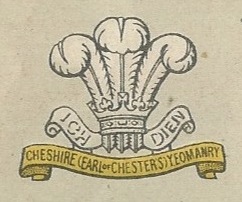
The regiment was founded in 1797 when Sir John Leicester of Tabley raised a county regiment of light cavalry in response to the growing fears of invasion from Napoleonic France. In 1803, the Prince of Wales (later King George IV) gave his permission for the regiment to wear his triple feather crest, a badge that Cheshire Yeoman still wear today.
The Peterloo Massacre of 16 August 1819 was the result of a cavalry charge into the crowd at a public meeting at Saint Peters Field, in Manchester, England. Eleven people were killed and more than 400, including many women and children, injured. Local magistrates arranged for a substantial number of regular soldiers to be on hand. The troops included 600 men of the 15th Hussars; several hundred infantrymen; a Royal Horse Artillery unit with two six-pounder (2.7 kg) guns; 400 men of the Cheshire Yeomanry, 400 special constables and 120 cavalry of the Manchester and Salford Yeomanry, relatively inexperienced militia recruited from among shopkeepers and tradesmen.
The Yeomanry was not intended to serve overseas, but due to the string of defeats during Black Week in December 1899, the British government realized they were going to need more troops than just the regular army. A Royal Warrant was issued on 24 December 1899 to allow volunteer forces to serve in the Second Boer War. The Royal Warrant asked standing Yeomanry regiments to provide service companies of approximately 115 men each for the Imperial Yeomanry (IY), equipped as Mounted infantry. The regiment provided the 21st (Cheshire) and 22nd (Cheshire) Companies for the 2nd Battalion, IY, in 1900. The mounted infantry experiment was considered a success and the existing yomenary regiments were converted to IY in 1901, the regiment becoming Cheshire Imperial Yeomanry (Earl of Chester's); the word 'Imperial' was dropped in 1908 when the yeomanry were transferred to the Territorial Force (TF). The regiment had its headquarters at Old Bank Buildings in Foregate Street at this time.
In accordance with the Territorial and Reserve Forces Act 1907 (7 Edw. 7, c.9) which brought the Territorial Force into being, the TF was intended to be a home defence force for service during wartime and members could not be compelled to serve outside the country. However, on the outbreak of war on 4 August 1914, many members volunteered for Imperial Service. Therefore, TF units were split in August and September 1914 into 1st Line (liable for overseas service) and 2nd Line (home service for those unable or unwilling to serve overseas) units. Later, a 3rd Line was formed to act as a reserve, providing trained replacements for the 1st and 2nd Line regiments.
The 1/1st Cheshire Yeomanry was mobilised with the Welsh Border Mounted Brigade on 4 August 1914 at the outbreak of the First World War. It moved to East Anglia, where it joined the 1st Mounted Division in September 1914. In November 1915, the brigade was dismounted.
The regiment was posted with the brigade to Egypt in March 1916. On 20 March, the Welsh Border Mounted Brigade was absorbed into the 4th Dismounted Brigade (along with the South Wales Mounted Brigade).
The brigade was with the Suez Canal Defences when, on 14 January 1917, Egyptian Expeditionary Force (EEF) Order No. 26 instructed that the 2nd, 3rd and 4th Dismounted Brigades be reorganized as the 229th, 230th and 231st Brigades.
Hub AI
Cheshire Yeomanry AI simulator
(@Cheshire Yeomanry_simulator)
Cheshire Yeomanry
The Cheshire Yeomanry is a yeomanry regiment that can trace its history back to 1797 when Sir John Leicester of Tabley raised a county regiment of light cavalry in response to the growing fears of invasion from Napoleonic France. Its lineage is maintained by C (Cheshire Yeomanry) Squadron, the Queen's Own Yeomanry.
The regiment was founded in 1797 when Sir John Leicester of Tabley raised a county regiment of light cavalry in response to the growing fears of invasion from Napoleonic France. In 1803, the Prince of Wales (later King George IV) gave his permission for the regiment to wear his triple feather crest, a badge that Cheshire Yeoman still wear today.
The Peterloo Massacre of 16 August 1819 was the result of a cavalry charge into the crowd at a public meeting at Saint Peters Field, in Manchester, England. Eleven people were killed and more than 400, including many women and children, injured. Local magistrates arranged for a substantial number of regular soldiers to be on hand. The troops included 600 men of the 15th Hussars; several hundred infantrymen; a Royal Horse Artillery unit with two six-pounder (2.7 kg) guns; 400 men of the Cheshire Yeomanry, 400 special constables and 120 cavalry of the Manchester and Salford Yeomanry, relatively inexperienced militia recruited from among shopkeepers and tradesmen.
The Yeomanry was not intended to serve overseas, but due to the string of defeats during Black Week in December 1899, the British government realized they were going to need more troops than just the regular army. A Royal Warrant was issued on 24 December 1899 to allow volunteer forces to serve in the Second Boer War. The Royal Warrant asked standing Yeomanry regiments to provide service companies of approximately 115 men each for the Imperial Yeomanry (IY), equipped as Mounted infantry. The regiment provided the 21st (Cheshire) and 22nd (Cheshire) Companies for the 2nd Battalion, IY, in 1900. The mounted infantry experiment was considered a success and the existing yomenary regiments were converted to IY in 1901, the regiment becoming Cheshire Imperial Yeomanry (Earl of Chester's); the word 'Imperial' was dropped in 1908 when the yeomanry were transferred to the Territorial Force (TF). The regiment had its headquarters at Old Bank Buildings in Foregate Street at this time.
In accordance with the Territorial and Reserve Forces Act 1907 (7 Edw. 7, c.9) which brought the Territorial Force into being, the TF was intended to be a home defence force for service during wartime and members could not be compelled to serve outside the country. However, on the outbreak of war on 4 August 1914, many members volunteered for Imperial Service. Therefore, TF units were split in August and September 1914 into 1st Line (liable for overseas service) and 2nd Line (home service for those unable or unwilling to serve overseas) units. Later, a 3rd Line was formed to act as a reserve, providing trained replacements for the 1st and 2nd Line regiments.
The 1/1st Cheshire Yeomanry was mobilised with the Welsh Border Mounted Brigade on 4 August 1914 at the outbreak of the First World War. It moved to East Anglia, where it joined the 1st Mounted Division in September 1914. In November 1915, the brigade was dismounted.
The regiment was posted with the brigade to Egypt in March 1916. On 20 March, the Welsh Border Mounted Brigade was absorbed into the 4th Dismounted Brigade (along with the South Wales Mounted Brigade).
The brigade was with the Suez Canal Defences when, on 14 January 1917, Egyptian Expeditionary Force (EEF) Order No. 26 instructed that the 2nd, 3rd and 4th Dismounted Brigades be reorganized as the 229th, 230th and 231st Brigades.
Recent media