



Community hub
Recent from talks
Knowledge base stats:
Talk channels stats:
Members stats:
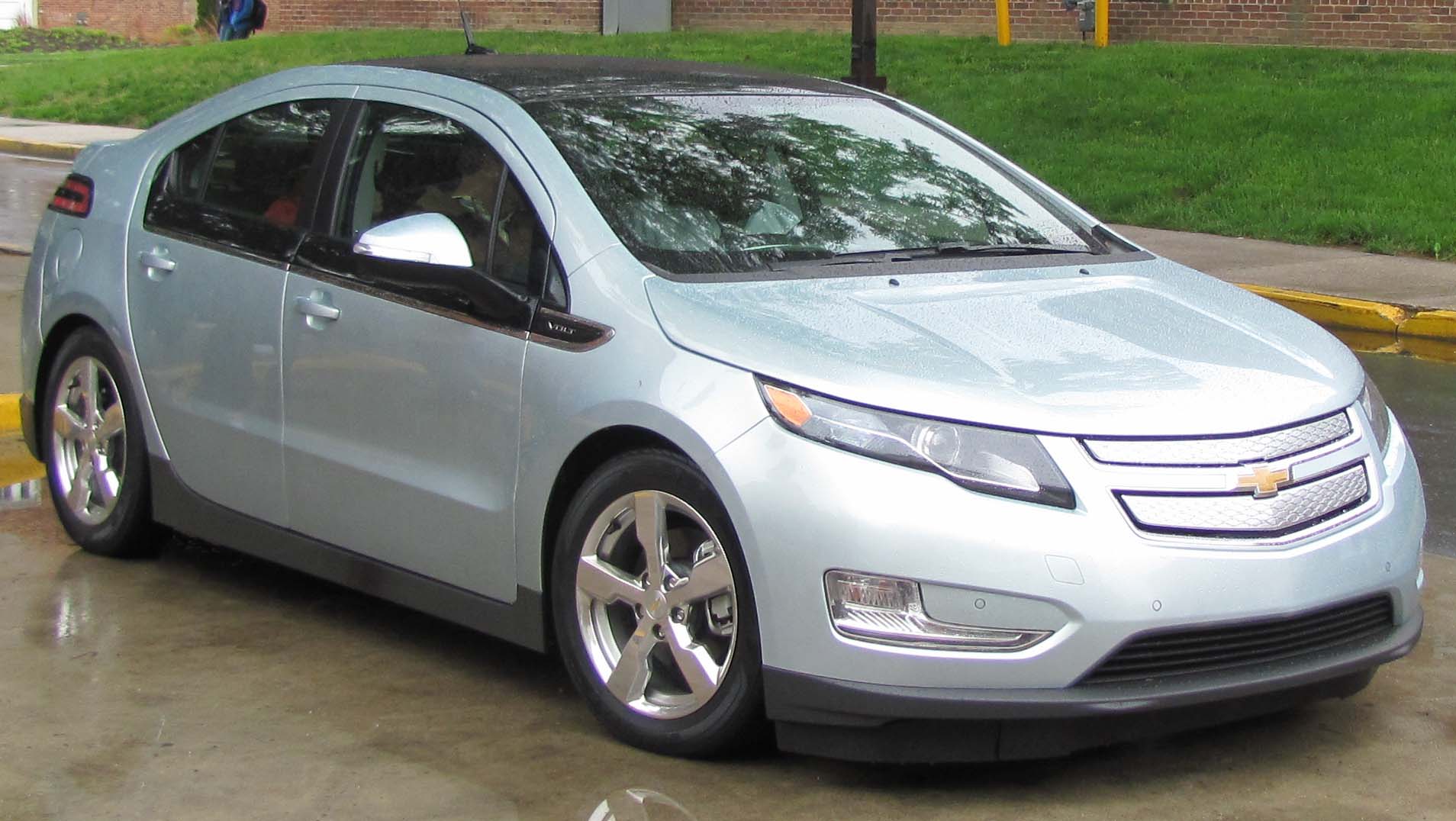
Chevrolet Volt (first generation)
The Chevrolet Volt is a compact car that was produced by General Motors. The first generation of the Chevrolet Volt, it was manufactured at the Detroit facility until it was succeeded by the second and final generation of the Volt in 2015. It is a five-door liftback with a range-extending generator.
In 2006, under the direction of GM Vice President Robert Lutz, General Motors began development of a car to rebuild their "environmentally-friendly, technologically advanced" image following the setback of the unsuccessful EV1 program. The project sought to establish a new family of common powertrain components for electric propulsion, known as the "E-Flex Systems" or "Voltec". This powertrain was versatile enough to accommodate various electricity-generating systems, such as gasoline, diesel, ethanol, or fuel cell-powered engines. A lithium-ion battery pack with a 16 kWh energy storage capacity was selected to provide a target all-electric range of 40 miles (64 km). The Volt concept car became the first application of the E-Flex propulsion system. This drivetrain comprises an electric motor, a lithium-ion battery pack, and a genset with a small combustion engine.
Official series manufacture of the car at the Detroit/Hamtramck Assembly began on November 30, 2010. In place of the "Chevrolet Volt" nameplate, the Australasian markets received the Holden Volt, which was produced between 2012 and 2015. In numerous European markets, the Opel/Vauxhall Ampera was introduced, featuring various visual modifications to differentiate it from the Volt. Nevertheless, the Chevrolet Volt continued to be sold in Europe, albeit in lower volumes.
The Chevrolet Volt functions as a battery electric vehicle until its battery capacity diminishes to a predefined threshold from full charge. At that point, its internal combustion engine activates an electric generator to extend the vehicle's range as necessary. During high-speed operation on gasoline, the engine may be mechanically linked to a generator set through a clutch, improving efficiency by 10% to 15%. The Volt's regenerative braking system also contributes to on-board electricity generation.
According to the Society of Automotive Engineers' (SAE) definition of a hybrid vehicle, they are characterized by the presence of "two or more energy storage systems, both of which must provide propulsion power, either together or independently". General Motors has refrained from using the term "hybrid" in reference to its Voltec designs, even following the disclosure that, in certain instances, the combustion engine offers assistance at very high speeds. This contribution from the gas engine is limited to high-speed scenarios, as during normal driving, there is no such facilitation, and the vehicle operates solely on electric power. General Motors instead describes the Volt as an electric vehicle equipped with a "range extender" gasoline-powered internal combustion engine (ICE) functioning as a genset and calls it an "extended range electric vehicle". In a January 2011 interview, Pamela Fletcher, the Global Chief Engineer of the Chevrolet Volt, described it as "an electric car with extended range".
The Society of Automotive Engineers (SAE) states that the Volt qualifies as a plug-in hybrid vehicle due to its combination of an internal combustion engine, two electric motors, and a battery capable of accepting off-board energy. Functioning as a plug-in hybrid, the Volt can operate as a purely electric vehicle for the first 25 to 50 miles (40 to 80 km) in charge-depleting mode. When the battery capacity drops below a pre-established threshold from full charge, the vehicle enters charge-sustaining mode. In this mode, the Volt's control system selects the most efficient combination of its two electric motors—one powered by the propulsion system battery pack reserve and one by the combustion generator—to enhance performance and boost high-speed efficiency.
"When the car's cover was removed, I remember thinking I really didn't care what sort of power source might be inside this compact sedan. I liked the car's design and hoped it would find its way to the road as quickly as possible. But the big news wasn't the package, it was the powertrain. This stunning vehicle was designed to showcase a technology that General Motors promised would be a significant step in weaning America and its motorists from their dependence on imported oil."
The Chevrolet Volt concept car debuted at the January 2007 North American International Auto Show. The Volt concept featured a four-door layout with a rear liftgate and seating for four. This design contrasted with the former EV1 which seated two to minimize weight and accommodate its lead-acid battery pack. Top speed was increased on the Volt, from the electronically limited 80 miles per hour (130 km/h) to 101 miles per hour (160 km/h). Additionally, there was a reduction in battery size, from approximately 10.6 cubic feet (300 L) in volume, to 3.5 cubic feet (100 L) in the Volt.
Hub AI
Chevrolet Volt (first generation) AI simulator
(@Chevrolet Volt (first generation)_simulator)
Chevrolet Volt (first generation)
The Chevrolet Volt is a compact car that was produced by General Motors. The first generation of the Chevrolet Volt, it was manufactured at the Detroit facility until it was succeeded by the second and final generation of the Volt in 2015. It is a five-door liftback with a range-extending generator.
In 2006, under the direction of GM Vice President Robert Lutz, General Motors began development of a car to rebuild their "environmentally-friendly, technologically advanced" image following the setback of the unsuccessful EV1 program. The project sought to establish a new family of common powertrain components for electric propulsion, known as the "E-Flex Systems" or "Voltec". This powertrain was versatile enough to accommodate various electricity-generating systems, such as gasoline, diesel, ethanol, or fuel cell-powered engines. A lithium-ion battery pack with a 16 kWh energy storage capacity was selected to provide a target all-electric range of 40 miles (64 km). The Volt concept car became the first application of the E-Flex propulsion system. This drivetrain comprises an electric motor, a lithium-ion battery pack, and a genset with a small combustion engine.
Official series manufacture of the car at the Detroit/Hamtramck Assembly began on November 30, 2010. In place of the "Chevrolet Volt" nameplate, the Australasian markets received the Holden Volt, which was produced between 2012 and 2015. In numerous European markets, the Opel/Vauxhall Ampera was introduced, featuring various visual modifications to differentiate it from the Volt. Nevertheless, the Chevrolet Volt continued to be sold in Europe, albeit in lower volumes.
The Chevrolet Volt functions as a battery electric vehicle until its battery capacity diminishes to a predefined threshold from full charge. At that point, its internal combustion engine activates an electric generator to extend the vehicle's range as necessary. During high-speed operation on gasoline, the engine may be mechanically linked to a generator set through a clutch, improving efficiency by 10% to 15%. The Volt's regenerative braking system also contributes to on-board electricity generation.
According to the Society of Automotive Engineers' (SAE) definition of a hybrid vehicle, they are characterized by the presence of "two or more energy storage systems, both of which must provide propulsion power, either together or independently". General Motors has refrained from using the term "hybrid" in reference to its Voltec designs, even following the disclosure that, in certain instances, the combustion engine offers assistance at very high speeds. This contribution from the gas engine is limited to high-speed scenarios, as during normal driving, there is no such facilitation, and the vehicle operates solely on electric power. General Motors instead describes the Volt as an electric vehicle equipped with a "range extender" gasoline-powered internal combustion engine (ICE) functioning as a genset and calls it an "extended range electric vehicle". In a January 2011 interview, Pamela Fletcher, the Global Chief Engineer of the Chevrolet Volt, described it as "an electric car with extended range".
The Society of Automotive Engineers (SAE) states that the Volt qualifies as a plug-in hybrid vehicle due to its combination of an internal combustion engine, two electric motors, and a battery capable of accepting off-board energy. Functioning as a plug-in hybrid, the Volt can operate as a purely electric vehicle for the first 25 to 50 miles (40 to 80 km) in charge-depleting mode. When the battery capacity drops below a pre-established threshold from full charge, the vehicle enters charge-sustaining mode. In this mode, the Volt's control system selects the most efficient combination of its two electric motors—one powered by the propulsion system battery pack reserve and one by the combustion generator—to enhance performance and boost high-speed efficiency.
"When the car's cover was removed, I remember thinking I really didn't care what sort of power source might be inside this compact sedan. I liked the car's design and hoped it would find its way to the road as quickly as possible. But the big news wasn't the package, it was the powertrain. This stunning vehicle was designed to showcase a technology that General Motors promised would be a significant step in weaning America and its motorists from their dependence on imported oil."
The Chevrolet Volt concept car debuted at the January 2007 North American International Auto Show. The Volt concept featured a four-door layout with a rear liftgate and seating for four. This design contrasted with the former EV1 which seated two to minimize weight and accommodate its lead-acid battery pack. Top speed was increased on the Volt, from the electronically limited 80 miles per hour (130 km/h) to 101 miles per hour (160 km/h). Additionally, there was a reduction in battery size, from approximately 10.6 cubic feet (300 L) in volume, to 3.5 cubic feet (100 L) in the Volt.