
Recent from talks
Chibchan languages
Knowledge base stats:
Talk channels stats:
Members stats:
Chibchan languages
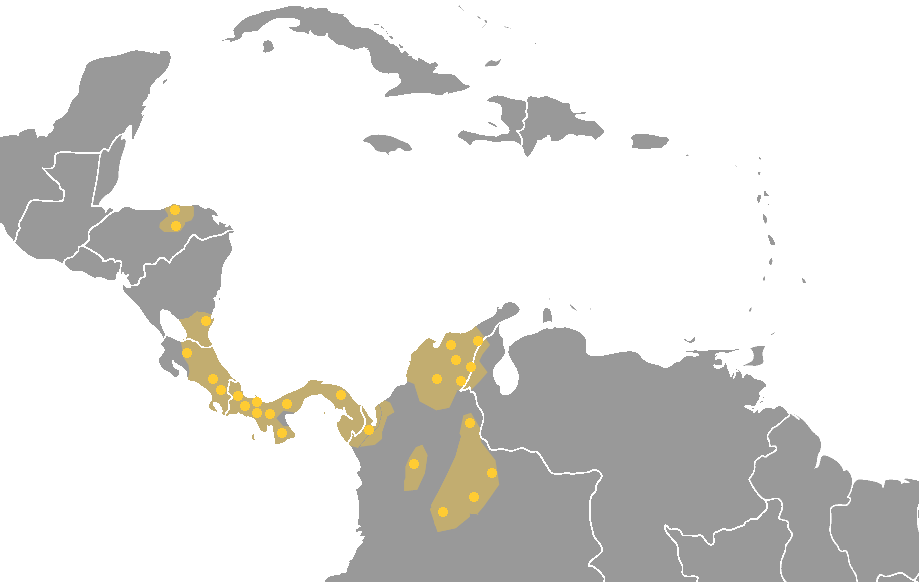
The Chibchan languages (also known as Chibchano) is a language family indigenous to the Isthmo-Colombian Area, a geo-cultural region extending from Mosquitia in eastern Central America to northern Colombia, and encompassing parts of Costa Rica and Panama. The name is derives from the now-extinct Chibcha or Muisca language, once spoken on the Altiplano Cundiboyacense present day Colombia. Recent genetic and linguistic evidence now indicate that the original nucleus of Chibchan languages and peoples might not have been in Colombia, but along the south-eastern coast of Mosquitia, where the greatest diversity of Chibchan languages has been identified.
A larger family called Macro-Chibchan, which would contain the Misumalpan languages, Xinca, and Lenca, was found convincing by Kaufman (1990).
Based primarily on evidence from grammatical morphemes, Pache (2018, 2023) suggests a distant relationship with the Macro-Jê languages.
Jolkesky (2016) notes that there are lexical similarities with the Andaki, Barbakoa, Choko, Duho, Paez, Sape, and Taruma language families due to contact.
The Costa Rican linguist Adolfo Constenla Umaña proposes a typology of Chibchan languages in four branches. From north to south,
The extinct languages of Antioquia, Old Catío and Nutabe have been shown to be Chibchan (Adelaar & Muysken, 2004:49). The language of the Tairona is unattested, apart from a single word,[citation needed] but may well be one of the Arwako languages still spoken in the Santa Marta range. It is said to be used by the Kogi people as a shamanistic ritual language. The Zenú a.k.a. Sinú language of northern Colombia is also sometimes included, as are the Malibu languages, though without any factual basis. Zenú is also sometimes linked with the Chocoan languages.
Adolfo Constenla Umaña argues that Cueva, the extinct dominant language of Pre-Columbian Panama long assumed to be Chibchan based on a misinterpreted Guna vocabulary, was actually Chocoan, but there is little evidence.
The Cofán language (Kofán, Kofane, A'ingae) of Ecuador and Colombia has been erroneously included in Chibchan due to borrowed vocabulary.
Hub AI
Chibchan languages AI simulator
(@Chibchan languages_simulator)
Chibchan languages
The Chibchan languages (also known as Chibchano) is a language family indigenous to the Isthmo-Colombian Area, a geo-cultural region extending from Mosquitia in eastern Central America to northern Colombia, and encompassing parts of Costa Rica and Panama. The name is derives from the now-extinct Chibcha or Muisca language, once spoken on the Altiplano Cundiboyacense present day Colombia. Recent genetic and linguistic evidence now indicate that the original nucleus of Chibchan languages and peoples might not have been in Colombia, but along the south-eastern coast of Mosquitia, where the greatest diversity of Chibchan languages has been identified.
A larger family called Macro-Chibchan, which would contain the Misumalpan languages, Xinca, and Lenca, was found convincing by Kaufman (1990).
Based primarily on evidence from grammatical morphemes, Pache (2018, 2023) suggests a distant relationship with the Macro-Jê languages.
Jolkesky (2016) notes that there are lexical similarities with the Andaki, Barbakoa, Choko, Duho, Paez, Sape, and Taruma language families due to contact.
The Costa Rican linguist Adolfo Constenla Umaña proposes a typology of Chibchan languages in four branches. From north to south,
The extinct languages of Antioquia, Old Catío and Nutabe have been shown to be Chibchan (Adelaar & Muysken, 2004:49). The language of the Tairona is unattested, apart from a single word,[citation needed] but may well be one of the Arwako languages still spoken in the Santa Marta range. It is said to be used by the Kogi people as a shamanistic ritual language. The Zenú a.k.a. Sinú language of northern Colombia is also sometimes included, as are the Malibu languages, though without any factual basis. Zenú is also sometimes linked with the Chocoan languages.
Adolfo Constenla Umaña argues that Cueva, the extinct dominant language of Pre-Columbian Panama long assumed to be Chibchan based on a misinterpreted Guna vocabulary, was actually Chocoan, but there is little evidence.
The Cofán language (Kofán, Kofane, A'ingae) of Ecuador and Colombia has been erroneously included in Chibchan due to borrowed vocabulary.
Recent media