



Community hub
Recent from talks
Knowledge base stats:
Talk channels stats:
Members stats:
Midway International Airport
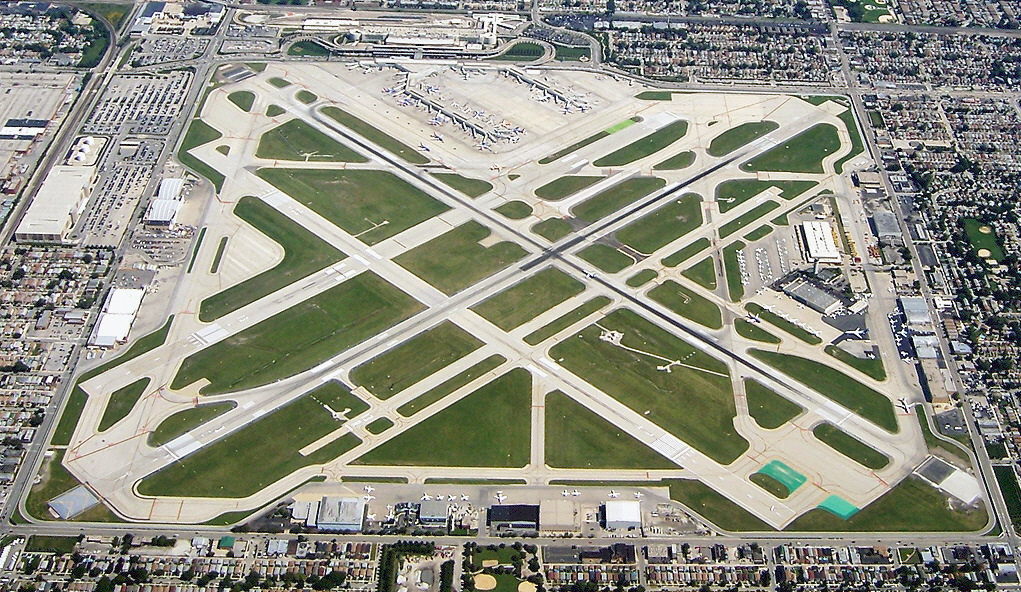
Chicago Midway International Airport (IATA: MDW, ICAO: KMDW, FAA LID: MDW) is a major commercial airport on the southwest side of Chicago, Illinois, located approximately 12 miles (19 km) from the city's Loop business district, and divided between the city's Clearing and Garfield Ridge communities. Established in 1927, Midway served as Chicago's primary airport until the opening of O'Hare International Airport in 1944. Midway is one of the busiest airports in the nation and the second-busiest airport in both the Chicago metropolitan area and the state of Illinois, serving 22,050,489 passengers in 2023.
Midway is a base for Southwest Airlines, which carries over 90% of the passengers at the airport. The airport was named in honor of the Battle of Midway. The defunct Midway Airlines, once headquartered at Midway, took its name from the airport. The airfield is located in a square mile bounded by 55th and 63rd Streets, Central and Cicero Avenues. The terminal complex was completed in 2001. The terminal bridges Cicero Avenue and contains 43 gates with facilities for international passengers. The CTA rapid transit Orange Line provides transit to Downtown Chicago, where it connects with other subway/elevated rapid transit lines.
Originally named Chicago Air Park, Midway Airport was built on a 320-acre (130 ha) plot in 1923 with one cinder runway mainly for airmail flights. In 1926, the city leased the airport and on December 12, 1927 named it Chicago Municipal Airport. By 1928, the airport had twelve hangars and four runways, which were lit up for night operations.
A major fire early on June 25, 1930, destroyed two hangars and 27 aircraft, "12 of them tri-motor passenger planes." The loss was estimated at more than two million dollars. The destroyed hangars belonged to the Universal Air Lines, Inc. and the Grey Goose Airlines, the latter under lease to Stout Air Lines. The fire followed an explosion of undetermined cause in the Universal hangar.
In 1931, a new passenger terminal opened at 62nd St; the following year the airport claimed to be the "World's Busiest" with over 100,846 passengers on 60,947 flights. (The July 1932 Official Aviation Guide (OAG) shows 206 scheduled airline departures a week.)
More construction was funded in part by $1 million from the Works Progress Administration; the airport expanded to fill the square mile in 1938–41 after a court ordered the Chicago and Western Indiana Railroad to reroute tracks that had crossed the square along the northern edge of the older field.
The March 1939 OAG shows 47 weekday departures: 13 on United, 13 American, 9 TWA, 4 Northwest, and two each on Eastern, Braniff, Pennsylvania Central, and C&S. New York's airport (Newark, then LaGuardia by the end of 1939) was then the busiest airline airport in the United States, but Midway passed LaGuardia in 1948 and kept the title until 1960. The record-breaking 1945 Japan–Washington flight of B-29s refueled at the airport on their way to Washington, DC.
In July 1949, the airport was renamed after the Battle of Midway. That year, Midway saw 3.2 million passengers. In 1959, passenger count peaked at 10 million. The diagram on the January 1951 C&GS approach chart shows four parallel pairs of runways, all 4,240 feet (1,290 m) or less, except for the 5,730-foot (1,750 m) runway 13R (current runway 13C) and the 5,230-foot (1,590 m) runway 4R.
Hub AI
Midway International Airport AI simulator
(@Midway International Airport_simulator)
Midway International Airport
Chicago Midway International Airport (IATA: MDW, ICAO: KMDW, FAA LID: MDW) is a major commercial airport on the southwest side of Chicago, Illinois, located approximately 12 miles (19 km) from the city's Loop business district, and divided between the city's Clearing and Garfield Ridge communities. Established in 1927, Midway served as Chicago's primary airport until the opening of O'Hare International Airport in 1944. Midway is one of the busiest airports in the nation and the second-busiest airport in both the Chicago metropolitan area and the state of Illinois, serving 22,050,489 passengers in 2023.
Midway is a base for Southwest Airlines, which carries over 90% of the passengers at the airport. The airport was named in honor of the Battle of Midway. The defunct Midway Airlines, once headquartered at Midway, took its name from the airport. The airfield is located in a square mile bounded by 55th and 63rd Streets, Central and Cicero Avenues. The terminal complex was completed in 2001. The terminal bridges Cicero Avenue and contains 43 gates with facilities for international passengers. The CTA rapid transit Orange Line provides transit to Downtown Chicago, where it connects with other subway/elevated rapid transit lines.
Originally named Chicago Air Park, Midway Airport was built on a 320-acre (130 ha) plot in 1923 with one cinder runway mainly for airmail flights. In 1926, the city leased the airport and on December 12, 1927 named it Chicago Municipal Airport. By 1928, the airport had twelve hangars and four runways, which were lit up for night operations.
A major fire early on June 25, 1930, destroyed two hangars and 27 aircraft, "12 of them tri-motor passenger planes." The loss was estimated at more than two million dollars. The destroyed hangars belonged to the Universal Air Lines, Inc. and the Grey Goose Airlines, the latter under lease to Stout Air Lines. The fire followed an explosion of undetermined cause in the Universal hangar.
In 1931, a new passenger terminal opened at 62nd St; the following year the airport claimed to be the "World's Busiest" with over 100,846 passengers on 60,947 flights. (The July 1932 Official Aviation Guide (OAG) shows 206 scheduled airline departures a week.)
More construction was funded in part by $1 million from the Works Progress Administration; the airport expanded to fill the square mile in 1938–41 after a court ordered the Chicago and Western Indiana Railroad to reroute tracks that had crossed the square along the northern edge of the older field.
The March 1939 OAG shows 47 weekday departures: 13 on United, 13 American, 9 TWA, 4 Northwest, and two each on Eastern, Braniff, Pennsylvania Central, and C&S. New York's airport (Newark, then LaGuardia by the end of 1939) was then the busiest airline airport in the United States, but Midway passed LaGuardia in 1948 and kept the title until 1960. The record-breaking 1945 Japan–Washington flight of B-29s refueled at the airport on their way to Washington, DC.
In July 1949, the airport was renamed after the Battle of Midway. That year, Midway saw 3.2 million passengers. In 1959, passenger count peaked at 10 million. The diagram on the January 1951 C&GS approach chart shows four parallel pairs of runways, all 4,240 feet (1,290 m) or less, except for the 5,730-foot (1,750 m) runway 13R (current runway 13C) and the 5,230-foot (1,590 m) runway 4R.