Hubbry Logo
Chick ShortenChick ShortenMain
Open search
Chick Shorten
Community hub
Chick Shorten
logo
8 pages, 0 posts
0 subscribers
Be the first to start a discussion here.
Chick Shorten
Chick Shorten
from Wikipedia

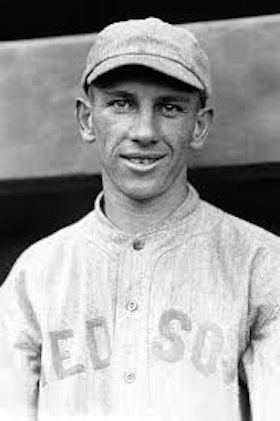
Charles Henry "Chick" Shorten (April 19, 1892 – October 23, 1965) was an American baseball player. He played professional baseball as an outfielder for 18 years from 1911 to 1928, including eight seasons in Major League Baseball with the Boston Red Sox (1915–1917), Detroit Tigers (1919–1921), St. Louis Browns (1922), and Cincinnati Reds (1924). He was a member of the 1916 Red Sox team that won the World Series, and Shorten compiled a .571 batting average in the 1916 World Series. In eight major league seasons, Shorten appeared in 527 games, including 352 as an outfielder, and compiled a .275 career batting average.

Key Information

Early years

[edit]

Shorten was born in Scranton, Pennsylvania, in 1892.[1] The son of Irish immigrants, his father and two uncles ran a grocery business in Scranton.[2] Shorten played two seasons of semi-pro baseball with the Minooka Blues.[2]

Professional baseball

[edit]

Minor leagues

[edit]

Shorten began playing professional baseball in August 1911 with his hometown Scranton baseball team in the New York State League.[3][4] He next played for the Worcester Busters in the New England League from 1912 to 1914, compiling batting averages of .335 in 1913 and .345 in 1914. He spent most of the 1915 season with the Providence Grays of the International League. He compiled a .322 batting average in a career-high 615 at bats with Providence.[3]

Boston Red Sox

[edit]

On September 22, 1915, Shorten made his major league debut with the Boston Red Sox. He appeared in six games with the 1915 Red Sox, compiling a .214 batting average in 14 at bats.[1]

In 1916, Shorten appeared in 53 games for the Red Sox, 13 as a starter in center field, eight as a starter in right field, and one start in left field. He compiled a .295 batting average and .352 on-base percentage in 124 plate appearances.[1] The 1916 Red Sox won the American League pennant with a 91-63 record and defeated the Brooklyn Robins in the 1916 World Series.[5] Shorten appeared in two games in the 1916 World Series for the Red Sox, and collected four hits and two RBIs in seven at-bats for a .571 batting average. He was also caught stealing twice in the series.[1] Fifty years later, Shorten's Associated Press obituary described him as the "batting hero of the 1916 World Series."[6]

In 1917, Shorten appeared in 69 games for the Red Sox, 22 as the team's starting center fielder, nine in left field, and four in right field. His batting average dropped precipitously by 116 points from .295 to .179.[1]

Military service

[edit]

After the 1917 season, Shorten was inducted into the United States Navy. He served at the Boston Navy Yard and underwent training at Wakefield, Massachusetts.[7]

Detroit Tigers

[edit]

On January 17, 1919, Shorten was traded by the Red Sox with Eddie Ainsmith and Slim Love to the Detroit Tigers in exchange for Ossie Vitt.[8] Shorten was one of four Detroit outfielders to bat above .300 in 1919 – Shorten at .315 in 95 games, Ty Cobb at .384 in 124 games, Bobby Veach at .355 in 139 games, and Ira Flagstead at .331 in 97 games.[9] Shorten remained with the Tigers for two more years, compiling batting averages of .288 in 1920 and .272 in 1921.[1]

St. Louis and Cincinnati

[edit]

In 1923, Shorten played for the St. Louis Browns. He appeared in 55 games, 13 as the starting center fielder and nine starts in right field and five in left field.[1]

In 1923, Shorten was assigned to play in Nashville, refused to report, was suspended, and announced his retirement from the game. He was reinstated after one year and signed with the Cincinnati Reds.[10] He appeared in 41 games for the 1924 Reds, mostly as a pinch hitter, and compiled a .275 batting average.[1]

In eight major league seasons, Shorten appeared in 527 games, including 352 as an outfielder and the rest as a pinch hitter. He compiled a career batting average of .275 with 370 hits, 51 doubles, 20 triples, three home runs, and 138 RBIs.[1] In 352 games in the outfield, Shorten had a .985 fielding percentage, 23 points higher than the average outfielder of that time.[1]

Minor leagues

[edit]

Although Shorten's major league career ended in 1924, he continued to play in the minor leagues for another four years - as the player-manager of the Reading Keystones in the International League in 1925, for the Newark Bears in 1926, and for the Scranton Miners in 1926 and 1927. He compiled a .354 batting average in 119 games in 1927 at age 35.[3]

Later years

[edit]

After retiring from baseball, Shorten worked in his family's grocery store in Scranton. He also worked as a scout for the Cleveland Indians in the 1950s.[2] Shorten died in 1965 at age 74 at his home in Scranton, Pennsylvania.[6]

References

[edit]
[edit]
Revisions and contributorsEdit on WikipediaRead on Wikipedia
from Grokipedia
Chick Shorten is an American former professional baseball outfielder known for his eight-season Major League Baseball career in the 1910s and 1920s, during which he played for the Boston Red Sox, Detroit Tigers, St. Louis Browns, and Cincinnati Reds. Born Charles Henry Shorten on April 19, 1892, in Scranton, Pennsylvania, he was a left-handed batter and thrower who primarily served as a reserve outfielder and pinch hitter across 527 games, compiling a career batting average of .275. Shorten made his MLB debut with the Boston Red Sox in 1915 and contributed to their 1916 World Series championship team, appearing in two games during the Fall Classic. He missed the 1918 season due to service in the United States Navy during World War I, enlisting in the Naval Reserve in 1917. He was traded to the Detroit Tigers in 1919, where he enjoyed some of his most consistent playing time before later stints with the Browns and Reds. His career included limited but notable offensive contributions as a platoon player, with his highest single-season games played total reaching 116 in 1920. Shorten retired from playing professional baseball in the late 1920s after time in the minors and later worked as a scout for the Cleveland Indians during the 1950s. He died on October 23, 1965, in Clarks Summit, Pennsylvania, at the age of 73.

Early life

Birth and family background

Charles Henry "Chick" Shorten was born on April 19, 1892, in Scranton, Pennsylvania. He was the son of Irish immigrants James Shorten, who arrived in the United States in 1877, and Amelia "Emma" (Scart) Shorten, who immigrated in 1873 at age 16. The family settled in Scranton, where James Shorten established and operated a grocery store at 2239 Pittston Avenue that offered staple and fancy groceries. This business later evolved into a family enterprise known as Shorten Brothers, involving Shorten's brothers Paul and Frederick, with other family members also employed there, and the Shortens residing in close proximity along Pittston Avenue.

Early years and entry into profession

Charles Henry "Chick" Shorten was born on April 19, 1892, in Scranton, Pennsylvania. He grew up in a family of Irish immigrants, with his father James operating a grocery store on Pittston Avenue that later developed into the family-run Shorten Brothers business. After completing eighth grade, Shorten attended Yeates Prep School in Lancaster, Pennsylvania, where he played outfield for the school's team. Before turning professional, Shorten played two seasons with the semipro Minooka Blues team in the Scranton area. His entry into organized professional baseball came in 1911, when he joined the Scranton Miners of the Class-B New York State League at age 19, appearing in 22 games that season. This marked the beginning of his career in the sport, initially with his hometown team.

Professional career

Major League Baseball career

Shorten played in Major League Baseball from 1915 to 1924, primarily as a reserve outfielder and pinch hitter. He debuted with the Boston Red Sox in 1915 and was part of their 1916 World Series championship team, appearing in two games and hitting .571 (notably going 3-for-4 in Game 3). After serving in the U.S. Navy during World War I, he was traded to the Detroit Tigers in 1919, where he saw more regular play, including a career-high 116 games in 1920. He later played for the St. Louis Browns and concluded his MLB tenure with the Cincinnati Reds in 1924.

Later playing career and retirement

After his major league career concluded with the Cincinnati Reds in 1924, Shorten continued his professional playing days in the minor leagues for several more seasons. He joined the Reading Keystones in 1925, where he briefly assumed managerial duties after Spencer Abbott resigned on May 30, before returning to player-only roles with Newark in 1926 and his hometown Scranton team in 1927 and 1928. Shorten did not play professionally after the 1928 season. He then transitioned out of baseball entirely and worked in the family grocery business, Shorten Brothers, in Scranton alongside his brothers and later his son. In 1950, Shorten returned to the sport when he was hired by former teammate Mike McNally, then the Cleveland Indians' farm director, to serve as a scout based in Scranton. He held this position through the 1959 season, during which he signed several minor league prospects including Charles Bolcar, Ernest Craumer, George Ettenger, and William T. Fisher. Shorten retired from scouting after 1959, citing the job's increasingly demanding requirements as the primary reason. He explained that the territory had expanded significantly, requiring extensive travel—including long night drives across New York, New England, and even Canada—often alone on unfamiliar roads, which he viewed as too risky. “The territory of a scout has become too extensive…Whereas you once patrolled your own part of the country, and had a good chance of getting a look at every boy with ability, you now wander hundreds of miles from home,” he said, adding, “Baseball has been too good to me to spoil everything by taking one chance too many.” This marked the end of his involvement in professional baseball.

Personal life

Family and relationships

Charles Henry "Chick" Shorten married Harriet Astle on June 6, 1923. The couple had two children: a son, Charles Shorten Jr., who later joined the family grocery business, and a daughter, Lois Shorten. At the time of his death in 1965, Shorten was survived by his wife Harriet, son Charles Jr., daughter Lois, and two grandchildren.

Residences and personal interests

Chick Shorten was born in Scranton, Pennsylvania, on April 19, 1892. He died in Clarks Summit, Pennsylvania, on October 23, 1965. No additional details on other residences or specific personal interests and hobbies are documented in major biographical sources.

Death

Charles "Chick" Shorten died on October 23, 1965, at Clarks Summit State Hospital in Newton Township, Lackawanna County, Pennsylvania, after a three-year illness caused by congestive heart failure. He was 73 years old. He was survived by his wife Harriet (married 1923), his son Charles Jr., his daughter Lois, three siblings, and two grandchildren. Obituaries, including an Associated Press release, highlighted his contributions to the Boston Red Sox's 1916 World Series championship. Shorten was buried at Abington Hills Cemetery in South Abington Township, Lackawanna County, Pennsylvania. No detailed public records or reports describe the administration of Shorten's estate, probate proceedings, or distribution of assets following his death. The family maintained ties to Scranton, where Shorten had worked in the Shorten Brothers grocery business after his playing career and where his son was involved in operations.

Legacy

Recognition in industry sources

Chick Shorten has received minimal recognition in film industry sources. He maintains a basic entry in the Internet Movie Database (IMDb) due to an appearance as himself in archival footage from the 1916 World Series, including birth and death details and this self-credit but no other acting roles or detailed motion picture career information. No mentions appear in major film histories, encyclopedias, industry publications, or books on cinema, indicating an absence of notable acknowledgment within the field. This limited presence aligns with his primary identification as a professional baseball player rather than a film industry figure. Obituaries and biographical accounts from the time of his death in 1965 focus exclusively on his athletic career, with no references to contributions or recognition in the motion picture industry.

Posthumous mentions

Chick Shorten has received relatively sparse posthumous attention, largely limited to specialized baseball historical resources rather than widespread media retrospectives or tributes. The Society for American Baseball Research published a comprehensive biographical profile on him in 2015, detailing his major league career from 1915 to 1924, his membership on the Boston Red Sox's World Series championship teams in 1915 and 1916 (with a playing role in 1916), and his later life running the family grocery business in Scranton while scouting for the Cleveland Indians from 1950 to 1959. The profile quotes his 1965 Associated Press obituary as describing him as the “batting hero of the 1916 World Series.” He is also referenced in targeted game retrospectives, including a 2017 SABR article recounting Game 5 of the 1916 World Series, where Shorten is noted for his third-inning single that drove in Harry Hooper during the Red Sox's decisive victory. Beyond these SABR contributions and ongoing documentation of his statistics on sites like Baseball-Reference, posthumous mentions of Shorten remain rare in broader baseball literature or popular retrospectives.

Areas of incomplete coverage

Despite the existence of detailed statistical records and a thorough biographical account from the Society for American Baseball Research, several aspects of Chick Shorten's life and career remain underexplored in available sources. Primary documentation centers on his major league playing tenure and transactions, leaving limited insight into his childhood experiences in Scranton beyond basic family and semipro involvement. The precise reasons for his 1923 refusal to report to minor league assignments in St. Paul and elsewhere are not fully explained in existing records. Similarly, narrative details on his post-playing years—such as day-to-day operations in the family grocery business and his scouting work for the Cleveland Indians from 1950 to 1959—are sparse beyond general mentions of employment and retirement due to travel demands. His minor league career after 1924 lacks comprehensive statistical or contextual accounts in major sources, with only partial records available for those seasons. Further archival research in Scranton-area newspapers, family documents, or local historical collections could address these gaps and provide a more complete picture of his personal and professional life.
Add your contribution
Related Hubs
User Avatar
No comments yet.