Hubbry Logo
Chicken lollipopChicken lollipopMain
Open search
Chicken lollipop
Community hub
Chicken lollipop
logo
8 pages, 0 posts
0 subscribers
Be the first to start a discussion here.
Chicken lollipop
Chicken lollipop
from Wikipedia

Chicken lollipop
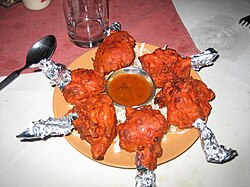
A platter of chicken lollipops, with spicy dipping sauce, served in Goa, India
TypeStarter
CourseHors d'oeuvre
Place of originIndia
Associated cuisineIndian
Serving temperatureHot
Main ingredientsChicken wings, batter
VariationsMutton lollipop
  •   Media: Chicken lollipop

Chicken lollipop is a popular Indian fried chicken appetiser. Chicken lollipop is essentially a frenched chicken winglet, wherein the meat is cut loose from the bone end and pushed down, creating a lollipop appearance.[1]

Recipe

[edit]

Recipes vary at different restaurants.[2] However, many start by using the middle segment of the chicken wing or thigh. The middle segment has one of the two bones removed, and the flesh on the segments is pushed to one end of the bone. These are then coated in a spicy red batter whose main ingredients include red chili powder, and turmeric.[3] The coated chicken is then marinated for a couple of hours. The marinated chicken is usually deep fried in oil, but another choice is baking the chicken. The exposed bone is sometimes wrapped in aluminum foil.

See also

[edit]

References

[edit]
Revisions and contributorsEdit on WikipediaRead on Wikipedia
from Grokipedia
Chicken lollipop is a popular Indo-Chinese fusion appetizer originating from the , particularly , , where chicken wing drumettes are frenched—meaning the meat is pushed down to one end of the bone to create a lollipop-like shape—before being marinated in a spicy blend of ginger, , , chili paste, and other seasonings, then coated in a batter and deep-fried to a crisp golden exterior. Often served as a starter in restaurants, it is sometimes tossed in a glossy, sweet-spicy sauce made from ingredients like tomato ketchup, , and additional chilies, enhancing its tangy and fiery flavor profile. The dish emerged as part of the broader Indo-Chinese culinary tradition, particularly in regions like Kolkata's , where it is famously known as "Drums of Heaven" and has been a staple in local eateries since at least the mid-20th century. This developed through Chinese immigrants adapting their recipes to Indian tastes and available ingredients, resulting in bold, spice-forward preparations that differ from traditional Chinese dishes. lollipop's unique presentation makes it an ideal for parties and gatherings, with variations including baked versions for a healthier alternative or air-fried options to reduce oil usage while maintaining crunch. Beyond India, the dish has gained international appeal, appearing on menus in countries with significant Indian diaspora populations, such as the , the , and the . Its enduring popularity stems from the combination of juicy, tender meat encased in a shatteringly crisp coating, making it a go-to choice for appetizers that balance heat, sweetness, and .

History and Origins

Indo-Chinese Roots

The roots of chicken lollipop trace back to the 19th and 20th centuries, when waves of Chinese immigrants, primarily from the Hakka community in southern , settled in (then Calcutta) during the British colonial era. These migrants, often working in tanneries and shoe factories in areas like Tiretta Bazaar and later Tangra, adapted their traditional cooking techniques to incorporate locally available ingredients and Indian palates, giving rise to Indo-Chinese cuisine. This fusion began as early as the late 18th century with initial arrivals seeking opportunities in sugar mills and trade, evolving into a distinct culinary style by the mid-20th century through restaurants like Nanking, established in 1924. Chicken lollipop emerged as part of this Indo-Chinese tradition in Kolkata's areas, such as Tangra, where the dish is famously known as "drums of heaven." The dish drew inspiration from preparations like , which emphasized crispy frying and bold seasonings, but was localized with Indian elements such as ample chili, , and soy-based sauces to suit spicier preferences. This naming and presentation solidified its status as a signature starter in the evolving Indo-Chinese repertoire, notably at establishments like Songhay on Waterloo Street.

Emergence in Indian Cuisine

Chicken lollipop gained popularity alongside the broader proliferation of Indo-Chinese cuisine through restaurants and fast-food outlets in major urban centers like and starting in the late . Pioneering establishments such as China Garden in helped elevate Indo-Chinese fusion dishes in fine-dining contexts, while street-side vendors and smaller eateries made them accessible in 's bustling markets. This spread extended to cities like Hyderabad and Bangalore, as Indo-Chinese menus incorporated local preferences for bolder flavors, transforming such appetizers from a niche offering to menu staples in both standalone restaurants and quick-service spots. Chicken lollipop played a role in establishing Indo-Chinese cuisine as a distinct and rapidly growing category in , separate from traditional Chinese fare due to its heavy use of Indian spices and sauces. By the early 2000s, the dish had become common on menus across the , symbolizing the fusion's appeal and contributing to the cuisine's expansion beyond immigrant communities into mainstream dining. Its popularity surged alongside other Indo-Chinese staples like Manchurian, as urban middle-class diners embraced the vibrant, quick-prep options that catered to evolving tastes amid India's . Indo-Chinese cuisine, including appetizers like chicken lollipop, benefited from cultural influences such as frequent visits by high-profile figures and to such eateries, which helped amplify its visibility in urban social settings. Economic factors, including low cost and straightforward preparation, supported the adoption of Indo-Chinese and home cooking in cities like and by the early 2000s, sustaining vendor livelihoods and accessibility for students and workers.

Description

Physical Characteristics

A chicken lollipop is prepared from a frenched chicken wing drumette or small drumstick, where the meat is molded into a compact, rounded at one end of the , while the other end remains exposed to form a handle, mimicking the shape of a traditional . This design allows for convenient handheld consumption as finger food. After cooking, the exterior develops a crispy, golden-brown crust from frying or baking, often acquiring a reddish hue and glossy sheen when coated in Indo-Chinese sauces like schezwan. It is commonly presented with the bone handle unwrapped or occasionally skewered for enhanced grip, emphasizing its finger-food appeal. The textural contrast defines its appeal: a crunchy outer encases a juicy, tender interior, providing a satisfying bite that highlights the dark meat's richness.

Key Components

The primary protein in a chicken lollipop is wings or drumettes, which are typically frenched to form the lollipop shape, with fresh pieces of uniform size recommended to promote even and cooking. Essential marinade components include ginger-garlic paste for aromatic depth, for , for acidity, and chili (in paste or sauce form) to infuse the with the bold, spicy flavors central to Indo-Chinese . The batter or coating consists of cornflour and all-purpose to create a crispy texture, combined with for binding, and spices such as and () to enhance savoriness and crispiness upon frying. After cooking, a glaze is applied using sauces like schezwan sauce for its fiery tang, for subtle sweetness, or ketchup for added acidity, which together provide the signature Indo-Chinese glossy finish and flavor balance.

Preparation

Frenching the Chicken

Frenching the chicken is a butchery technique used to prepare chicken wings for lollipop-style presentation by exposing a portion of the to create an , allowing for easier eating without direct contact with the . This method is essential for chicken lollipops, transforming standard wing drumettes and flats into compact, handle-equipped pieces that retain juiciness while facilitating uniform coating and cooking. The primary tools required for frenching include a sharp paring knife for precise cutting and scraping, kitchen shears or poultry shears to separate joints cleanly, and food-safe gloves to maintain and prevent slips during handling. The process begins with separating the chicken wing into its three parts: the drumette, wingette (or flat), and tip, by cutting through the joints using kitchen shears—discard or reserve the tip for . For the drumette, make a small incision at the thinner end near the joint, then use the knife to gently scrape the skin and downward toward the thicker end, exposing about 1-2 inches of clean while keeping the intact as a bulbous "lollipop" head; trim any excess skin or fat to ensure a neat appearance. For the wingette, cut a slit between the two bones to separate the thinner , scrape the off it and discard the , then push and swirl the remaining toward one end of the thicker to form the shape, optionally flipping the skin inside out for better adhesion during later steps. Finally, trim any remaining tendons or loose tissue with the shears, and if desired, insert a small through the base to secure the shape during handling. Common pitfalls in frenching include over-scraping the , which can tear the and lead to dryness upon cooking, or incomplete removal, resulting in chewy textures and uneven shapes that hinder . Additionally, uneven pushing of the can cause lopsided lollipops, making subsequent batter application inconsistent. Once frenched, these pieces are ready for and to enhance flavor before .

Marination and Coating

The marination process for lollipop begins after the drumettes have been frenched, involving an immersion in a flavorful mixture to infuse taste and promote tenderness. Typical ingredients include for depth, ginger and paste for aromatic sharpness, red chili powder or paste for heat, along with salt and for seasoning balance; additional elements like green chili sauce or may be incorporated for tanginess. This marinade is applied by coating the pieces thoroughly, then allowing them to rest covered in the for 30 minutes to overnight, depending on desired intensity—the longer duration enhances flavor penetration into the while breaking down proteins for a juicier texture. Following , the step prepares the chicken for cooking by creating a protective, crispy exterior. The pieces are typically dipped first in an —made from beaten or egg whites mixed with a splash of water—for , then dredged in a seasoned blend of all-purpose and cornstarch (often in a 1:1 ratio), which may include traces of the marinade spices for extra flavor. This double-layer application forms either a wet batter (if water is added to the flour-cornstarch mix) or a dry , ensuring even coverage without excess thickness. The combined and serve to deepen flavor absorption during the resting period while the outer layer acts as a barrier, retaining and preventing the from drying out upon cooking, resulting in a succulent interior contrasted by a shatteringly crisp shell. For optimal results, coated pieces should rest at room temperature for 10-15 minutes to allow the batter to set and adhere firmly, minimizing slippage during subsequent handling.

Cooking Methods

Frying Techniques

The primary frying technique for lollipop involves deep- the coated pieces in neutral oils to achieve a crispy exterior while ensuring the remains juicy. Neutral oils such as or canola are preferred due to their high smoke points, which prevent burning and impart no strong flavors that could overpower the dish. These oils should be heated to 350-375°F (175-190°C) in a deep pan or fryer, allowing for even cooking without excessive absorption. Once the oil reaches the target , the coated lollipops are added in small batches to prevent the oil from dropping significantly, which could result in greasy rather than crispy results. Each batch is fried for 8-10 minutes, turning occasionally, until the exterior turns and the internal reaches 165°F (74°C) for . After frying, the lollipops are removed and drained on paper towels or a wire rack to eliminate excess . For enhanced crispiness, a double-frying method is often employed, particularly in restaurant-style preparations. The initial fry occurs at a lower of around 325°F (160°C) for 3-4 minutes to cook the chicken through without browning. The pieces are then rested briefly to allow to escape, followed by a second fry at 375°F (190°C) for 1-2 minutes to develop a shatteringly crisp . This technique, borrowed from broader practices, ensures a superior texture by separating the cooking and crisping stages. To maintain safety and consistency, overcrowding the fryer must be avoided, as it lowers the oil temperature and increases the risk of oil splatters or uneven cooking. Fryers should be monitored with a thermometer, and the oil reused only after straining and filtering to remove food particles.

Alternative Methods

Alternative methods for preparing chicken lollipops offer healthier options by minimizing oil absorption compared to traditional deep-frying, while still achieving a crispy exterior and juicy interior. These approaches are particularly suitable for home cooking, as they require less specialized equipment and allow for easier control over cooking times. Baking involves preheating the to 400°F (200°C) and arranging the coated lollipops on a wire rack over a baking sheet to promote even air circulation. Bake for 25-30 minutes, flipping halfway through to ensure uniform crispiness, until the internal temperature reaches 165°F (74°C). This method yields a tender result with reduced fat content, ideal for those seeking a lighter alternative. Grilling chicken lollipops requires medium around 350-375°F (175-190°C) on a two-zone setup, where direct heat sears the exterior for 20-30 minutes, turning occasionally, until the internal reaches 150-155°F (66-68°C), before moving to indirect heat for an additional 10-15 minutes, totaling 30-45 minutes. Baste periodically with during the process to maintain moisture and enhance flavor without drying out the ; cook until the internal hits 165°F (74°C). This technique imparts a smoky char, distinguishing it from oven-based methods. Air-frying provides a quick, oil-sparing option by preheating the appliance to 380°F (190°C) and placing the lollipops in a single layer, lightly spraying with oil for added crispiness. Cook for 12-15 minutes, shaking or flipping midway, until golden and the internal temperature reaches 165°F (74°C). Unlike standard , this uses circulation to mimic deep-fried texture with significantly less oil. These alternatives reduce oil usage by up to 70-80% relative to deep-, making them adaptable for dietary preferences and everyday meals while preserving the dish's signature crunch.

Variations

Traditional Indo-Chinese Style

The traditional Indo-Chinese style of lollipop features deep-fried chicken wings or drumettes that are finished by tossing in a signature spicy Schezwan or chili-garlic glaze, creating a glossy, flavorful that adheres to the crispy exterior. This step occurs immediately after to ensure the clings without making the soggy, with the Schezwan variant drawing from fermented chili peppers for intense heat and the chili-garlic option emphasizing fresh aromatics. The base preparation involves marinating frenched in a simple batter before , but the hallmark of this style lies in the post-fry toss for authentic fusion appeal. The spice profile balances bold Indo-Chinese elements, with heat derived from green chilies or red chili paste that provides a sharp, lingering burn, complemented by the tang of vinegar for acidity that cuts through the richness. Umami depth comes primarily from , which infuses the marinade and sauce, enhancing savoriness without overpowering the natural chicken flavor. This combination avoids heavy sweetness, relying instead on the natural from frying and subtle garlic-ginger notes for layered complexity. Typically served as an appetizer, it highlights the dish's finger-food convenience. For authenticity, fresh wings are essential to achieve tender meat and crisp skin, and over-sweetening should be avoided by limiting or sugar in the to preserve the spicy-tangy equilibrium.

Regional and Fusion Adaptations

In Indian adaptations, lollipops are often marinated in a yogurt-based blend, incorporating spices like and red , before being oven-roasted to impart a flavorful texture. This variation draws from traditional tandoori techniques associated with , where the drumettes are cooked in an oven at around 200°C (390°F) for 10-15 minutes or up to 1 hour until cooked through. Western fusions reimagine chicken lollipops with bold, sauce-heavy coatings that emphasize or methods. For instance, barbecue-style versions involve the frenched drumsticks with a dry rub of , , , and , then glazing with a tangy BBQ sauce made from , , , and during the final stages of cooking on a smoker at 365°F for approximately 35-50 minutes. Buffalo-style adaptations coat the grilled or fried lollipops in a spicy hot sauce-butter mixture, often served with a cooling dip comprising , , and for contrast. Asian influences in modern recipes introduce glazes inspired by East and Southeast Asian flavors, enhancing the dish's versatility. Korean-inspired versions feature a gochujang-based glaze combining the fermented chili paste with , which is brushed onto smoked lollipops for a sweet-spicy finish after cooking at 275°F for 2-2.5 hours until the internal temperature reaches 175°F. These adaptations highlight the dish's adaptability to bold profiles, with the glaze simmering to a sticky consistency that clings to the . Vegetarian alternatives replicate the lollipop form using cauliflower florets, which are trimmed to expose a stem "handle" similar to frenching chicken, then battered with a mix of cornflour, , ginger-garlic paste, and before deep-frying until crispy. This plant-based version maintains the appetizer's handheld appeal and crunchy exterior, often served with dips like green , and has gained popularity in Indian vegetarian menus as a healthier, spice-infused .

Cultural Significance

Role in Indian Food Culture

Chicken lollipop holds a prominent place as a go-to starter dish in Indian restaurants, parties, and stalls nationwide, often served crispy and spiced to appeal to diverse palates. Its finger-friendly format and bold flavors make it a crowd-pleaser at social gatherings and casual dining spots, where it frequently tops appetizer menus in Indo-Chinese eateries. As a hallmark of Indo-Chinese fusion cuisine, chicken lollipop exemplifies the successful integration of Chinese frying techniques with Indian spices like chili and , diversifying traditional Indian fare by introducing accessible, non-vegetarian options that bridge cultural boundaries. This adaptation has elevated it to a staple that reflects India's evolving culinary landscape, where fusion dishes like this have become integral to everyday eating and events such as festivals and family gatherings. Indo-Chinese , including dishes like chicken lollipop, aligns with broader urban dining trends in , particularly amid increased leisure eating in cities like and . Economically, chicken lollipop serves as an affordable protein source on menus, enhancing profitability through high demand and low preparation costs relative to its selling price, which supports the viability of Indo-Chinese outlets in competitive urban markets. Its consistent popularity contributes to menu diversity, drawing repeat customers and bolstering the sector's growth.

Global Popularity and Adaptations

Chicken lollipop, originating from Indo-Chinese cuisine in , has gained popularity in the and through communities establishing restaurants, where it appears on fusion menus blending spicy marinades with local preferences. In the , it is a staple in Indian Chinese eateries, appealing to diverse audiences with its finger-friendly format and bold flavors. Similarly, in the UK, London-based spots like Fatt Pundit have popularized it as a crowd-pleasing starter, incorporating and soy-based batters to suit British palates. Adaptations have tailored the dish to regional tastes and health trends. In the , grilled versions have emerged in culture, where frenched drumsticks are smoked or grilled with honey-BBQ glazes for smoky, caramelized results at backyard gatherings. In , low-fat baked options have proliferated, using marinades and oven-baking to reduce oil while retaining crispiness, aligning with wellness-focused dining. The dish's global reach amplified in the 2010s through online platforms, with viral recipes on and encouraging home cooks to experiment with coatings like for added crunch. Plant-based iterations using soya or mimic the original's texture and spice profile, catering to vegan markets amid rising demand for alternatives.

References

Add your contribution
Related Hubs
User Avatar
No comments yet.