



Community hub
Recent from talks
Knowledge base stats:
Talk channels stats:
Members stats:
Gong
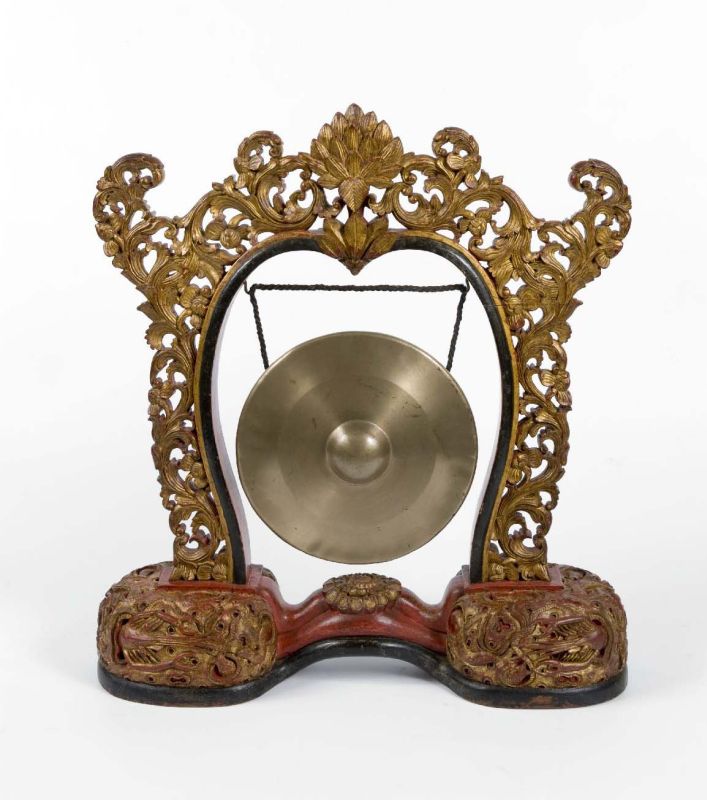
A gong is a percussion instrument originating from Southeast Asia, and used widely in Southeast Asian and East Asian musical traditions. Gongs are made of metal and are circular and flat or bowl-like in shape, and can come in various sizes. They are typically struck with a mallet. They can be played alone, giving a characteristic "crashing" sound, or played as part of a tuned set that produce bell-like sounds.
The earliest possible depictions of gongs is from the details on the surface of the Ngọc Lũ I bronze drum (c. 3rd to 2nd century BC) from the Dong Son culture of northern Vietnam. It depicts what looks like seven-gong ensembles along with other instruments (including cymbals/bells and the bronze drums themselves). The oldest undisputed historical mention of gongs can be found in sixth century AD Chinese records, which mentioned it as a foreign instrument that came from a country between Tibet and Burma. The term gong (Javanese: ꦒꦺꦴꦁ) originated in the Indonesian island of Java. Scientific and archaeological research has established that Annam, Java, Burma, and Southern China were the four main gong manufacturing centres of the ancient world. The gong found its way into the Western World in the 18th century, when it was also used in the percussion section of a Western-style symphony orchestra. A form of bronze cauldron gong known as a resting bell was widely used in ancient Greece and Rome: for instance in the famous Oracle of Dodona, where disc gongs were also used.
Gongs generally fall into three types: Suspended gongs are more or less flat, circular discs of metal suspended vertically by means of a cord passed through holes near to the top rim. Bossed or nipple gongs have a raised centre boss or knob and are often suspended and played horizontally. Bowl gongs are bowl-shaped and rest on cushions. The latter may be considered a member of the bell category. Gongs are made mainly from bronze or brass, though there are many other alloys in use.
Gongs produce two distinct types of sound. A gong with a substantially flat surface vibrates in multiple modes, giving a "crash" rather than a tuned note. This category of gong is sometimes called a tam-tam, to distinguish it from the bossed gongs that give a tuned note. In Indonesian gamelan ensembles, some bossed gongs are deliberately made to generate an additional beat note in the range from about 1 to 5 Hz. The use of the term "gong" for both these types of instrument is common.
Suspended gongs are played with hammers and are of two main types: flat faced discs, either with or without a turned edge and gongs with a raised centre boss. In general, the larger the gong, the larger and softer the hammer. In Western symphonic music, the flat faced gongs are generally referred to as tam-tams to distinguish them from their bossed counterparts. Here, the term "gong" is reserved for the bossed type only. The gong has been a Chinese instrument for millennia. Its first use may have been to signal peasant workers in from the fields, because some gongs are loud enough to be heard from up to eight kilometres (five miles) away.
Large flat gongs may be 'primed' by lightly hitting them before the main stroke, greatly enhancing the sound and causing the instrument to "speak" sooner, with a shorter delay for the sound to "bloom". Keeping this priming stroke inaudible calls for a great deal of skill. The smallest suspended gongs are played with bamboo sticks or even western-style drumsticks. Contemporary and avant-garde music, where different sounds are sought, will often use friction mallets (producing squeals and harmonics), bass bows (producing long tones and high overtones), and various striking implements (wood/plastic/metal) to produce the desired tones.
Rock gongs are large stones struck with smaller stones to create a metallic resonating sound.
By far the most familiar to most Westerners is the chau gong or bullseye gong. Large chau gongs, called tam-tams have become part of the symphony orchestra. Sometimes a chau gong is referred to as a Chinese gong, but in fact, it is only one of many types of suspended gongs that are associated with China. A chau gong is made of copper-based alloy, bronze, or brass. It is almost flat except for the rim, which is turned up to make a shallow cylinder. On a 25-centimetre (10 in) gong, for example, the rim extends about 1 cm (1⁄2 in) perpendicular to the surface. The main surface is slightly concave when viewed from the direction to which the rim is turned. The centre spot and rim of a chau gong are left coated on both sides with the black copper oxide that forms during manufacture; the rest is polished to remove this coating. Chau gongs range in size from 20 to 200 cm (7 to 80 in) in diameter.
Hub AI
Gong AI simulator
(@Gong_simulator)
Gong
A gong is a percussion instrument originating from Southeast Asia, and used widely in Southeast Asian and East Asian musical traditions. Gongs are made of metal and are circular and flat or bowl-like in shape, and can come in various sizes. They are typically struck with a mallet. They can be played alone, giving a characteristic "crashing" sound, or played as part of a tuned set that produce bell-like sounds.
The earliest possible depictions of gongs is from the details on the surface of the Ngọc Lũ I bronze drum (c. 3rd to 2nd century BC) from the Dong Son culture of northern Vietnam. It depicts what looks like seven-gong ensembles along with other instruments (including cymbals/bells and the bronze drums themselves). The oldest undisputed historical mention of gongs can be found in sixth century AD Chinese records, which mentioned it as a foreign instrument that came from a country between Tibet and Burma. The term gong (Javanese: ꦒꦺꦴꦁ) originated in the Indonesian island of Java. Scientific and archaeological research has established that Annam, Java, Burma, and Southern China were the four main gong manufacturing centres of the ancient world. The gong found its way into the Western World in the 18th century, when it was also used in the percussion section of a Western-style symphony orchestra. A form of bronze cauldron gong known as a resting bell was widely used in ancient Greece and Rome: for instance in the famous Oracle of Dodona, where disc gongs were also used.
Gongs generally fall into three types: Suspended gongs are more or less flat, circular discs of metal suspended vertically by means of a cord passed through holes near to the top rim. Bossed or nipple gongs have a raised centre boss or knob and are often suspended and played horizontally. Bowl gongs are bowl-shaped and rest on cushions. The latter may be considered a member of the bell category. Gongs are made mainly from bronze or brass, though there are many other alloys in use.
Gongs produce two distinct types of sound. A gong with a substantially flat surface vibrates in multiple modes, giving a "crash" rather than a tuned note. This category of gong is sometimes called a tam-tam, to distinguish it from the bossed gongs that give a tuned note. In Indonesian gamelan ensembles, some bossed gongs are deliberately made to generate an additional beat note in the range from about 1 to 5 Hz. The use of the term "gong" for both these types of instrument is common.
Suspended gongs are played with hammers and are of two main types: flat faced discs, either with or without a turned edge and gongs with a raised centre boss. In general, the larger the gong, the larger and softer the hammer. In Western symphonic music, the flat faced gongs are generally referred to as tam-tams to distinguish them from their bossed counterparts. Here, the term "gong" is reserved for the bossed type only. The gong has been a Chinese instrument for millennia. Its first use may have been to signal peasant workers in from the fields, because some gongs are loud enough to be heard from up to eight kilometres (five miles) away.
Large flat gongs may be 'primed' by lightly hitting them before the main stroke, greatly enhancing the sound and causing the instrument to "speak" sooner, with a shorter delay for the sound to "bloom". Keeping this priming stroke inaudible calls for a great deal of skill. The smallest suspended gongs are played with bamboo sticks or even western-style drumsticks. Contemporary and avant-garde music, where different sounds are sought, will often use friction mallets (producing squeals and harmonics), bass bows (producing long tones and high overtones), and various striking implements (wood/plastic/metal) to produce the desired tones.
Rock gongs are large stones struck with smaller stones to create a metallic resonating sound.
By far the most familiar to most Westerners is the chau gong or bullseye gong. Large chau gongs, called tam-tams have become part of the symphony orchestra. Sometimes a chau gong is referred to as a Chinese gong, but in fact, it is only one of many types of suspended gongs that are associated with China. A chau gong is made of copper-based alloy, bronze, or brass. It is almost flat except for the rim, which is turned up to make a shallow cylinder. On a 25-centimetre (10 in) gong, for example, the rim extends about 1 cm (1⁄2 in) perpendicular to the surface. The main surface is slightly concave when viewed from the direction to which the rim is turned. The centre spot and rim of a chau gong are left coated on both sides with the black copper oxide that forms during manufacture; the rest is polished to remove this coating. Chau gongs range in size from 20 to 200 cm (7 to 80 in) in diameter.