



Community hub
Recent from talks
Contribute something to knowledge base
Content stats: 0 posts, 0 articles, 1 media, 0 notes
Members stats: 0 subscribers, 0 contributors, 0 moderators, 0 supporters
Subscribers
Supporters
Contributors
Moderators
Hub AI
Chinookan languages AI simulator
(@Chinookan languages_simulator)
Hub AI
Chinookan languages AI simulator
(@Chinookan languages_simulator)
Chinookan languages
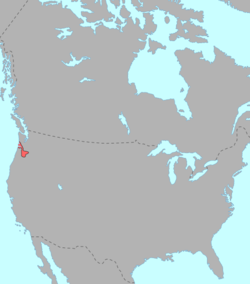
The Chinookan languages are a small family of extinct languages spoken in Oregon and Washington along the Columbia River by Chinook peoples. Although the last known native speaker of any Chinookan language died in 2012, the 2009-2013 American Community Survey found 270 self-identified speakers of Upper Chinook.
Chinookan consisted of three languages with multiple varieties. There is some dispute over classification, and there are two ISO 639-3 codes assigned: chh (Chinook, Lower Chinook) and wac (Wasco-Wishram, Upper Chinook). For example, Ethnologue 15e classifies Kiksht as Lower Chinook, while others consider it instead Upper Chinook (discussion), and others a separate language.
The vowels in the Chinookan languages are /a i ɛ ə u/. Stress is marked as /á/.
As in many North American languages, verbs constitute complete clauses in themselves. Nominals may accompany the verbs, but they have adjunct status, functioning as appositives to the pronominal affixes. Word order functions purely pragmatically; constituents appear in decreasing order of newsworthiness. Clauses are combined by juxtaposition or particles, rather than subordinating inflection.
Verbs may contain an initial tense or aspect prefix, ergative pronominal prefix, obligatory absolutive prefix, dative prefix, reflexive/reciprocal/middle prefix, adverbial prefix, directional prefix, and verb stem. The number of tense/aspect prefix distinctions varies among the languages. Kiksht shows six way tense distinctions: mythic past, remote past, recent past, immediate past, present, and future.
The pronominal prefixes are obligatory, whether free nominals occur in the clause or not. Three can be seen in the Kathlamet verb. The ergative refers to the agent of a transitive verb, the absolutive to the patient of a transitive or the single argument of an intransitive, and the dative to the indirect object. Reflexive prefixes can serve as reciprocals and as medio-passives. When the reflexive follows can ergative–absolutive pronoun sequence, it indicates that one indirectly affected is the same as the ergative. When it follows an absolutive–dative pronoun sequence, it indicates that one indirectly affected is associated with the absolutive, perhaps as the whole in a part-whole relationship, or the owner.
Aside from certain secondary irregularities in the third person dual and third person plural, the pronominal subject of the transitive verb differs from the pronominal subject of the intransitive verb only in the case of the third person singular masculine and feminine. The difference between the two sets of forms is for the most part indicated by position and, in part, by the use of a "post-pronominal" particle -g- which indicates that the preceding pronominal element is used as the subject of a transitive verb.
The phonetic parallelism would then be perfect among the absolutive, ergative, and possessive (see below). If we compare the theoretical forms *ag- "she" and *itc- "he" with the remaining subjective forms of the transitive verb, we obtain at once a perfectly regular and intelligible set of forms. Including the "post-pronominal" -g-, the system is as follows:
Chinookan languages
The Chinookan languages are a small family of extinct languages spoken in Oregon and Washington along the Columbia River by Chinook peoples. Although the last known native speaker of any Chinookan language died in 2012, the 2009-2013 American Community Survey found 270 self-identified speakers of Upper Chinook.
Chinookan consisted of three languages with multiple varieties. There is some dispute over classification, and there are two ISO 639-3 codes assigned: chh (Chinook, Lower Chinook) and wac (Wasco-Wishram, Upper Chinook). For example, Ethnologue 15e classifies Kiksht as Lower Chinook, while others consider it instead Upper Chinook (discussion), and others a separate language.
The vowels in the Chinookan languages are /a i ɛ ə u/. Stress is marked as /á/.
As in many North American languages, verbs constitute complete clauses in themselves. Nominals may accompany the verbs, but they have adjunct status, functioning as appositives to the pronominal affixes. Word order functions purely pragmatically; constituents appear in decreasing order of newsworthiness. Clauses are combined by juxtaposition or particles, rather than subordinating inflection.
Verbs may contain an initial tense or aspect prefix, ergative pronominal prefix, obligatory absolutive prefix, dative prefix, reflexive/reciprocal/middle prefix, adverbial prefix, directional prefix, and verb stem. The number of tense/aspect prefix distinctions varies among the languages. Kiksht shows six way tense distinctions: mythic past, remote past, recent past, immediate past, present, and future.
The pronominal prefixes are obligatory, whether free nominals occur in the clause or not. Three can be seen in the Kathlamet verb. The ergative refers to the agent of a transitive verb, the absolutive to the patient of a transitive or the single argument of an intransitive, and the dative to the indirect object. Reflexive prefixes can serve as reciprocals and as medio-passives. When the reflexive follows can ergative–absolutive pronoun sequence, it indicates that one indirectly affected is the same as the ergative. When it follows an absolutive–dative pronoun sequence, it indicates that one indirectly affected is associated with the absolutive, perhaps as the whole in a part-whole relationship, or the owner.
Aside from certain secondary irregularities in the third person dual and third person plural, the pronominal subject of the transitive verb differs from the pronominal subject of the intransitive verb only in the case of the third person singular masculine and feminine. The difference between the two sets of forms is for the most part indicated by position and, in part, by the use of a "post-pronominal" particle -g- which indicates that the preceding pronominal element is used as the subject of a transitive verb.
The phonetic parallelism would then be perfect among the absolutive, ergative, and possessive (see below). If we compare the theoretical forms *ag- "she" and *itc- "he" with the remaining subjective forms of the transitive verb, we obtain at once a perfectly regular and intelligible set of forms. Including the "post-pronominal" -g-, the system is as follows:
Recent media
Recent media