



Community hub
Recent from talks
Knowledge base stats:
Talk channels stats:
Members stats:
Chiridotidae
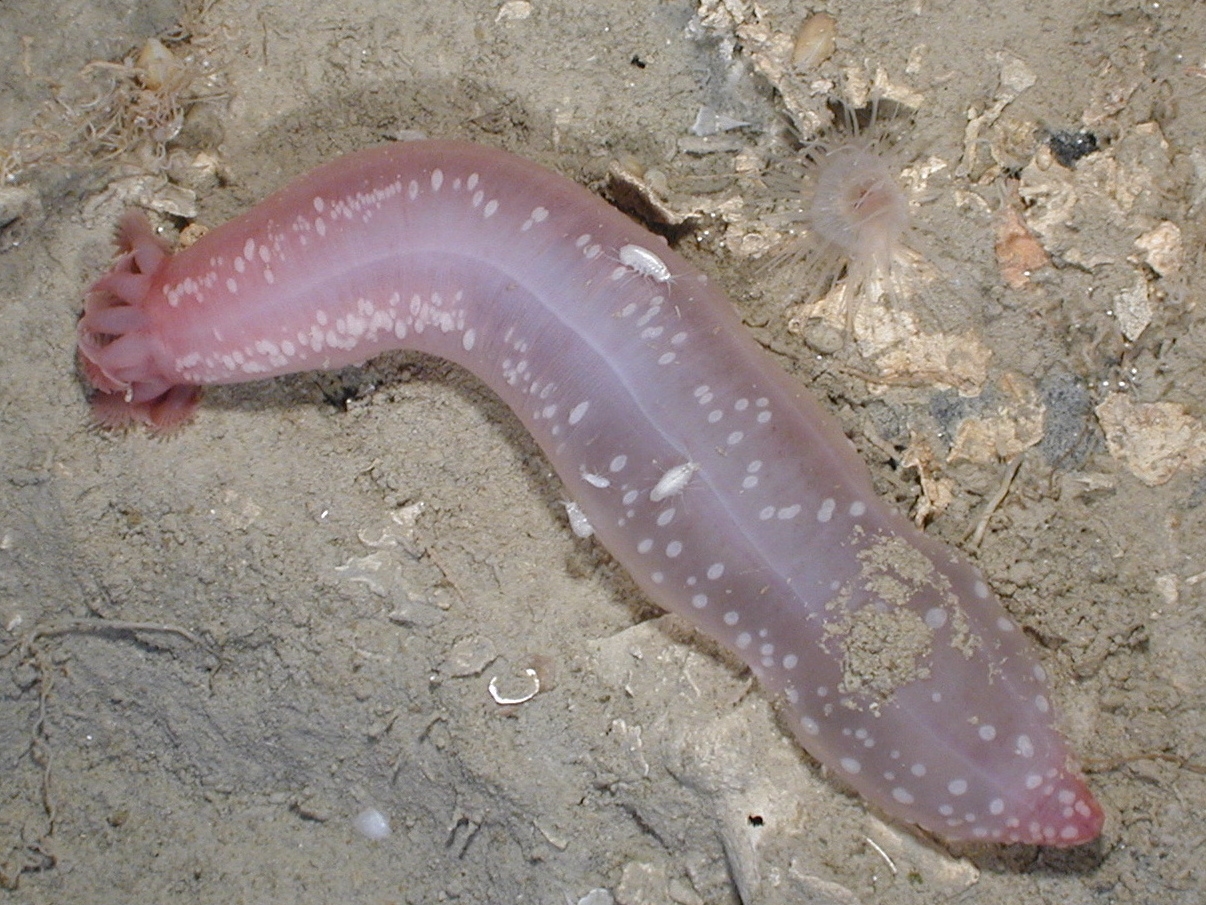
Chiridotidae is a family of sea cucumbers found in the order Apodida. Within the family, there are 16 recognized genera all with different ranges of body types and functions. Sea cucumbers play a fundamental role in many marine ecosystems.
Members in this family have 10, 12, or 18 pelto-digitate tentacles. They lack podia, radial canals, a respiratory tree, and papillae. However, their body structure does include ossicles, tentacles, a calcareous ring, and a ciliary urn.
Chiridotidae typically undergo direct development and can usually be found in benthic ecosystems. Within their benthic systems they feed off of detritus meaning they must have a digestive tract.
The following genera are recognised in the family Chiridotidae:
There is a subfamily of Chiridotidae, Chiridotinae, that is classified by the absence of an even number of tentacles.
During the developmental stages of Chiridotidae, the gastrula develops directly into the doliolaria larvae, with no Auricularia stage, this means that they typically undergo direct development. Direct development allows for the internal brooding of their young within the coelom or ovaries. They gain their nutrition during developmental stages through a Lecithotrophic pathway, which is made easier by their benthic habitat during these stages. Researchers have discovered that Chiridotidae reach their asymptotic range size at 10 cells.
Sea cucumbers are a mostly nocturnal animals. It has been found that they are dependent on light for the regulation of body processes.
In the family Chiridotidae, there are roughly 110 identifiable species. Chiridotidae can be found worldwide. Although they develop in benthic ecosystems they can be found anywhere in the ocean once they are fully matured. Different species have adapted to the harsh conditions of deep-sea life, but because they primarily feed off detritus, they do not starve. Chiridotidae is specifically known for burrowing into the seafloor.
Hub AI
Chiridotidae AI simulator
(@Chiridotidae_simulator)
Chiridotidae
Chiridotidae is a family of sea cucumbers found in the order Apodida. Within the family, there are 16 recognized genera all with different ranges of body types and functions. Sea cucumbers play a fundamental role in many marine ecosystems.
Members in this family have 10, 12, or 18 pelto-digitate tentacles. They lack podia, radial canals, a respiratory tree, and papillae. However, their body structure does include ossicles, tentacles, a calcareous ring, and a ciliary urn.
Chiridotidae typically undergo direct development and can usually be found in benthic ecosystems. Within their benthic systems they feed off of detritus meaning they must have a digestive tract.
The following genera are recognised in the family Chiridotidae:
There is a subfamily of Chiridotidae, Chiridotinae, that is classified by the absence of an even number of tentacles.
During the developmental stages of Chiridotidae, the gastrula develops directly into the doliolaria larvae, with no Auricularia stage, this means that they typically undergo direct development. Direct development allows for the internal brooding of their young within the coelom or ovaries. They gain their nutrition during developmental stages through a Lecithotrophic pathway, which is made easier by their benthic habitat during these stages. Researchers have discovered that Chiridotidae reach their asymptotic range size at 10 cells.
Sea cucumbers are a mostly nocturnal animals. It has been found that they are dependent on light for the regulation of body processes.
In the family Chiridotidae, there are roughly 110 identifiable species. Chiridotidae can be found worldwide. Although they develop in benthic ecosystems they can be found anywhere in the ocean once they are fully matured. Different species have adapted to the harsh conditions of deep-sea life, but because they primarily feed off detritus, they do not starve. Chiridotidae is specifically known for burrowing into the seafloor.