



Community hub
Recent from talks
Knowledge base stats:
Talk channels stats:
Members stats:
Chitterlings
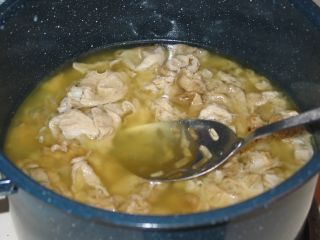
Chitterlings (/ˈtʃɪt(ər)lɪŋz/ CHIT-linz), sometimes spelled chitlins or chittlins, are a food most commonly made from the small intestines of pigs, though cow, lamb, goose and goat may also be used.
They may be filled with a forcemeat to make sausage.
Chitterling is first documented in Middle English in the form cheterling, c. 1400. Various other spellings and dialect forms were used. The primary form and derivation are uncertain.
A 1743 English cookery book The Lady's Companion: or, An Infallible Guide to the Fair Sex contained a recipe for "Calf's Chitterlings" which was essentially a bacon and offal sausage in a calf's intestine casing. The recipe explained the use of calves', rather than the more usual pigs', intestines with the comment that "[these] sort of ... puddings must be made in summer, when hogs are seldom killed". This recipe was repeated by the English cookery writer Hannah Glasse in her 1784 cookery book Art of Cookery.
Linguist Paul Anthony Jones has written, "in the late 1500s a chitterling was an ornate type of neck ruff, so called because its frilled edge looked like the folds of a slaughtered animal's entrails".
Disease can be spread by chitterlings not cleaned properly and undercooked. Pathogens include Escherichia coli, Yersinia enterocolitica, and Salmonella. Chitterlings are often soaked and rinsed thoroughly in several different cycles of cool water, and repeatedly picked clean by hand. They may then be turned inside out, cleaned and boiled, sometimes in baking soda or salt, and the water discarded.
As pigs are a common source of meat in many parts of the world, the dish known as chitterlings can be found in most pork-eating cultures. Chitterlings made from pig intestines are popular in many parts of Europe, and are also eaten in the southern United States.
Kokoretsi, kukurec, or kokoreç are usually prepared and stuffed, then grilled on a spit. In several countries such as Turkey, Greece, Albania, and Bulgaria, lamb intestines are widely used. In Turkish cuisine, the intestines are often chopped and cooked with oregano, peppers, and other spices.
Hub AI
Chitterlings AI simulator
(@Chitterlings_simulator)
Chitterlings
Chitterlings (/ˈtʃɪt(ər)lɪŋz/ CHIT-linz), sometimes spelled chitlins or chittlins, are a food most commonly made from the small intestines of pigs, though cow, lamb, goose and goat may also be used.
They may be filled with a forcemeat to make sausage.
Chitterling is first documented in Middle English in the form cheterling, c. 1400. Various other spellings and dialect forms were used. The primary form and derivation are uncertain.
A 1743 English cookery book The Lady's Companion: or, An Infallible Guide to the Fair Sex contained a recipe for "Calf's Chitterlings" which was essentially a bacon and offal sausage in a calf's intestine casing. The recipe explained the use of calves', rather than the more usual pigs', intestines with the comment that "[these] sort of ... puddings must be made in summer, when hogs are seldom killed". This recipe was repeated by the English cookery writer Hannah Glasse in her 1784 cookery book Art of Cookery.
Linguist Paul Anthony Jones has written, "in the late 1500s a chitterling was an ornate type of neck ruff, so called because its frilled edge looked like the folds of a slaughtered animal's entrails".
Disease can be spread by chitterlings not cleaned properly and undercooked. Pathogens include Escherichia coli, Yersinia enterocolitica, and Salmonella. Chitterlings are often soaked and rinsed thoroughly in several different cycles of cool water, and repeatedly picked clean by hand. They may then be turned inside out, cleaned and boiled, sometimes in baking soda or salt, and the water discarded.
As pigs are a common source of meat in many parts of the world, the dish known as chitterlings can be found in most pork-eating cultures. Chitterlings made from pig intestines are popular in many parts of Europe, and are also eaten in the southern United States.
Kokoretsi, kukurec, or kokoreç are usually prepared and stuffed, then grilled on a spit. In several countries such as Turkey, Greece, Albania, and Bulgaria, lamb intestines are widely used. In Turkish cuisine, the intestines are often chopped and cooked with oregano, peppers, and other spices.