


Community hub
Recent from talks
Contribute something to knowledge base
Content stats: 0 posts, 0 articles, 1 media, 0 notes
Members stats: 0 subscribers, 0 contributors, 0 moderators, 0 supporters
Subscribers
Supporters
Contributors
Moderators
Hub AI
Chloroauric acid AI simulator
(@Chloroauric acid_simulator)
Hub AI
Chloroauric acid AI simulator
(@Chloroauric acid_simulator)
Chloroauric acid
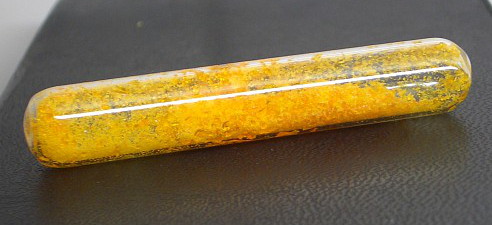
Chloroauric acid is an inorganic compound with the chemical formula H[AuCl4]. It forms hydrates H[AuCl4]·nH2O. Both the trihydrate and tetrahydrate are known. Both are orange-yellow solids consisting of the planar [AuCl4]− anion. Often chloroauric acid is handled as a solution, such as those obtained by dissolution of gold in aqua regia. These solutions can be converted to other gold complexes or reduced to metallic gold or gold nanoparticles.
The tetrahydrate crystallizes as [H5O2]+[AuCl4]− and two water molecules.
The oxidation state of gold in H[AuCl4] and [AuCl4]− anion is +3. The salts of H[AuCl4] (tetrachloroauric(III) acid) are tetrachloroaurates(III), containing [AuCl4]− anions (tetrachloroaurate(III) anions), which have square planar molecular geometry. The Au–Cl distances are around 2.28 Å. Other d8 complexes adopt similar structures, e.g. tetrachloroplatinate(II) [PtCl4]2−.
Solid chloroauric acid is a hydrophilic (ionic) protic solute. It is soluble in water and other oxygen-containing solvents, such as alcohols, esters, ethers, and ketones. For example, in dry dibutyl ether or diethylene glycol, the solubility exceeds 1 M. Saturated solutions in the organic solvents often are the liquid solvates of specific stoichiometry. Chloroauric acid is a strong monoprotic acid.
When heated in air, solid H[AuCl4]·nH2O melts in the water of crystallization, quickly darkens and becomes dark brown.
Since [AuCl4]− is prone to hydrolyze, upon treatment with an alkali metal base, chloroauric acid converts to gold(III) hydroxide. The related thallium salt(Tl+[AuCl4]−) is poorly soluble in all nonreacting solvents. Salts of quaternary ammonium cations are known. Other complex salts include [Au(bipy)Cl2]+[AuCl4]− and [Co(NH3)6]3+[AuCl4]−(Cl−)2.
Partial reduction of chloroauric acid gives oxonium dichloridoaurate(1−). Reduction may also yield other gold(I) complexes, especially with organic ligands. Often the ligand serves as reducing agent as illustrated with thiourea, CS(NH2)2:
Chloroauric acid is the precursor to gold nanoparticles by precipitation onto mineral supports. Heating of H[AuCl4]·nH2O in a stream of chlorine gives gold(III) chloride (Au2Cl6). Gold nanostructures can be made from chloroauric acid in a two-phase redox reaction whereby metallic clusters are amassed through the simultaneous attachment of self-assembled thiol monolayers on the growing nuclei. [AuCl4]− is transferred from aqueous solution to toluene using tetraoctylammonium bromide where it is then reduced with aqueous sodium borohydride in the presence of a thiol.
Chloroauric acid
Chloroauric acid is an inorganic compound with the chemical formula H[AuCl4]. It forms hydrates H[AuCl4]·nH2O. Both the trihydrate and tetrahydrate are known. Both are orange-yellow solids consisting of the planar [AuCl4]− anion. Often chloroauric acid is handled as a solution, such as those obtained by dissolution of gold in aqua regia. These solutions can be converted to other gold complexes or reduced to metallic gold or gold nanoparticles.
The tetrahydrate crystallizes as [H5O2]+[AuCl4]− and two water molecules.
The oxidation state of gold in H[AuCl4] and [AuCl4]− anion is +3. The salts of H[AuCl4] (tetrachloroauric(III) acid) are tetrachloroaurates(III), containing [AuCl4]− anions (tetrachloroaurate(III) anions), which have square planar molecular geometry. The Au–Cl distances are around 2.28 Å. Other d8 complexes adopt similar structures, e.g. tetrachloroplatinate(II) [PtCl4]2−.
Solid chloroauric acid is a hydrophilic (ionic) protic solute. It is soluble in water and other oxygen-containing solvents, such as alcohols, esters, ethers, and ketones. For example, in dry dibutyl ether or diethylene glycol, the solubility exceeds 1 M. Saturated solutions in the organic solvents often are the liquid solvates of specific stoichiometry. Chloroauric acid is a strong monoprotic acid.
When heated in air, solid H[AuCl4]·nH2O melts in the water of crystallization, quickly darkens and becomes dark brown.
Since [AuCl4]− is prone to hydrolyze, upon treatment with an alkali metal base, chloroauric acid converts to gold(III) hydroxide. The related thallium salt(Tl+[AuCl4]−) is poorly soluble in all nonreacting solvents. Salts of quaternary ammonium cations are known. Other complex salts include [Au(bipy)Cl2]+[AuCl4]− and [Co(NH3)6]3+[AuCl4]−(Cl−)2.
Partial reduction of chloroauric acid gives oxonium dichloridoaurate(1−). Reduction may also yield other gold(I) complexes, especially with organic ligands. Often the ligand serves as reducing agent as illustrated with thiourea, CS(NH2)2:
Chloroauric acid is the precursor to gold nanoparticles by precipitation onto mineral supports. Heating of H[AuCl4]·nH2O in a stream of chlorine gives gold(III) chloride (Au2Cl6). Gold nanostructures can be made from chloroauric acid in a two-phase redox reaction whereby metallic clusters are amassed through the simultaneous attachment of self-assembled thiol monolayers on the growing nuclei. [AuCl4]− is transferred from aqueous solution to toluene using tetraoctylammonium bromide where it is then reduced with aqueous sodium borohydride in the presence of a thiol.
Recent media
Recent media