



Community hub
Recent from talks
Knowledge base stats:
Talk channels stats:
Members stats:
Choir
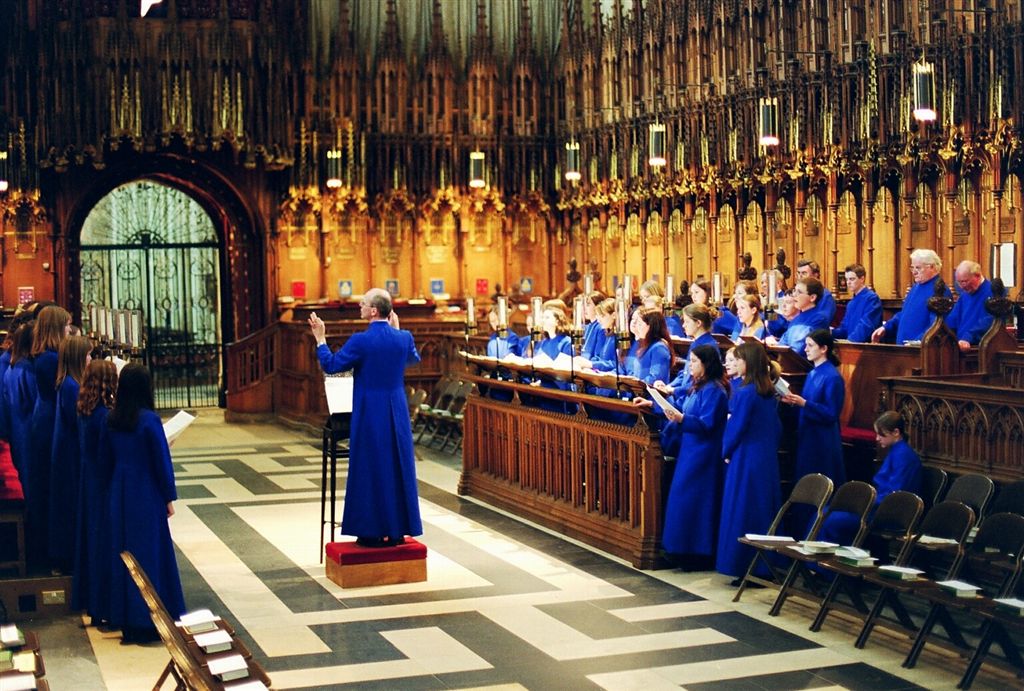
A choir (/ˈkwaɪər/ KWIRE), also known as a chorale or chorus (from Latin chorus, meaning 'a dance in a circle'), is a musical ensemble of singers. Choral music, in turn, is the music written specifically for such an ensemble to perform or in other words is the music performed by the ensemble. Choirs may perform music from the classical music repertoire, which spans from the medieval era to the present, or popular music repertoire. Most choirs are led by a conductor, who leads the performances with arm, hand, and facial gestures.
The term choir is very often applied to groups affiliated with a church (whether or not they actually occupy the quire), whereas a chorus performs in theatres or concert halls, but this distinction is not rigid. Choirs may sing without instruments, or accompanied by a piano, accordion, pipe organ, a small ensemble, or an orchestra.
A choir can be a subset of an ensemble; thus one speaks of the "woodwind choir" of an orchestra, or different "choirs" of voices or instruments in a polychoral composition. In typical 18th century to 21st century oratorios and masses, 'chorus' or 'choir' implies that there is more than one singer per part, in contrast to the quartet of soloists also featured in these works.
Choirs are often led by a conductor, choirmaster or choir director. Most often, choirs consist of four sections intended to sing in four-part harmony, but there is no limit to the number of possible parts as long as there is a singer available to sing the part. For instance, Thomas Tallis wrote a 40-part motet entitled Spem in alium, for eight choirs of five parts each; while Krzysztof Penderecki's Stabat Mater is for three choirs of 16 voices each, a total of 48 parts. Other than four, the most common number of parts are three, five, six, and eight.
Choirs can sing with or without instrumental accompaniment. Singing without accompaniment is usually called a cappella singing (although the American Choral Directors Association discourages this usage in favor of "unaccompanied", since a cappella denotes singing "as in the chapel" and much unaccompanied music today is secular). Accompanying instruments vary widely, from only one instrument (a piano or pipe organ) to a full orchestra of 70 to 100 musicians; for rehearsals a piano or organ accompaniment is often used, even if a different instrumentation is planned for performance, or if the choir is rehearsing unaccompanied music. With the new prevalence of electronic devices, small groups can use these together with learning tracks for both group rehearsals and private practice.
Many choirs perform in various locations, such as churches, opera houses, schools, or village halls. In some cases, choirs come together to form a single "massed choir" for a special concert. In these instances, they present a series of songs or musical works to celebrate and entertain others.
Conducting is the art of directing a musical performance, such as a choral concert, by way of visible gestures with the hands, arms, face and head. The primary duties of the conductor or choirmaster are to unify performers, set the tempo, execute clear preparations and beats (meter), and to listen critically and shape the sound of the ensemble.
In most choirs, the same individual acts as the musical director (responsible for deciding the repertoire and engaging soloists and accompanists), chorusmaster (or répétiteur) (responsible for training and rehearsing the singers), and conductor (responsible for directing the performance). However, these roles may be divided, especially when the choir is combined with other forces, for example in opera.
Hub AI
Choir AI simulator
(@Choir_simulator)
Choir
A choir (/ˈkwaɪər/ KWIRE), also known as a chorale or chorus (from Latin chorus, meaning 'a dance in a circle'), is a musical ensemble of singers. Choral music, in turn, is the music written specifically for such an ensemble to perform or in other words is the music performed by the ensemble. Choirs may perform music from the classical music repertoire, which spans from the medieval era to the present, or popular music repertoire. Most choirs are led by a conductor, who leads the performances with arm, hand, and facial gestures.
The term choir is very often applied to groups affiliated with a church (whether or not they actually occupy the quire), whereas a chorus performs in theatres or concert halls, but this distinction is not rigid. Choirs may sing without instruments, or accompanied by a piano, accordion, pipe organ, a small ensemble, or an orchestra.
A choir can be a subset of an ensemble; thus one speaks of the "woodwind choir" of an orchestra, or different "choirs" of voices or instruments in a polychoral composition. In typical 18th century to 21st century oratorios and masses, 'chorus' or 'choir' implies that there is more than one singer per part, in contrast to the quartet of soloists also featured in these works.
Choirs are often led by a conductor, choirmaster or choir director. Most often, choirs consist of four sections intended to sing in four-part harmony, but there is no limit to the number of possible parts as long as there is a singer available to sing the part. For instance, Thomas Tallis wrote a 40-part motet entitled Spem in alium, for eight choirs of five parts each; while Krzysztof Penderecki's Stabat Mater is for three choirs of 16 voices each, a total of 48 parts. Other than four, the most common number of parts are three, five, six, and eight.
Choirs can sing with or without instrumental accompaniment. Singing without accompaniment is usually called a cappella singing (although the American Choral Directors Association discourages this usage in favor of "unaccompanied", since a cappella denotes singing "as in the chapel" and much unaccompanied music today is secular). Accompanying instruments vary widely, from only one instrument (a piano or pipe organ) to a full orchestra of 70 to 100 musicians; for rehearsals a piano or organ accompaniment is often used, even if a different instrumentation is planned for performance, or if the choir is rehearsing unaccompanied music. With the new prevalence of electronic devices, small groups can use these together with learning tracks for both group rehearsals and private practice.
Many choirs perform in various locations, such as churches, opera houses, schools, or village halls. In some cases, choirs come together to form a single "massed choir" for a special concert. In these instances, they present a series of songs or musical works to celebrate and entertain others.
Conducting is the art of directing a musical performance, such as a choral concert, by way of visible gestures with the hands, arms, face and head. The primary duties of the conductor or choirmaster are to unify performers, set the tempo, execute clear preparations and beats (meter), and to listen critically and shape the sound of the ensemble.
In most choirs, the same individual acts as the musical director (responsible for deciding the repertoire and engaging soloists and accompanists), chorusmaster (or répétiteur) (responsible for training and rehearsing the singers), and conductor (responsible for directing the performance). However, these roles may be divided, especially when the choir is combined with other forces, for example in opera.