Hubbry Logo
ChoirChoirMain
Open search
Choir
Community hub
Choir
logo
8 pages, 0 posts
0 subscribers
Be the first to start a discussion here.
Choir
Choir
from Wikipedia

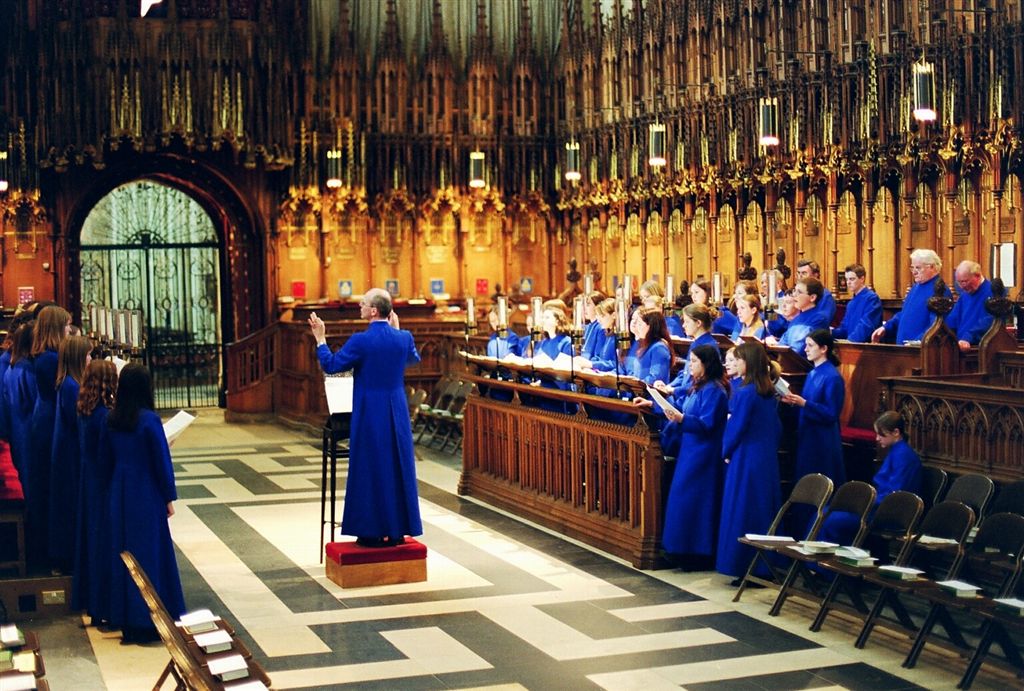
Evensong rehearsal by Blue Coat CE School Choir, Coventry, in the quire of York Minster, showing carved choirstalls

A choir (/ˈkwaɪər/ KWIRE), also known as a chorale or chorus (from Latin chorus, meaning 'a dance in a circle'), is a musical ensemble of singers. Choral music, in turn, is the music written specifically for such an ensemble to perform or in other words is the music performed by the ensemble. Choirs may perform music from the classical music repertoire, which spans from the medieval era to the present, or popular music repertoire. Most choirs are led by a conductor, who leads the performances with arm, hand, and facial gestures.

The term choir is very often applied to groups affiliated with a church (whether or not they actually occupy the quire), whereas a chorus performs in theatres or concert halls, but this distinction is not rigid. Choirs may sing without instruments, or accompanied by a piano, accordion, pipe organ, a small ensemble, or an orchestra.

A choir can be a subset of an ensemble; thus one speaks of the "woodwind choir" of an orchestra, or different "choirs" of voices or instruments in a polychoral composition. In typical 18th century to 21st century oratorios and masses, 'chorus' or 'choir' implies that there is more than one singer per part, in contrast to the quartet of soloists also featured in these works.

A holiday choir singing several songs in Düsseldorf, Germany

Structure

[edit]

Choirs are often led by a conductor, choirmaster or choir director. Most often, choirs consist of four sections intended to sing in four-part harmony, but there is no limit to the number of possible parts as long as there is a singer available to sing the part. For instance, Thomas Tallis wrote a 40-part motet entitled Spem in alium, for eight choirs of five parts each; while Krzysztof Penderecki's Stabat Mater is for three choirs of 16 voices each, a total of 48 parts. Other than four, the most common number of parts are three, five, six, and eight.

Choirs can sing with or without instrumental accompaniment. Singing without accompaniment is usually called a cappella singing (although the American Choral Directors Association[1] discourages this usage in favor of "unaccompanied", since a cappella denotes singing "as in the chapel" and much unaccompanied music today is secular). Accompanying instruments vary widely, from only one instrument (a piano or pipe organ) to a full orchestra of 70 to 100 musicians; for rehearsals a piano or organ accompaniment is often used, even if a different instrumentation is planned for performance, or if the choir is rehearsing unaccompanied music. With the new prevalence of electronic devices, small groups can use these together with learning tracks for both group rehearsals and private practice.

Many choirs perform in various locations, such as churches, opera houses, schools, or village halls. In some cases, choirs come together to form a single "massed choir" for a special concert. In these instances, they present a series of songs or musical works to celebrate and entertain others.

Role of conductor

[edit]

Conducting is the art of directing a musical performance, such as a choral concert, by way of visible gestures with the hands, arms, face and head. The primary duties of the conductor or choirmaster are to unify performers, set the tempo, execute clear preparations and beats (meter), and to listen critically and shape the sound of the ensemble.[2]

In most choirs, the same individual acts as the musical director (responsible for deciding the repertoire and engaging soloists and accompanists), chorusmaster (or répétiteur) (responsible for training and rehearsing the singers), and conductor (responsible for directing the performance). However, these roles may be divided, especially when the choir is combined with other forces, for example in opera.

The conductor or choral director typically stands on a raised platform, and may or may not use a baton; using a baton gives the conductor's gestures greater visibility, but many choral conductors prefer conducting with their hands for greater expressiveness, particularly when working with a smaller ensemble. In the 2010s, most conductors do not play an instrument when conducting, although in earlier periods of classical music history, leading an ensemble while playing an instrument was common. In Baroque music from the 1600s to the 1750s, conductors performing in the 2010s may lead an ensemble while playing a harpsichord or the violin (see Concertmaster). Conducting while playing a piano may also be done with musical theatre pit orchestras. Communication is typically non-verbal during a performance (this is strictly the case in art music, but in jazz big bands or large pop ensembles, there may be occasional spoken instructions). However, in rehearsals, the conductor will often give verbal instructions to the ensemble, since the conductor generally also serves as an artistic director who crafts the ensemble's interpretation of the music.

Conductors act as guides to the choirs they conduct. They choose the works to be performed and study their scores, to which they may make certain adjustments (e.g., regarding tempo, repetitions of sections, assignment of vocal solos, etc.), work out their interpretation, and relay their vision to the singers. Choral conductors may also have to conduct instrumental ensembles such as orchestras if the choir is singing a piece for choir and orchestra. They may also attend to organizational matters, such as scheduling rehearsals,[3] planning a concert season, hearing auditions, and promoting their ensemble in the media.

In worship services

[edit]

Historically, the sung repertoire divides into sacred or religious music and secular music. While much religious music has been written with concert performance in mind, its origin lies in its role within the context of liturgy.

Accompaniment

[edit]
Egyptian Alexandria Jewish choir of Rabbin Moshe Cohen at Samuel Menashe synagogue, Alexandria, Egypt

Like post-Diaspora Jews during the first centuries, it was widely agreed by Christians that musical instruments should be excluded from worship. The consensus among early writers was that divine worship should privilege the unaccompanied human voice.[4]

Most Eastern Orthodox Christian churches, some American Protestant groups, and traditional Jewish synagogues do not accompany their songs with musical instruments. In churches of the Western Rite the accompanying instrument is usually the organ, although in colonial America, the Moravian Church used groups of strings and winds. Many churches that use a contemporary worship format use a small amplified band to accompany the singing, and Roman Catholic Churches may use, at their discretion, additional orchestral accompaniment.

Liturgical function

[edit]

In addition to leading the singing in which the congregation participates, such as hymns and service music, some church choirs sing full liturgies, including propers (introit, gradual, communion antiphons appropriate for the different times of the liturgical year). In Christianity, chief among these are the Evangelical Lutheran, Anglican and Roman Catholic churches; far more common, however, is the performance of anthems or motets at designated times in the service. In the Catholic Church, the Second Vatican Council's Constitution on the Sacred Liturgy confirmed that choirs featured among those who "exercise a genuine liturgical function" within services such as the Mass.[5] Singing in a congregation contributes to the effaciousness of the ritual. In Christianity, singing has played a significant role in the early Church, not only in authorising certain hymns but also providing the faithful with true Christian spirit.[6]

Types

[edit]
The boychoir Cantores Minores in the Helsinki Cathedral in 2013

One of the main classifications of choirs is by gender and age since these factors have traditionally been thought to affect how a choir sounds[7] and what music it performs.[8] The types are listed here in approximate descending order of prevalence at the professional and advanced amateur or semi-professional levels.

  • Adult mixed choir (with male and female voices) is perhaps the most common and dominant type, usually consisting of soprano, alto, tenor, and bass voices, often abbreviated as SATB.[9] Often one or more voices is divided into two, e.g., SSAATTBB, where each voice is divided into two parts, and SATBSATB, where the choir is divided into two semi-independent four-part choirs. Occasionally baritone voice is also used (e.g., SATBarB), often sung by the higher basses. In smaller choirs with fewer men, SAB, or soprano, alto, and baritone arrangements allow the few men to share the role of both the tenor and bass in a single part and altos may also sing the tenor part.
  • Male choir (or choir of men & boys) with the same SATB voicing as a mixed choir, but with boys singing the upper part (often called trebles or boy sopranos) and men singing alto (in falsetto), also known as countertenors. This format was until recently typical of the British cathedral choir (e.g. King's College, St Paul's, Westminster Abbey). However, all cathedrals now accept women and by 2019 female choristers outnumbered males in English cathedral choirs.[10]
  • Men's chorus (Male voice choir, Männerchor), a choir of adult men, low voices only, usually consisting of two tenors, baritone, and bass, often abbreviated as TTBB (or ATBB if the upper part sings falsetto in alto range). ATBB may be seen in some barbershop quartet music.
  • Boys' choir, a choir of boys, typically singing SSA or SSAA, sometimes including a cambiata/tenor part for boys/young men whose voices are changing and a baritone part for boys/young men whose voices have changed.
  • Women's choir, a choir of adult women, high voices only, usually consisting of soprano and alto voices, two parts in each, often abbreviated as SSAA, or as soprano I, soprano II, and alto, abbreviated SSA. If all singers are young, the term "girls' choir" is used instead.
  • Children's mixed choir (with male and female voices), often two-part SA or three-part SSA, sometimes more voices.

The all-female and mixed children's choirs tend to be professionally less prevalent than the high voiced boys' choirs, the lower voiced men's choruses, or the full SATB choirs.[9] This is due to some extent to lack of scholarships and other types of funding, and a lack of professional opportunities for women such as that of being lay clerks or musical directors.[8]

Choirs are also categorized by the institutions in which they operate:

Lambrook School choir in the 1960s, a typical boys' school choir of the time

Some choirs are categorized by the type of music they perform, such as

In schools

[edit]

In the United States, middle schools and high schools often offer choir as a class or activity. Some choirs participate in competitions. One kind of choir popular in high schools is show choir. During middle school and high school students' voices are changing. Although girls experience voice change, it is much more significant in boys. A lot of literature in music education has been focused on how male voice change works and how to help adolescent male singers.[12] Research done by John Cooksey categorizes male voice change into five stages, and most middle school boys are in the early stages of change.[12] The vocal range of male and female students may be limited while their voice is changing, and choir teachers must be able to adapt, which can be a challenge to teaching this age range.[13]

Nationally, male students are enrolled in choir at much lower numbers than their female students.[14] The music education field has had a longtime interest in the "missing males" in music programs.[14] Speculation as to why there are not as many boys in choir, and possible solutions vary widely. One researcher found that boys who enjoy choir in middle school may not always go on to high school choir because it simply does not fit into their schedules.[15] Some research speculates that one reason that boys' participation in choir is so low is because the U.S. does not encourage male singers.[16] Often, schools will have a women's choir, which helps the balance issues mixed choirs face by taking on extra female singers. However, without a men's choir also, this can make the problem worse by not giving boys as many opportunities to sing as girls.[14] Other researchers have noted that having an ensemble, or a workshop dedicated to male singers, can help with their confidence and singing abilities.[15][16] British cathedral choirs are usually made from pupils enrolled in schools.

Arrangements on stage

[edit]
One possible layout
Choir in front of the orchestra

There are various schools of thought regarding how the various sections should be arranged on stage. It is the conductor's decision on where the different voice types are placed. In symphonic choirs it is common (though by no means universal) to order the choir behind the orchestra from highest to lowest voices from left to right, corresponding to the typical string layout. In a cappella or piano-accompanied situations it is not unusual for the men to be in the back and the women in front; some conductors prefer to place the basses behind the sopranos, arguing that the outer voices need to tune to each other.

More experienced choirs may sing with the voices all mixed. Sometimes singers of the same voice are grouped in pairs or threes. Proponents of this method argue that it makes it easier for each individual singer to hear and tune to the other parts, but it requires more independence from each singer. Opponents argue that this method loses the spatial separation of individual voice lines, an otherwise valuable feature for the audience, and that it eliminates sectional resonance, which lessens the effective volume of the chorus. For music with double (or multiple) choirs, usually the members of each choir are together, sometimes significantly separated, especially in performances of 16th-century music (such as works in the Venetian polychoral style). Some composers actually specify that choirs should be separated, such as in Benjamin Britten's War Requiem. Some composers use separated choirs to create "antiphonal" effects, in which one choir seems to "answer" the other choir in a musical dialogue.

Consideration is also given to the spacing of the singers. Studies have found that not only the actual formation, but the amount of space (both laterally and circumambiently) affects the perception of sound by choristers and auditors.[17]

History

[edit]

Antiquity

[edit]
Relief, now in Athens, showing Dionysus with actresses (possibly from The Bacchae) carrying masks and drums

The origins of choral music are found in traditional music, as singing in big groups is extremely widely spread in traditional cultures (both singing in one part, or in unison, like in Ancient Greece, as well as singing in parts, or in harmony, like in contemporary European choral music).[18]

The oldest unambiguously choral repertory that survives is that of ancient Greece, of which the 2nd century BC Delphic hymns and the 2nd century AD. hymns of Mesomedes are the most complete. The original Greek chorus sang its part in Greek drama, and fragments of works by Euripides (Orestes) and Sophocles (Ajax) are known from papyri. The Seikilos epitaph (2c BC) is a complete song (although possibly for solo voice). One of the latest examples, Oxyrhynchus hymn (3c) is also of interest as the earliest Christian music.

Of the Roman drama's music a single line of Terence surfaced in the 18th century. However, musicologist Thomas J. Mathiesen comments that it is no longer believed to be authentic.[19]

Medieval music

[edit]
Church singing, Tacuinum Sanitatis Casanatensis (14th century)

The earliest notated music of western Europe is Gregorian chant, along with a few other types of chant which were later subsumed (or sometimes suppressed) by the Catholic Church. This tradition of unison choir singing lasted from sometime between the times of St. Ambrose (4th century) and Gregory the Great (6th century) up to the present. During the later Middle Ages, a new type of singing involving multiple melodic parts, called organum, became predominant for certain functions, but initially this polyphony was only sung by soloists. Further developments of this technique included clausulae, conductus and the motet (most notably the isorhythmic motet), which, unlike the Renaissance motet, describes a composition with different texts sung simultaneously in different voices. The first evidence of polyphony with more than one singer per part comes in the Old Hall Manuscript (1420, though containing music from the late 14th century), in which there are apparent divisi, one part dividing into two simultaneously sounding notes.

Renaissance music

[edit]
Luca della Robbia's Cantoria, Museo dell'Opera del Duomo, Florence

During the Renaissance, sacred choral music was the principal type of formally notated music in Western Europe. Throughout the era, hundreds of masses and motets (as well as various other forms) were composed for a cappella choir, though there is some dispute over the role of instruments during certain periods and in certain areas. Some of the better-known composers of this time include Guillaume Dufay, Josquin des Prez, Giovanni Pierluigi da Palestrina, John Dunstable, and William Byrd; the glories of Renaissance polyphony were choral, sung by choirs of great skill and distinction all over Europe. Choral music from this period continues to be popular with[20] many choirs throughout the world today.

The madrigal, a partsong conceived for amateurs to sing in a chamber setting, originated at this period. Although madrigals were initially dramatic settings of unrequited-love poetry or mythological stories in Italy, they were imported into England and merged with the more dancelike balletto, celebrating carefree songs of the seasons, or eating and drinking. To most English speakers, the word madrigal now refers to the latter, rather than to madrigals proper, which refers to a poetic form of lines consisting of seven and eleven syllables each.

The interaction of sung voices in Renaissance polyphony influenced Western music for centuries. Composers are routinely trained in the "Palestrina style" to this day, especially as codified by the 18th century music theorist Johann Joseph Fux. Composers of the early 20th century also wrote in Renaissance-inspired styles. Herbert Howells wrote a Mass in the Dorian mode entirely in strict Renaissance style, and Ralph Vaughan Williams's Mass in G minor is an extension of this style. Anton Webern wrote his dissertation on the Choralis Constantinus of Heinrich Isaac and the contrapuntal techniques of his serial music may be informed by this study.

Baroque music

[edit]
Baroque cantata with one voice per part

The Baroque period in music is associated with the development around 1600 of the figured bass and the basso continuo system. The figured bass part was performed by the basso continuo group, which at minimum included a chord-playing instrument (e.g., pipe organ, harpsichord, lute) and a bass instrument (e.g., violone). Baroque vocal music explored dramatic implications in the realm of solo vocal music such as the monodies of the Florentine Camerata and the development of early opera. This innovation was in fact an extension of established practice of accompanying choral music at the organ, either from a skeletal reduced score (from which otherwise lost pieces can sometimes be reconstructed) or from a basso seguente, a part on a single staff containing the lowest sounding part (the bass part).

A new genre was the vocal stile concertato, combining voices and instruments; its origins may be sought in the polychoral music of the Venetian school. Claudio Monteverdi (1567–1643) brought it to perfection with his Vespers and his Eighth Book of Madrigals, which call for great virtuosity on the part of singers and instruments alike. (His Fifth Book includes a basso continuo "for harpsichord or lute".) His pupil Heinrich Schütz (1585–1672) (who had earlier studied with Giovanni Gabrieli) introduced the new style to Germany. Alongside the new music of the seconda pratica, contrapuntal motets in the stile antico or old style continued to be written well into the 19th century. Choirs at this time were usually quite small and that singers could be classified as suited to church or to chamber singing. Monteverdi, himself a singer, is documented as taking part in performances of his Magnificat with one voice per part.[21]

Independent instrumental accompaniment opened up new possibilities for choral music. Verse anthems alternated accompanied solos with choral sections; the best-known composers of this genre were Orlando Gibbons and Henry Purcell. Grands motets (such as those of Lully and Delalande) separated these sections into separate movements. Oratorios (of which Giacomo Carissimi was a pioneer) extended this concept into concert-length works, usually based on Biblical or moral stories.

A pinnacle of baroque choral music, (particularly oratorio), may be found in George Frideric Handel's works, notably Messiah and Israel in Egypt. While the modern chorus of hundreds had to await the growth of Choral Societies and his centennial commemoration concert, we find Handel already using a variety of performing forces, from the soloists of the Chandos Anthems to larger groups (whose proportions are still quite different from modern orchestra choruses):

Yesterday [Oct. 6] there was a Rehearsal of the Coronation Anthem in Westminster-Abby, set to musick by the famous Mr Hendall: there being 40 voices, and about 160 violins, Trumpets, Hautboys, Kettle-Drums and Bass' proportionable..!

— Norwich Gazette, October 14, 1727

Lutheran composers wrote instrumentally accompanied cantatas, often based on chorale tunes. Substantial late 17th-century sacred choral works in the emerging German tradition exist (the cantatas of Dietrich Buxtehude being a prime example), though the Lutheran church cantata did not assume its more codified, recognizable form until the early 18th century. Georg Philipp Telemann (based in Frankfurt) wrote over 1000 cantatas, many of which were engraved and published (e.g. his Harmonische Gottesdienst) and Christoph Graupner (based in Darmstadt) over 1400. The cantatas of Johann Sebastian Bach (1685–1750) are perhaps the most recognizable (and often-performed) contribution to this repertoire: his obituary mentions five complete cycles of his cantatas, of which three, comprising some 200 works, are known today, in addition to motets. Bach himself rarely used the term cantata. Motet refers to his church music without orchestra accompaniment, but instruments playing colla parte with the voices. His works with accompaniment consists of his Passions, Masses, the Magnificat and the cantatas.

A point of hot controversy today is the so-called "Rifkin hypothesis," which re-examines the famous "Entwurff" Bach's 1730 memo to the Leipzig City Council (A Short but Most Necessary Draft for a Well Appointed Church Music) calling for at least 12 singers. In light of Bach's responsibility to provide music to four churches and be able to perform double choir compositions with a substitute for each voice, Joshua Rifkin concludes that Bach's music was normally written with one voice per part in mind. A few sets of original performing parts include ripieni who reinforce rather than slavishly double the vocal quartet.

Classical and Romantic music

[edit]

Composers of the late 18th century became fascinated with the new possibilities of the symphony and other instrumental music, and generally neglected choral music. Mozart's mostly sacred choral works stand out as some of his greatest (such as the "Great" Mass in C minor and Requiem in D minor, the latter of which is highly regarded). Haydn became more interested in choral music near the end of his life following his visits to England in the 1790s, when he heard various Handel oratorios performed by large forces; he wrote a series of masses beginning in 1797 and his two great oratorios The Creation and The Seasons. Beethoven wrote only two masses, both intended for liturgical use, although his Missa solemnis is probably suitable only for the grandest ceremonies due to its length, difficulty and large-scale scoring. He also pioneered the use of chorus as part of symphonic texture with his Ninth Symphony and Choral Fantasia.

In the 19th century, sacred music escaped from the church and leaped onto the concert stage, with large sacred works unsuitable for church use, such as Berlioz's Te Deum and Requiem, and Brahms's Ein deutsches Requiem. Rossini's Stabat mater, Schubert's masses, and Verdi's Requiem also exploited the grandeur offered by instrumental accompaniment. Oratorios also continued to be written, clearly influenced by Handel's models. Berlioz's L'enfance du Christ and Mendelssohn's Elijah and St Paul are in the category. Schubert, Mendelssohn, and Brahms also wrote secular cantatas, the best known of which are Brahms's Schicksalslied and Nänie.

A few composers developed a cappella music, especially Bruckner, whose masses and motets startlingly juxtapose Renaissance counterpoint with chromatic harmony. Mendelssohn and Brahms also wrote significant a cappella motets. The amateur chorus (beginning chiefly as a social outlet) began to receive serious consideration as a compositional venue for the part-songs of Schubert, Schumann, Mendelssohn, Brahms, and others. These 'singing clubs' were often for women or men separately, and the music was typically in four-part (hence the name "part-song") and either a cappella or with simple instrumentation. At the same time, the Cecilian movement attempted a restoration of the pure Renaissance style in Catholic churches.

20th and 21st centuries

[edit]

In the United States, development of mixed choirs was pioneered by groups such as The St. Olaf Choir and Westminster Choir College. These groups were characterized by arrangements of hymns and other sacred works of christian nature which helped define the choral sound of the United States for most of the 20th century. Secular choral music in the United States was popularized by groups such as the Dale Warland Singers throughout the late 20th century.

The Big Choral Census online survey was established to find out how many choirs there were in the UK, of what type, with how many members, singing what type of music and with what sort of funding. Results estimated that there were some 40,000 choral groups operating in the UK and over 2 million people singing regularly in a choir. Over 30 percent of the groups listed described themselves a community choirs, half of the choirs listed sing contemporary music although singing classical music is still popular. Most choirs are self funding. It is thought that the increase in popularity of singing together in groups has been fed to some extent in the UK by TV programmes such as Gareth Malone's 'The Choir'.[22] In 2017, the Purwa Caraka Music Studio Choir of Indonesia began the trend when they covered children's songs in a choral arrangement for the film Surat Kecil untuk Tuhan.[23]

Apart from their roles in liturgy and entertainment, choirs and choruses may also have social-service functions,[24] including for mental health treatment[25] or as therapy for homeless and disadvantaged people, like the Choir of Hard Knocks[26] or for special groups such as Military Wives.

See also

[edit]
  • Carol (music) – a festive song or hymn often sung by a choir or a few singers with or without instrumental accompaniment
  • Come and sing

References

[edit]
[edit]
Revisions and contributorsEdit on WikipediaRead on Wikipedia
from Grokipedia
A choir is a consisting of singers who perform choral music, typically organized into voice sections such as , , , and bass, ranging from lowest to highest pitch. These groups may sing —without instrumental accompaniment—or with orchestral support, and they encompass both professional and amateur participants across religious, educational, and community settings. The origins of choral music trace back to ancient civilizations, where group singing played a central role in rituals and performances. In around the 5th century BCE, the chorus was integral to theater, with ensembles of singers and dancers narrating stories and providing commentary in tragedies by playwrights like and . This tradition evolved through the medieval period in , where sacred choral singing emerged in , beginning with monophonic in monasteries and developing into polyphonic by the . The (14th–17th centuries) marked a golden age for choral composition, with masters like and creating intricate polyphonic works for church choirs, emphasizing balanced vocal lines and textual clarity. In the Baroque era (1600–1750), choral music expanded beyond sacred contexts through forms like the oratorio and cantata, exemplified by George Frideric Handel's Messiah (1741), which featured large ensembles and dramatic narratives. The Classical and Romantic periods (1750–1900) democratized choral singing, incorporating secular themes and larger forces; Ludwig van Beethoven's Symphony No. 9 (1824) premiered with a choir in its "Ode to Joy" finale, while Franz Schubert composed accessible masses and part-songs. The 20th and 21st centuries brought diversification, blending influences from jazz, folk, gospel, and global traditions, with composers like Igor Stravinsky and contemporary figures exploring experimental textures and social themes. In the United States, as of 2009, over 42 million people engage in choral singing, with choral music remaining one of the most widespread forms of participatory music-making worldwide for artistic, cultural, and communal benefits. Choirs vary widely in size, purpose, and repertoire, reflecting their adaptability. Standard types include the mixed choir ( voices), chamber choir (small, 12–24 singers for intimate works), treble choir (sopranos and altos, often youth-focused), and male chorus (tenors and basses). Specialized ensembles encompass gospel choirs rooted in African American spirituals, show choirs combining song with dance, and community choruses open to all ages and skill levels. Professional groups, such as choruses or boy choirs like the (founded 1498), maintain historical traditions, while school and church choirs emphasize education and worship. Participation in choirs fosters social bonds, vocal technique, and emotional , with research highlighting reductions in stress and enhancements in cognitive health.

Definition and Fundamentals

Definition and Purpose

A is a composed of singers who perform collectively, typically organized into multiple voice parts that sing in to produce a unified . This collective approach distinguishes choral singing from individual vocal performance, as the ensemble's goal is to blend voices into a cohesive texture rather than highlight soloistic elements. The term "choir" originates from the Greek word khoros (χορός), which referred to a or a band of dancers and singers in ancient dramatic contexts. It evolved through Latin chorus, meaning a group performing in during a play, and entered English via cuer (12th century), initially denoting both the singers and the church space where they performed. By the , the word had shifted to emphasize the vocal group itself, particularly in religious settings, while retaining its roots in communal performance. The primary purposes of a choir include creating rich or textures, where singers produce independent melodic lines that interweave or harmonize in chordal structures to convey complex musical ideas. allows for contrapuntal interplay among voices, enhancing expressive depth in compositions, while supports lyrical melodies with accompanying harmonies. Beyond technical musical goals, choirs serve to amplify through layered vocal timbres and foster bonds among participants via shared and experiences. In contrast to instrumental ensembles, which rely on varied timbres from different instruments, choirs emphasize the human voice's natural and collective intonation for a homogeneous yet dynamic .

Vocal Composition and Ranges

In choral music, the standard vocal composition for mixed ensembles is the SATB configuration, comprising soprano, alto, tenor, and bass voices, which provides a balanced harmonic structure spanning approximately four octaves. The soprano section, typically sung by high female or unchanged male voices, occupies the highest range from C4 to A5 (or occasionally up to C6 in more demanding works), and serves as the primary melody carrier, delivering the principal thematic material to project clarity and brightness in the ensemble's sound. Altos, the lower female voices ranging from F3 to D5, contribute inner harmonies that add warmth and depth, often filling harmonic gaps between the soprano and lower parts to support the overall texture without dominating. Tenors, high adult male voices from C3 to A4, provide a bridging role with their brighter timbre, echoing or harmonizing the soprano line while contributing to the upper-mid register for harmonic fullness. The bass section, the lowest voices from E2 to E4, forms the harmonic foundation by outlining root notes and supporting chord progressions, ensuring structural stability and resonance that anchors the entire choir. Variations in vocal composition adapt the model to specific ensemble demographics, such as all-female or all- groups. Treble choirs, often comprising unchanged boys' or women's voices, typically use SSA or SSAA voicings, emphasizing high ranges similar to and parts to create a lighter, more unified without lower registers. In contrast, all- configurations like TTBB feature two parts, , and bass, condensing the vocal spectrum into a narrower range (from approximately B2 to E4) to achieve a robust, homogeneous sound suited to barbershop or men's chorus traditions. These adaptations maintain harmonic integrity by redistributing roles, with the highest part often taking melodic duties akin to the in . Achieving a unified choral sound requires careful balance and blending among voice parts, where no single section overpowers the others to ensure even dynamic distribution and harmonic cohesion. Balance involves proportional representation—ideally 4:3:3:4 singers for :::bass in —to match timbral intensities, preventing the brighter sopranos or resonant basses from unbalancing the texture. Blending, the fusion of individual timbres into a seamless whole, relies on unified shapes, breath control, and pitch matching, allowing diverse voices to merge without distinguishable edges for a polished, ensemble identity. This process enhances the choir's ability to convey complex harmonies, as each part interlocks to produce and beyond solo capabilities.

Organizational Structure

Leadership and Conductor's Role

The conductor serves as the artistic and interpretive leader of a choir, responsible for analyzing and interpreting the musical score to convey the composer's intent through performance. This involves making decisions on , dynamics, and articulation to ensure a cohesive and expressive rendition. Through precise gestures—such as hand movements for entrances, beat patterns for , and facial expressions for emotional nuance—the conductor guides singers in real-time, synchronizing their efforts and shaping phrasing to create musical flow and balance among vocal parts. Qualifications for a choir conductor typically include formal musical training, such as a in music , choral , or a related field, often supplemented by graduate studies for advanced positions. Essential skills encompass strong abilities to foster group cohesion and , alongside technical proficiencies like to demonstrate parts during rehearsals or sight-read scores. Knowledge of composition principles aids in deeper score analysis and occasional adaptations, enabling conductors to tailor to the ensemble's capabilities. The role of the conductor in choral evolved significantly from the onward, transitioning from incidental by ensemble members—such as the first violinist or —to a dedicated, centralized position that unified larger groups amid increasingly complex music. By the late , the use of a baton became standardized, allowing for clearer of and expression across expanded formations. This development reflected broader orchestral practices but adapted to choral needs, emphasizing vocal blend and textual delivery in performances. In interactions with singers, conductors conduct auditions to assess , pitch accuracy, and blend potential, ensuring the ensemble's overall quality and balance. During rehearsals, they provide targeted feedback on technique and interpretation, balancing constructive with encouragement to build and address weaknesses. Motivation techniques, such as setting achievable goals, celebrating progress, and cultivating a supportive environment, help sustain singer engagement and commitment, particularly in volunteer or community choirs where intrinsic drive is key.

Ensemble Size and Formation

Choirs vary significantly in ensemble size, which directly impacts their sonic character, logistical demands, and suitability for specific repertoires. Small ensembles, often termed chamber choirs, typically range from 8 to 40 singers, allowing for precise intonation and nuanced expression in intimate works such as Renaissance motets or contemporary a cappella pieces. Medium-sized groups, like many church choirs, commonly consist of 40 to 80 voices, providing a balanced texture for liturgical music and hymns that require moderate volume and sectional clarity. Larger formations, such as oratorio choirs, exceed 80 singers—sometimes reaching hundreds for major performances—and deliver expansive, dramatic effects in grand-scale compositions like Handel's Messiah. Several factors influence choir size, including venue acoustics, repertoire requirements, and logistical considerations. In reverberant spaces like cathedrals, larger ensembles exploit prolonged sound decay to achieve a resonant, immersive , while drier environments favor smaller groups to maintain clarity. plays a key role; polyphonic works demand smaller sizes for balanced part independence, whereas symphonic choruses require expansive forces to match orchestral dynamics. Logistical challenges, particularly funding for rehearsals, travel, and personnel, often constrain size, with and groups relying on and donations to sustain larger rosters amid rising costs. Formation arrangements are tailored to optimize vocal balance, , and projection. A semicircular setup positions singers in an arc facing the conductor, promoting even sound distribution and mutual auditory cues among sections for cohesive blending. Tiered risers elevate rear rows, enhancing sightlines to the conductor and while improving projection by staggering heights to reduce acoustic shadowing from front singers. Acoustically, ensemble size shapes the overall and perceptual impact. Larger choirs produce a fuller, more powerful sound through cumulative volume—doubling the number of singers increases output by approximately 3 dB—ideal for filling large halls with rich harmonics. Smaller ensembles, conversely, foster intimacy and transparency, emphasizing individual and subtle dynamic shifts in closer settings.

Types of Choirs

Professional and Community Choirs

Professional choirs consist of paid singers who perform at a high level of technical proficiency, often under formal contracts or union agreements. These ensembles typically require rigorous auditions to ensure vocal quality, ability, and skills among members. For example, the Chorus employs full-time professional singers under the American Guild of Musical Artists (AGMA) union agreement, with weekly salaries starting at approximately $1,717 (rising to $2,146 by the fourth season as of 2025), health and dental benefits, and a plan. Funding derives primarily from revenues, ticket sales, and occasional state appropriations, such as New York's $5 million allocation in 2025. Similarly, the operates as a private non-profit organization, funding operations through international concerts, recordings, sponsorships, and donations, with its young singers receiving performance fees; the group has received emergency government aid, such as €800,000 from in 2023. Funding for such groups often relies on endowments, performance contracts, and institutional support, allowing sustained operations and high production values. In contrast, community choirs are primarily composed of amateur adult volunteers who participate for personal enjoyment and , with many groups being non-auditioned to promote inclusivity. These ensembles emphasize accessible participation, welcoming singers of varying skill levels for weekly rehearsals and performances, such as concerts or civic events. The focus lies in fostering social bonds, where singing together enhances , reduces , and builds ties among diverse adults. Examples include choral societies like those affiliated with Chorus America, which prioritize volunteer engagement over professional standards. Repertoire choices reflect these operational differences, with professional choirs favoring specialized selections like classical masterpieces, excerpts, and contemporary commissions that demand precision and vocal agility. Community choirs, however, opt for broader, more accessible works including pop arrangements, folk songs, and light classical pieces to accommodate varied tastes and abilities among members. Both types face distinct challenges: professional choirs grapple with the intensity of audition processes, which can be highly competitive and stressful, requiring singers to demonstrate exceptional range, intonation, and rehearsal reliability to secure positions. Community choirs, meanwhile, struggle with member retention due to factors like aging demographics, work-life conflicts, and limited ethnic diversity, often leading to fluctuating attendance and the need for ongoing recruitment efforts.

Educational and Youth Choirs

Educational and youth choirs play a vital role in fostering musical development among young participants, integrating choral singing into structured learning environments. choirs, embedded within K-12 curricula across the , emphasize foundational skills such as and to build vocal proficiency and ensemble cohesion. These programs typically involve students from elementary through high school levels, where instructors use sequential lessons incorporating visual, aural, and kinesthetic methods to teach notation, , and pitch accuracy. For instance, curricula like "Sing at First Sight" are employed to guide students in reading unfamiliar music, enhancing their to perform independently within group settings. Youth choirs, often operating as extracurricular or community-based initiatives, target participants aged 8 to 18 and extend beyond classroom boundaries to include advanced performance opportunities. These ensembles, such as the Brooklyn Youth Chorus, rehearse after school or on weekends under trained conductors, focusing on diverse repertoires in multiple languages and voice parts to cultivate artistic expression. Many youth choirs engage in touring and competitive events, allowing members to showcase their skills at regional or national festivals, which promotes discipline and cultural exchange. Examples include programs like the Young People's Chorus of New York City, which combines rigorous training with public performances to nurture emerging talent. Participation in these choirs yields significant benefits, including enhanced and personal growth. Studies indicate that involvement improves like focus and accomplishment while boosting self-confidence through collaborative performances and public exposure. For young singers, the structured environment fosters emotional regulation, , and , contributing to overall . Prestigious examples, such as All-State Honor Choirs organized by state educators associations, select top participants via auditions for intensive workshops and concerts, providing recognition and advanced training that can inspire lifelong musical engagement. The expansion of educational and youth choirs accelerated in the 20th century amid broader music education reforms, particularly during the Progressive era and post-World War II standardization efforts. Early 1900s initiatives, influenced by figures like , integrated music into public school systems to support holistic , evolving into formalized choral programs by mid-century. Organizations such as the National Association for Music Education (NAfME), founded in 1934, advocated for comprehensive curricula that prioritized ensemble experiences, leading to widespread adoption of choir-based instruction in schools nationwide. This growth reflected societal shifts toward accessible arts education, solidifying choirs as key components of youth musical formation.

Religious and Specialized Choirs

Religious choirs play a central role in across various denominations, often performing sacred music to enhance liturgical services. In Protestant traditions, church choirs lead congregational , perform anthems that the assembly cannot execute, and support through hymns and choral arrangements, fostering communal participation and spiritual edification. Catholic choirs, historically composed of clerics or , primarily pray the through sacred music, including , which holds pride of place as the Church's official , emphasizing praise over performance. In Eastern Orthodox traditions, choirs , a monophonic rooted in the medieval Greek-speaking world, delivering hymns and responses that embody the rite's contemplative and modal structure. Specialized choirs extend religious and cultural expressions into niche forms, often drawing from ethnic or genre-specific roots. Gospel choirs, emerging from African American communities in the 19th-century American South, incorporate call-and-response patterns, , and polyrhythms derived from slave and early worship practices, with formal organization advancing through Thomas Dorsey's 1932 National Convention of Gospel Choirs and Choruses. Their repertoire features sacred texts set to energetic hymns, emphasizing emotional delivery and communal . Barbershop quartets, a form of close harmony originating in late-19th-century African American Southern traditions, structure songs in four parts—, lead, , and bass—with chords supporting homorhythmic melodies, typically drawn from popular or sentimental tunes adapted for unaccompanied performance. Show choirs, blending choral singing with and , emerged in the mid-20th century in American schools and competitions, often performing pop and musical theater arrangements. Ethnic folk choirs preserve cultural identities by performing traditional repertoires tied to specific heritages, such as indigenous rhythms or regional hymns, educating participants and audiences on historical narratives and legends through strophic songs. These ensembles, like those representing multiethnic folklore in events such as the World Choir Games, unify communities by maintaining oral musical legacies. Non-Christian religious choirs include Jewish synagogue ensembles chanting Hebrew and Islamic groups performing nasheeds or in styles. Across religious and specialized types, choirs are predominantly volunteer-based, often affiliated with congregations, parishes, or cultural organizations, where members rehearse weekly to support worship or heritage events without professional compensation. This structure reinforces ties to communities or ethnic groups, prioritizing devotion and preservation over commercial aims.

Performance Practices

Stage and Spatial Arrangements

In traditional choral performances, choirs are typically arranged in a straight line or semi-circular arc to achieve even distribution and optimal visibility for the conductor. The arc formation, with singers positioned in concentric curves radiating from the conductor's standpoint, promotes a sense of cohesion and enhances vocal blending by allowing singers to hear each other more uniformly. This setup is particularly favored in classical and concert settings for its acoustic balance, as it directs outward toward the audience while minimizing internal echoes. Within these formations, vocal sections are often organized from highest to lowest pitch, with sopranos placed on the outer flanks or sometimes at the center to optimize the projection of higher frequencies, which disperse more readily in open spaces. Basses and occupy the inner or rear positions to anchor the foundation without overpowering the . on choral spacing indicates that such arrangements, when combined with windowed positioning (where singers have clear sightlines to the conductor through gaps in front rows), are preferred for their perceived clarity and richness of tone. Modern variations depart from rigid rows to incorporate stages, where the choir extends forward into the space, or surround configurations that position subgroups around the performance area for a more enveloping auditory experience. Additionally, virtual choirs, where singers record individually and combine tracks digitally, have become a key practice post-2020, enabling global collaboration and performances in hybrid formats as of 2025. These immersive setups, increasingly used in contemporary and choral works, heighten engagement by creating a three-dimensional sound field, as seen in performances employing spatial audio techniques. Key considerations in stage arrangements include ensuring mutual visibility between the conductor, singers, and audience to facilitate precise ensemble timing and expression. Acoustic projection is enhanced through tiered risers, which elevate rear rows to prevent sound masking and improve dispersion, while safety protocols for large ensembles mandate stable, non-slip platforms to avoid hazards during dynamic movements. Ensemble size influences these choices, with larger groups requiring wider spacing to maintain blend without overcrowding. Adaptations vary by venue: in concert halls, multi-level risers maximize projection and sightlines within reverberant acoustics, whereas outdoor performances often favor flat, straight-line setups to contend with variable wind patterns and ensure broad visibility. Televised or recorded settings prioritize formations that accommodate camera angles, such as angled arcs, to capture and visual symmetry without altering core acoustic principles.

Accompaniment and Singing Styles

Choral ensembles employ a variety of accompaniment types to enhance their performances, ranging from unaccompanied to full instrumental support. singing, meaning "in the " or without instruments, emphasizes the pure, blended sound of voices alone and is common in and contemporary for its focus on vocal precision and intonation. Traditional accompaniments often feature the organ or , particularly in sacred and smaller-scale works, providing harmonic foundation and rhythmic guidance while allowing vocal lines to remain prominent. For larger compositions such as oratorios, full orchestras supply rich timbres and dynamic contrasts, amplifying the emotional scope of the choral writing. Singing styles in choral music vary to suit stylistic demands, with principles—emphasizing smooth, even tone production and technical agility—influencing classical choral approaches for their beauty and control. control is essential for blend and clarity, where singers adjust rate and extent to achieve uniform texture; excessive vibrato can obscure tuning, while minimal vibrato enhances purity in certain passages. Choral , or coordinated movements integrated with singing, adds visual expression and supports rhythmic precision, particularly in contemporary and performances. Key techniques underpin effective choral execution, including breath support, which involves coordinated diaphragmatic engagement to sustain phrases and maintain tonal consistency across the ensemble. practices prioritize clear enunciation of consonants and unified vowels to ensure textual intelligibility, often through unified phonetic standards like International Phonetic Alphabet adaptations. Tuning techniques focus on precise intervals, such as major thirds, practiced via and matching to achieve in settings. The evolution of accompaniment reflects broader musical trends, shifting from predominantly practices in early periods—prioritizing vocal independence—to increasingly accompanied forms in the Romantic era, where orchestras enabled grander, expressive scales in works by composers like Brahms. This transition highlighted instrumental-vocal interplay, expanding choral possibilities while preserving traditions for intimate or liturgical contexts.

Cultural and Liturgical Roles

Functions in Worship

In religious , choirs fulfill essential liturgical roles by leading congregational , thereby fostering participation and unity during services such as the or . They perform specialized repertoire, including motets, anthems, and settings of the Mass ordinary, which elevate the and provide moments of focused that the assembly alone cannot achieve. This function symbolizes communal praise, representing the collective voice of the faithful in offering to the divine. Distinct traditions highlight these roles across denominations. In Anglican liturgy, choirs sing anthems—short choral pieces reflecting scriptural readings or the liturgical calendar—during the distribution of Communion, enhancing the Eucharistic celebration with meditative depth. ensembles, known as scholae cantorum, lead the Roman Catholic Mass by intoning antiphons and responsorial , promoting a monophonic style that integrates seamlessly with the rite to support quiet reflection and prayer. In , polyphonic choirs harmonize chants to beautify the text and elevate the spiritual atmosphere, drawing from late-16th-century Russian developments that add layered voices without overshadowing the monophonic core. Theologically, choirs serve as the voice of the divine, embodying the harmony of the and facilitating a deeper immersion in the sacred. Their music transforms by creating holy moments of and edification, connecting participants to God's Word through artistic expression that glorifies the Creator. In modern contexts, choirs have adapted to ecumenical and interfaith settings, where ensembles from diverse denominations collaborate in joint services to promote unity and mutual respect during gatherings. These adaptations maintain liturgical while fostering across traditions, as seen in programs that integrate from multiple faiths for shared hymns and responses.

Secular and Contemporary Applications

Choirs frequently perform in secular contexts such as concerts and festivals, where they present a wide range of repertoires from classical to contemporary works, drawing large audiences and promoting cultural participation. For instance, and ensembles participate in international events like the World Choir Games, which highlight secular choral traditions and foster global connections. Choirs also sing national anthems at public events, including sporting competitions and civic ceremonies, to evoke national pride and unity among diverse crowds. In corporate environments, singing groups serve as team-building tools, helping employees develop collaboration skills through shared musical experiences that release and reduce stress. Therapeutic choirs, meanwhile, provide structured group singing for benefits, with indicating improvements in psychological , such as elevated mood and stronger social bonds. Programs tailored for conditions like demonstrate how choral participation can enhance vocal control and emotional resilience. Contemporary trends have popularized pop choirs, often inspired by the television series Glee, which revitalized interest in show choirs by blending pop songs with and theatrical elements, leading to a surge in adult and youth ensembles worldwide. Flash mobs represent another innovative application, involving spontaneous choral performances in public spaces like malls or streets, which surprise audiences and spread via for viral impact. Choral has expanded into initiatives, where group singing acts as an accessible intervention to alleviate anxiety and build community support. Choirs integrate into media through film scores, where their layered vocals add dramatic depth, as seen in pieces like Jerry Goldsmith's "Ave Satani" from or Philip Glass's "Vessels" in . Professional recordings enable the distribution of choral works across platforms, sustaining the genre's economic viability despite challenges in streaming revenue. Virtual choirs, first pioneered by in 2010, gained widespread adoption following the 2020 global disruptions from the , allowing remote participants to synchronize via software; 's Virtual Choir 6, "Sing Gently," united 17,572 singers from 129 countries in a single performance. Global influences are evident in multicultural fusions, where choirs blend diverse traditions—such as African rhythms with Western harmonies—to create world music ensembles that bridge cultural divides and encourage cross-cultural dialogue. Events like the Global Choir Fusion competition gather international groups for collaborative performances, emphasizing unity through shared vocal expressions.

Historical Development

Ancient and Medieval Eras

The choral tradition originated in during the 5th century BCE, where choruses integral to theatrical performances consisted of up to 15 members who sang and danced in unison to accompany verse, providing commentary on the dramatic action and embodying the communal voice. These choruses, rooted in dithyrambic hymns to , evolved from earlier ritual processions and emphasized collective expression over individual roles. In Roman adaptations of Greek drama, particularly , the chorus retained a significant presence as a and emotional commentator, though its role diminished in comedic forms where act divisions often eliminated choral interludes. Early Christian singing practices, emerging in the 1st to 4th centuries CE, drew from Jewish synagogue traditions and adapted them for basilican worship, featuring unaccompanied unison chants with responsorial and antiphonal styles where soloists alternated with groups. By the 4th century, the establishment of the schola cantorum in Rome under Pope Sylvester formalized clerical training for papal choirs, enabling structured group performances of psalms and hymns in basilicas to foster communal devotion. These choirs, composed exclusively of male clerics, emphasized monophonic singing without instruments, reflecting a synthesis of Roman liturgical needs and inherited oral melodic formulas. In the medieval period from the 6th to 13th centuries, Gregorian chant, named after Pope Gregory I (r. 590–604), became the dominant monophonic form in Western liturgy, though it was compiled during his papacy and standardized in the 8th and 9th centuries through Carolingian reforms, sung by monastic choirs to punctuate the Divine Office and Mass in cloistered communities. Monastic choirs, such as those at Fulda Abbey established in 744 CE, served as elite clerical ensembles preserving sacred repertoire through daily recitation, often without instrumental accompaniment. Oral transmission initially dominated chant practices, with performers memorizing melodies via neumes before rhythmic notation developed, ensuring fidelity amid regional variations. The 12th-century Notre Dame school in Paris marked the rise of early polyphony, where composers like Léonin and Pérotin added voices to Gregorian bases in organum, performed by cathedral choirs to enhance liturgical solemnity. Key figures included Hildegard von Bingen (1098–1179), whose visionary compositions, such as sequences and antiphons for her Rupertsberg convent choir, featured wide-ranging melodies up to two-and-a-half octaves with expressive melismas, expanding monophonic traditions. Socially, medieval choirs remained clerical preserves, excluding lay participation and relying on oral pedagogy within monasteries to maintain exclusivity and doctrinal purity.

Renaissance and Baroque Periods

The Renaissance period (c. 1450–1600) marked a golden age for polyphonic choral music in , characterized by intricate vocal textures and a focus on performance ideals that emphasized the purity of the human voice without instrumental support. Composers like (c. 1450–1521) exemplified this era through masterful motets, sacred polyphonic works on Latin texts not drawn from the ordinary, which showcased and smooth rhythmic flow to enhance textual clarity. Similarly, (c. 1525–1594) advanced the motet form with balanced and serene expressiveness, influencing standards across Catholic . Secular choral genres, such as the , emerged alongside sacred forms, setting poetry to polyphony with techniques like to vividly illustrate emotional nuances in the text. The invention of music around by Ottaviano Petrucci revolutionized choral music dissemination, enabling the of polyphonic scores like the Harmonice Musices Odhecaton and leading to thousands of published collections that spread compositions beyond elite institutions. This technological advance democratized access to complex repertoires, fostering innovations in —such as pervasive and modal harmony—that built on medieval but prioritized harmonic balance and textual intelligibility. Institutional growth accompanied these developments, with cathedral choirs in cities like expanding to include professional male ensembles of boys and men, supporting larger-scale polyphonic performances in liturgical settings. Transitioning into the Baroque era (c. 1600–1750), choral music evolved toward greater emotional depth and dramatic integration of instruments, departing from Renaissance a cappella purity while retaining counterpoint as a foundational technique. Johann Sebastian Bach (1685–1750) composed over 200 church cantatas, multi-movement sacred works blending choruses, arias, and recitatives with continuo accompaniment to convey affective responses to biblical texts. George Frideric Handel (1685–1759), a leading oratorio composer, created dramatic choral narratives like Messiah (1741), featuring homophonic choruses and orchestral support to heighten expressive power in secular concert settings. Court chapels, such as those in Leipzig and London, became hubs for these forms, employing professional singers and instrumentalists to perform cantatas and oratorios that emphasized rhetorical delivery and text-driven affects. Baroque innovations further refined through invertible structures and fugal entries, allowing for heightened emotional expressiveness that mirrored the era's focus on human passion, as seen in Bach's harmonizations and Handel's triumphant choral climaxes. Professional cathedral and court choirs proliferated across , with institutions like St. Thomas Church in Leipzig maintaining salaried ensembles of up to 20 singers, enabling sustained performance of this richly accompanied .

Classical, Romantic, and Modern Eras

The Classical era marked a shift toward more structured and symphonic choral works, building on Enlightenment ideals of clarity and balance while incorporating larger ensembles. Ludwig van Beethoven's (Op. 123), composed between 1819 and 1823, exemplifies this evolution as a monumental setting of the Mass Ordinary for soloists, chorus, and , lasting nearly 90 minutes and demanding substantial vocal and instrumental forces. First performed in 1824, the work integrates choral with orchestral drama, influencing subsequent large-scale sacred compositions by emphasizing emotional depth within classical forms. In the Romantic era (c. 1820–1900), choral music expanded dramatically in scale and expressiveness, often serving as a vehicle for personal and national sentiments. Felix Mendelssohn's oratorios, such as St. Paul (1836) and Elijah (1846), revived the genre with vivid storytelling and emotional intensity, drawing on biblical narratives to blend solo arias, choruses, and orchestral accompaniment in ways that captivated 19th-century audiences. These works, performed widely across Europe, highlighted Romantic choral music's focus on dramatic narrative and lyrical beauty. Concurrently, romantic nationalism fueled the growth of choral societies, where amateur ensembles promoted cultural identity through folk-inspired songs and patriotic anthems; in regions like Germany and Hungary, organizations such as the Hungarian Choral Association (founded in the 1860s) integrated vernacular texts and rhythms to foster national unity. The 20th century introduced avant-garde experimentation and diverse influences to choral traditions, diverging from Romantic grandeur toward innovation and accessibility. Igor Stravinsky's choral output, including the Symphony of Psalms (1930) and later serialist pieces like Threni (1958) and the Cantata (1952), pushed boundaries with dissonant harmonies, rhythmic complexity, and neoclassical restraint, redefining choral sound in modernist contexts. Gospel music, emerging from African American church traditions, infused choral practices with improvisational elements, call-and-response patterns, and rhythmic vitality, influencing composers who blended these with European forms in sacred works during the mid-century. Similarly, jazz contributed syncopated rhythms, blue notes, and scat-like vocal techniques to choral arrangements, as seen in pieces like Bob Chilcott's Little Jazz Mass (1996), broadening the genre's stylistic palette. Post-World War II, amateur choral ensembles experienced significant growth, driven by community rebuilding and the establishment of professional radio choirs in Europe; in the United States, university and civic groups expanded rapidly, with ensembles like those at the University of Nebraska seeing steady increases in participation and repertoire diversity from the late 1940s onward. Entering the 21st century, choral music has embraced digital innovation and global connectivity, expanding access beyond traditional ensembles. Composer pioneered virtual choirs starting in 2009 with , uniting over 2,000 singers from around the world via video submissions; this model culminated in Virtual Choir 6: Sing Gently (2020), featuring 17,572 participants from 129 countries during the , demonstrating technology's role in democratizing choral performance. Digital tools, including recording software and online platforms, now enable remote rehearsals and hybrid events, fostering diverse repertoires that incorporate and multimedia. Global choral festivals, such as those organized by the International Federation for Choral Music (IFCM), have proliferated, with events like the World Choral Symposium drawing thousands for cross-cultural exchanges and competitions. Modern choral practices face ongoing challenges related to inclusivity, demographics, and . Gender imbalance persists, with surveys indicating significantly more women than men in choirs—often exceeding 70% female participation—prompting efforts to adapt ensembles for and non-binary singers through inclusive programming and voice placement strategies. Inclusivity initiatives also address cultural and ability diversity, though barriers remain in roles. Additionally, climate change impacts touring, with about 16% of choirs reporting environmental factors like disrupting travel and events, leading to calls for reduced carbon footprints in international festivals.

References

Add your contribution
Related Hubs
User Avatar
No comments yet.