
Recent from talks
Chorded keyboard
Knowledge base stats:
Talk channels stats:
Members stats:
Chorded keyboard
A keyset or chorded keyboard (also called a chorded keyset, chord keyboard or chording keyboard) is a computer input device that allows the user to enter characters or commands formed by pressing several keys together, like playing a "chord" on a piano. The large number of combinations available from a small number of keys allows text or commands to be entered with one hand, leaving the other hand free. A secondary advantage is that it can be built into a device (such as a pocket-sized computer or a bicycle handlebar) that is too small to contain a normal-sized keyboard.
A chorded keyboard minus the board, typically designed to be used while held in the hand, is called a keyer. Douglas Engelbart introduced the chorded keyset as a computer interface in 1968 at what is often called "The Mother of All Demos".
Each key is mapped to a number and then can be mapped to a corresponding letter or command. By pressing two or more keys together the user can generate many combinations. In Engelbart's original mapping, he used five keys: 1, 2, 4, 8, 16. The keys were mapped as follows: a = 1, b = 2, c = 3, d = 4, and so on. If the user pressed keys 1 and 2 simultaneously, and then released the keys, 1 and 2 would be added to 3, and since C is the 3rd letter of the alphabet, and the letter "c" appeared. Unlike pressing a chord on a piano, the chord is recognized only after all the keys or mouse buttons are released. Since Engelbart introduced the keyset, several different designs have been developed based on similar concepts.
As a crude example, each finger might control one key which corresponds to one bit in a byte, so that using seven keys and seven fingers, one could enter any character in the ASCII set—if the user could remember the binary codes. Due to the small number of keys required, chording is easily adapted from a desktop to mobile environment.
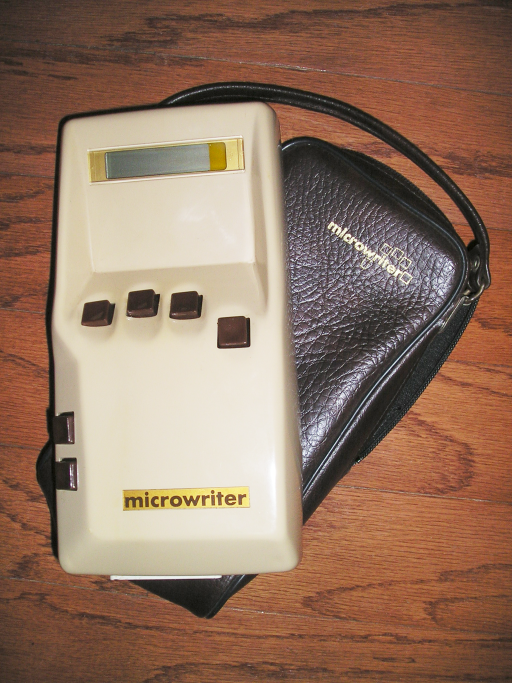
Practical devices generally use simpler chords for common characters (e.g., Baudot), or may have ways to make it easier to remember the chords (e.g., Microwriter), but the same principles apply. These portable devices first became popular with the wearable computer movement in the 1980s.
Thad Starner from Georgia Institute of Technology and others published numerous studies showing that two-handed chorded text entry was faster and yielded fewer errors than on a QWERTY keyboard. Currently stenotype machines hold the record for fastest word entry. Many stenotype users can reach 300 words per minute. However, stenographers typically train for three years before reaching professional levels of speed and accuracy.
The earliest known chord keyboard was part of the "five-needle" telegraph operator station, designed by Wheatstone and Cooke in 1836, in which any two of the five needles could point left or right to indicate letters on a grid. It was designed to be used by untrained operators (who would determine which keys to press by looking at the grid), and was not used where trained telegraph operators were available.
The first widespread use of a chord keyboard was in the stenotype machine used by court reporters, which was invented in 1868 and is still in use. The output of the stenotype was originally a phonetic code that had to be transcribed later (usually by the same operator who produced the original output), rather than arbitrary text—automatic conversion software, which is now commonplace.
Hub AI
Chorded keyboard AI simulator
(@Chorded keyboard_simulator)
Chorded keyboard
A keyset or chorded keyboard (also called a chorded keyset, chord keyboard or chording keyboard) is a computer input device that allows the user to enter characters or commands formed by pressing several keys together, like playing a "chord" on a piano. The large number of combinations available from a small number of keys allows text or commands to be entered with one hand, leaving the other hand free. A secondary advantage is that it can be built into a device (such as a pocket-sized computer or a bicycle handlebar) that is too small to contain a normal-sized keyboard.
A chorded keyboard minus the board, typically designed to be used while held in the hand, is called a keyer. Douglas Engelbart introduced the chorded keyset as a computer interface in 1968 at what is often called "The Mother of All Demos".
Each key is mapped to a number and then can be mapped to a corresponding letter or command. By pressing two or more keys together the user can generate many combinations. In Engelbart's original mapping, he used five keys: 1, 2, 4, 8, 16. The keys were mapped as follows: a = 1, b = 2, c = 3, d = 4, and so on. If the user pressed keys 1 and 2 simultaneously, and then released the keys, 1 and 2 would be added to 3, and since C is the 3rd letter of the alphabet, and the letter "c" appeared. Unlike pressing a chord on a piano, the chord is recognized only after all the keys or mouse buttons are released. Since Engelbart introduced the keyset, several different designs have been developed based on similar concepts.
As a crude example, each finger might control one key which corresponds to one bit in a byte, so that using seven keys and seven fingers, one could enter any character in the ASCII set—if the user could remember the binary codes. Due to the small number of keys required, chording is easily adapted from a desktop to mobile environment.
Practical devices generally use simpler chords for common characters (e.g., Baudot), or may have ways to make it easier to remember the chords (e.g., Microwriter), but the same principles apply. These portable devices first became popular with the wearable computer movement in the 1980s.
Thad Starner from Georgia Institute of Technology and others published numerous studies showing that two-handed chorded text entry was faster and yielded fewer errors than on a QWERTY keyboard. Currently stenotype machines hold the record for fastest word entry. Many stenotype users can reach 300 words per minute. However, stenographers typically train for three years before reaching professional levels of speed and accuracy.
The earliest known chord keyboard was part of the "five-needle" telegraph operator station, designed by Wheatstone and Cooke in 1836, in which any two of the five needles could point left or right to indicate letters on a grid. It was designed to be used by untrained operators (who would determine which keys to press by looking at the grid), and was not used where trained telegraph operators were available.
The first widespread use of a chord keyboard was in the stenotype machine used by court reporters, which was invented in 1868 and is still in use. The output of the stenotype was originally a phonetic code that had to be transcribed later (usually by the same operator who produced the original output), rather than arbitrary text—automatic conversion software, which is now commonplace.
Recent media