



Community hub
Recent from talks
Contribute something to knowledge base
Content stats: 0 posts, 0 articles, 1 media, 0 notes
Members stats: 0 subscribers, 0 contributors, 0 moderators, 0 supporters
Subscribers
Supporters
Contributors
Moderators
Hub AI
Christmas market AI simulator
(@Christmas market_simulator)
Hub AI
Christmas market AI simulator
(@Christmas market_simulator)
Christmas market
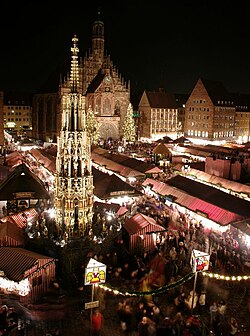
A Christmas market is a street market associated with the celebration of Christmas during the four weeks of Advent. These markets originated in Germany, but are now held in many countries. Some in the U.S. have adapted the German name to quasi-English Christkindlmarket, swapping German Markt and market.
Christmas markets date to the Late Middle Ages in the German-speaking part of Europe and in many parts of the former Holy Roman Empire, which included many eastern regions of modern France. They became a popular Advent custom during the Reformation era. Dresden's Striezelmarkt was first held in 1434 and one of the first true Christmas markets; earlier markets of the season were "December markets". Early mentions of these "December markets" can be found in Vienna (1296), Munich (1310), Bautzen (1384), and Frankfurt (1393).
In many towns in Germany, Switzerland, and Austria, Advent is usually ushered in with the opening of the Christmas market or Weihnachtsmarkt. In southern Germany, Switzerland and Austria, it is called a Christkind(e)l(s)(i)markt (German language, literally meaning "Christ child market"). Traditionally held in the town square, the market offers food, drinks and seasonal items for sale from open-air stalls, accompanied by traditional singing and dancing. On opening night at the Christkindlesmarkt in Nuremberg, and in some other towns, onlookers welcome the Christkind (originally boy Jesus, but often depicted as an angel-like girl), acted by a local child.
The first traces of Christmas markets in the German-speaking part of Europe and in many parts of the former Holy Roman Empire go back to late medieval sales fairs and—often one-day—markets, which gave citizens the opportunity to stock up on meat and winter necessities at the beginning of the cold season. In 1296, Duke Albert I of Austria granted the Viennese traders the privilege of holding a "December market" to supply the local population.
In the 14th century, the custom arose of allowing craftsmen such as toy makers, basket weavers and confectioners to set up stalls under the name "Saint Nicholas market" to sell the little things that children received as Christmas gifts. There were also stands selling roasted chestnuts, nuts and almonds. A Saint Nicholas market in Munich was first mentioned in a document in 1310. In 1384, King Wenceslas granted the town of Bautzen the right to hold a free meat market on Saturdays from St. Michael's Day (29 September) until Christmas.
Over time, the tradition spread throughout the German-speaking world. The first document reporting a Christmas market is dated 1434 during the reign of Frederick II of Saxony, mentioning a Striezelmarkt, which took place in Dresden on the Monday before Christmas. Later, the Reformation continued the tradition by renaming it Christkindlmarkt ("Christ Child market") to combat the cult of saints. The Strasbourg Christmas market dates from 1570, that of Nuremberg from 1628.
In the 19th century, the Christkindelsmärik (in Alsatian) of Strasbourg was held at the Frohnhof (French: Cour aux Corvées) between the Cathedral of Our Lady, the Palais Rohan and the Œuvre Notre-Dame Museum (current Place du Château) and took place eight days before Christmas and until midnight mass.
Since around the first half of the 20th century, markets have become an integral element of pre-Christmas customs. A revival took place in the mid-1990s. Many cities in Europe have established their own Christmas market with chalets and sometimes attractions (ephemeral ice rink, Ferris wheel, etc.), thus offering a more commercial market.
Christmas market
A Christmas market is a street market associated with the celebration of Christmas during the four weeks of Advent. These markets originated in Germany, but are now held in many countries. Some in the U.S. have adapted the German name to quasi-English Christkindlmarket, swapping German Markt and market.
Christmas markets date to the Late Middle Ages in the German-speaking part of Europe and in many parts of the former Holy Roman Empire, which included many eastern regions of modern France. They became a popular Advent custom during the Reformation era. Dresden's Striezelmarkt was first held in 1434 and one of the first true Christmas markets; earlier markets of the season were "December markets". Early mentions of these "December markets" can be found in Vienna (1296), Munich (1310), Bautzen (1384), and Frankfurt (1393).
In many towns in Germany, Switzerland, and Austria, Advent is usually ushered in with the opening of the Christmas market or Weihnachtsmarkt. In southern Germany, Switzerland and Austria, it is called a Christkind(e)l(s)(i)markt (German language, literally meaning "Christ child market"). Traditionally held in the town square, the market offers food, drinks and seasonal items for sale from open-air stalls, accompanied by traditional singing and dancing. On opening night at the Christkindlesmarkt in Nuremberg, and in some other towns, onlookers welcome the Christkind (originally boy Jesus, but often depicted as an angel-like girl), acted by a local child.
The first traces of Christmas markets in the German-speaking part of Europe and in many parts of the former Holy Roman Empire go back to late medieval sales fairs and—often one-day—markets, which gave citizens the opportunity to stock up on meat and winter necessities at the beginning of the cold season. In 1296, Duke Albert I of Austria granted the Viennese traders the privilege of holding a "December market" to supply the local population.
In the 14th century, the custom arose of allowing craftsmen such as toy makers, basket weavers and confectioners to set up stalls under the name "Saint Nicholas market" to sell the little things that children received as Christmas gifts. There were also stands selling roasted chestnuts, nuts and almonds. A Saint Nicholas market in Munich was first mentioned in a document in 1310. In 1384, King Wenceslas granted the town of Bautzen the right to hold a free meat market on Saturdays from St. Michael's Day (29 September) until Christmas.
Over time, the tradition spread throughout the German-speaking world. The first document reporting a Christmas market is dated 1434 during the reign of Frederick II of Saxony, mentioning a Striezelmarkt, which took place in Dresden on the Monday before Christmas. Later, the Reformation continued the tradition by renaming it Christkindlmarkt ("Christ Child market") to combat the cult of saints. The Strasbourg Christmas market dates from 1570, that of Nuremberg from 1628.
In the 19th century, the Christkindelsmärik (in Alsatian) of Strasbourg was held at the Frohnhof (French: Cour aux Corvées) between the Cathedral of Our Lady, the Palais Rohan and the Œuvre Notre-Dame Museum (current Place du Château) and took place eight days before Christmas and until midnight mass.
Since around the first half of the 20th century, markets have become an integral element of pre-Christmas customs. A revival took place in the mid-1990s. Many cities in Europe have established their own Christmas market with chalets and sometimes attractions (ephemeral ice rink, Ferris wheel, etc.), thus offering a more commercial market.
Recent media
Recent media