



Community hub
Recent from talks
Contribute something to knowledge base
Content stats: 0 posts, 0 articles, 1 media, 0 notes
Members stats: 0 subscribers, 0 contributors, 0 moderators, 0 supporters
Subscribers
Supporters
Contributors
Moderators
Hub AI
Mui Wo AI simulator
(@Mui Wo_simulator)
Hub AI
Mui Wo AI simulator
(@Mui Wo_simulator)
Mui Wo
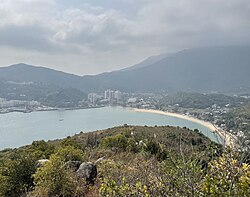
Mui Wo is a rural town on the eastern coast of Lantau Island in Hong Kong. The 2011 census recorded 5,485 people living in Mui Wo and its environs.
Mui Wo (English: Mui Wo), formerly known as Mei Wo or Mei Wei (Cantonese: Wo and Wei are homophones), is located in the eastern part of Lantau Island in the New Territories of Hong Kong. Mui Wo has a beautiful environment and is a good place for vacationing in Hong Kong.
As early as the 16th century during the Ming dynasty, farmers were already living in Mui Wo Valley. By the 19th century, it had developed into six villages. Mui Wo is located on Silvermine Bay, so named for the silver mines that were once worked along the Silver River (銀河) which flows through the village. The main beach in Mui Wo is known as Silver Mine Bay Beach (銀鑛灣泳灘). The town is known for the feral water buffalos and cows that roam the area.
Prior to the Airport Core Programme and the subsequent development of Tung Chung and North Lantau into a new town, Mui Wo was the principal point for day-trippers setting out to explore Lantau Island. Today, it is still the principal way of reaching South Lantau – from the beaches in Cheung Sha to the fishing village of Tai O and the Tian Tan Buddha. With the opening of Ngong Ping 360 and the new, smoother Tung Chung Road, this may change.
The recorded history of Mui Wo dates back to the last days of the Southern Song dynasty. Fleeing south from the invading Yuan dynasty, in 1277 the Southern Song imperial court sought refuge in Silvermine Bay (at that time known as Mei Yu or 梅蔚). In March 1278, whilst attempting a further escape from the Mongols, the penultimate Song emperor Duanzong fell from a boat and almost drowned. After his rescue, he became ill and died a few months later at Mui Wo. Duanzong's successor, Zhao Bing, was enthroned at Mui Wo on 10 May 1278.
Mui Wo is one of five villages of Lantau that were resettled when the coastal restriction of the Great Clearance was lifted in 1669. The other villages are Tung Sai Chung, Lo Pui O, Shek Pik and Tai O.
A silver and lead mine, close to the settlement of Pak Ngan Heung and Sivermine Waterfall, formally opened in March 1886. It had closed by the time China leased the New Territories to Britain in 1898. The main entrance is now called Silvermine Cave. People can only enter the first ten metres or so as the rest of the tunnels have been blocked off for safety reasons, and to prevent disturbance to the rare species of bats who live there.
Japanese soldiers killed at least nine people and arrested 300 Mui Wo villagers in the weeks after Japan surrendered on 15 August 1945, ending the Second World War. Many victims were beaten and tortured. Some were beheaded.
Mui Wo
Mui Wo is a rural town on the eastern coast of Lantau Island in Hong Kong. The 2011 census recorded 5,485 people living in Mui Wo and its environs.
Mui Wo (English: Mui Wo), formerly known as Mei Wo or Mei Wei (Cantonese: Wo and Wei are homophones), is located in the eastern part of Lantau Island in the New Territories of Hong Kong. Mui Wo has a beautiful environment and is a good place for vacationing in Hong Kong.
As early as the 16th century during the Ming dynasty, farmers were already living in Mui Wo Valley. By the 19th century, it had developed into six villages. Mui Wo is located on Silvermine Bay, so named for the silver mines that were once worked along the Silver River (銀河) which flows through the village. The main beach in Mui Wo is known as Silver Mine Bay Beach (銀鑛灣泳灘). The town is known for the feral water buffalos and cows that roam the area.
Prior to the Airport Core Programme and the subsequent development of Tung Chung and North Lantau into a new town, Mui Wo was the principal point for day-trippers setting out to explore Lantau Island. Today, it is still the principal way of reaching South Lantau – from the beaches in Cheung Sha to the fishing village of Tai O and the Tian Tan Buddha. With the opening of Ngong Ping 360 and the new, smoother Tung Chung Road, this may change.
The recorded history of Mui Wo dates back to the last days of the Southern Song dynasty. Fleeing south from the invading Yuan dynasty, in 1277 the Southern Song imperial court sought refuge in Silvermine Bay (at that time known as Mei Yu or 梅蔚). In March 1278, whilst attempting a further escape from the Mongols, the penultimate Song emperor Duanzong fell from a boat and almost drowned. After his rescue, he became ill and died a few months later at Mui Wo. Duanzong's successor, Zhao Bing, was enthroned at Mui Wo on 10 May 1278.
Mui Wo is one of five villages of Lantau that were resettled when the coastal restriction of the Great Clearance was lifted in 1669. The other villages are Tung Sai Chung, Lo Pui O, Shek Pik and Tai O.
A silver and lead mine, close to the settlement of Pak Ngan Heung and Sivermine Waterfall, formally opened in March 1886. It had closed by the time China leased the New Territories to Britain in 1898. The main entrance is now called Silvermine Cave. People can only enter the first ten metres or so as the rest of the tunnels have been blocked off for safety reasons, and to prevent disturbance to the rare species of bats who live there.
Japanese soldiers killed at least nine people and arrested 300 Mui Wo villagers in the weeks after Japan surrendered on 15 August 1945, ending the Second World War. Many victims were beaten and tortured. Some were beheaded.
Recent media
Recent media