


Community hub
Recent from talks
Contribute something to knowledge base
Content stats: 0 posts, 0 articles, 1 media, 0 notes
Members stats: 0 subscribers, 0 contributors, 0 moderators, 0 supporters
Subscribers
Supporters
Contributors
Moderators
Hub AI
Cinelerra AI simulator
(@Cinelerra_simulator)
Hub AI
Cinelerra AI simulator
(@Cinelerra_simulator)
Cinelerra
Cinelerra is a video editing and track-based digital compositing program (an NLE, Non-Linear Editor) designed for Linux. It is a free software distributed under the open source GNU General Public License. In addition to editing, it supports advanced composition operations such as keying and mattes, including a title generator, many effects to edit video and audio, keyframe automation, and many other professional functions depending on the variant. It processes audio in 64 floating-point form. Video is processed in RGBA or YUVA color spaces, in 16-bit integer or floating-point form. It is resolution and image refresh rate independent. The HV & GG variants support up to 8K video. The GG variant can also create DVDs and Blu-rays.
In 1996 Adam Williams of Heroine Virtual, lead developer of Cinelerra, released a Unix audio editor called Broadcast 1.0 which could handle 2G audio files. In 1997 Broadcast 2.0 was released, still audio only but unlimited tracks. 1999 saw Broadcast2000, which included video. Around 2001 Broadcast 2000 supported MPEG-2, VOB and Quicktimemovies. See the History of Cinelerra versions section for more detail.
Because of UI limitations, Williams rewrote significant parts and released that as Cinelerra on August 12, 2002, while Broadcast2000 was withdrawn by Heroine Virtual in September 2001. Cinelerra became the first 64-bit media production application when it was rewritten to work with the AMD Opteron processor in June 2003 and was presented at SIGGRAPH 2004 in San Diego. Since then, many versions have been released.
The original version is still being produced by Williams. There have been several spin-offs made by the open source community, Cinelerra-GG and Cinelerra-CVE (a fork of Cinelerra-CV) are presently under active development. For a complete overview of versions, see the Variants section below. Even though the different variants look the same, there are considerable functional differences between them.[1]
An overview of the different variants that released more than one version:
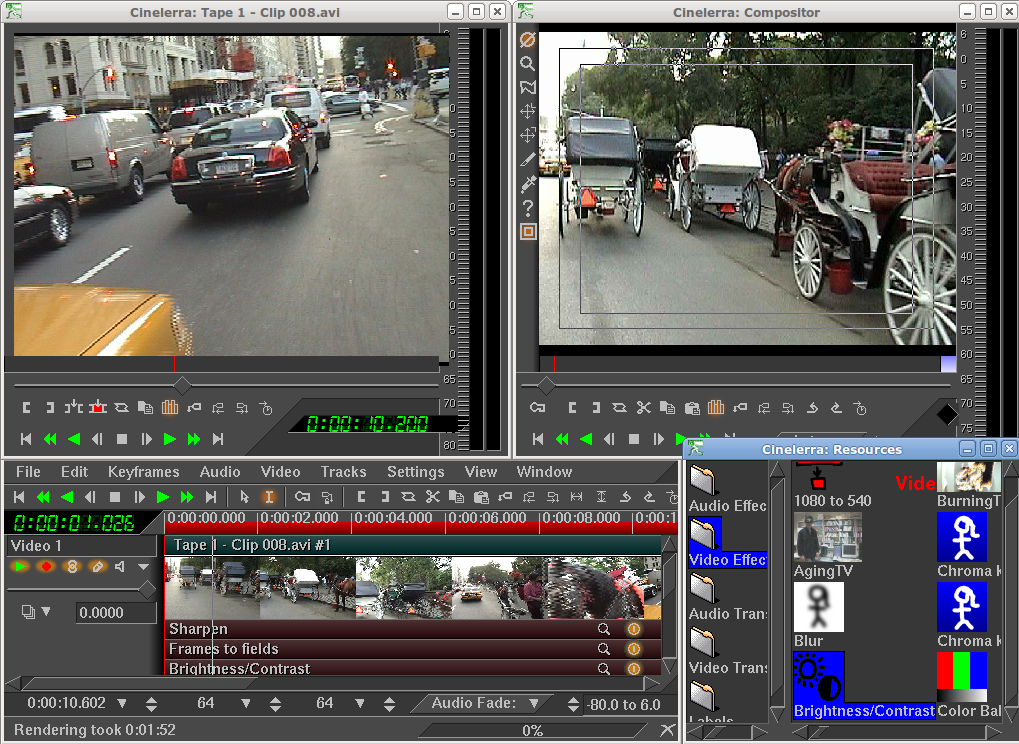
Cinelerra's interface is similar to that of other Non-linear editing systems, such as Adobe Premiere Pro, Final Cut Pro, and Avid Media Composer. However, because it includes a compositing engine, it may also be likened to compositing software such as Adobe After Effects, Smoke on Linux or Shake. The user is by default presented with four windows (clockwise from lower left in picture at top right):
Cinelerra uses its own widget toolkit Guicast (the Cinelerra GUI library), not conforming to the human interface guidelines of major Linux desktops such as GNOME and KDE. This has the advantage that it looks and works the same no matter which distribution or desktop is used, and removes being dependent on a changing version of the desktop (for instance GNOME 2 / GNOME 3). Guicast was written by Adam Williams. The repository of Guicast is available on GitHub [2]
"The journey began in 1997 with a 1st toolkit for Broadcast 1.0 called BCBase. The mane alternatives at the time were Xaw, TK, Motif, XView. They were really bad. GTK & Qt were just getting started. Qt was still royalty based. It was renamed Guicast to be more general purpose but it remained tied to video editing. 25 years later, the alternatives are still really bad ..."
Cinelerra
Cinelerra is a video editing and track-based digital compositing program (an NLE, Non-Linear Editor) designed for Linux. It is a free software distributed under the open source GNU General Public License. In addition to editing, it supports advanced composition operations such as keying and mattes, including a title generator, many effects to edit video and audio, keyframe automation, and many other professional functions depending on the variant. It processes audio in 64 floating-point form. Video is processed in RGBA or YUVA color spaces, in 16-bit integer or floating-point form. It is resolution and image refresh rate independent. The HV & GG variants support up to 8K video. The GG variant can also create DVDs and Blu-rays.
In 1996 Adam Williams of Heroine Virtual, lead developer of Cinelerra, released a Unix audio editor called Broadcast 1.0 which could handle 2G audio files. In 1997 Broadcast 2.0 was released, still audio only but unlimited tracks. 1999 saw Broadcast2000, which included video. Around 2001 Broadcast 2000 supported MPEG-2, VOB and Quicktimemovies. See the History of Cinelerra versions section for more detail.
Because of UI limitations, Williams rewrote significant parts and released that as Cinelerra on August 12, 2002, while Broadcast2000 was withdrawn by Heroine Virtual in September 2001. Cinelerra became the first 64-bit media production application when it was rewritten to work with the AMD Opteron processor in June 2003 and was presented at SIGGRAPH 2004 in San Diego. Since then, many versions have been released.
The original version is still being produced by Williams. There have been several spin-offs made by the open source community, Cinelerra-GG and Cinelerra-CVE (a fork of Cinelerra-CV) are presently under active development. For a complete overview of versions, see the Variants section below. Even though the different variants look the same, there are considerable functional differences between them.[1]
An overview of the different variants that released more than one version:
Cinelerra's interface is similar to that of other Non-linear editing systems, such as Adobe Premiere Pro, Final Cut Pro, and Avid Media Composer. However, because it includes a compositing engine, it may also be likened to compositing software such as Adobe After Effects, Smoke on Linux or Shake. The user is by default presented with four windows (clockwise from lower left in picture at top right):
Cinelerra uses its own widget toolkit Guicast (the Cinelerra GUI library), not conforming to the human interface guidelines of major Linux desktops such as GNOME and KDE. This has the advantage that it looks and works the same no matter which distribution or desktop is used, and removes being dependent on a changing version of the desktop (for instance GNOME 2 / GNOME 3). Guicast was written by Adam Williams. The repository of Guicast is available on GitHub [2]
"The journey began in 1997 with a 1st toolkit for Broadcast 1.0 called BCBase. The mane alternatives at the time were Xaw, TK, Motif, XView. They were really bad. GTK & Qt were just getting started. Qt was still royalty based. It was renamed Guicast to be more general purpose but it remained tied to video editing. 25 years later, the alternatives are still really bad ..."
Recent media
Recent media