


Community hub
Recent from talks
Contribute something to knowledge base
Content stats: 0 posts, 0 articles, 1 media, 0 notes
Members stats: 0 subscribers, 0 contributors, 0 moderators, 0 supporters
Subscribers
Supporters
Contributors
Moderators
Hub AI
Cinema of Germany AI simulator
(@Cinema of Germany_simulator)
Hub AI
Cinema of Germany AI simulator
(@Cinema of Germany_simulator)
Cinema of Germany
The cinema of Germany can be traced back to the late 19th century. The film industry in Germany made major technical and artistic contributions to early film, broadcasting and television technology. Babelsberg became a household synonym for the early 20th century film industry in Europe, similar to Hollywood later. Early German and German-speaking filmmakers and actors heavily contributed to early Hollywood, many of whom were Jewish refugees fleeing Nazi persecution.
Germany witnessed major changes to its identity during the 20th and 21st century. Those changes determined the periodisation of national cinema into a succession of distinct eras and movements.
German movies and German artists earned 230 Oscar nominations and 54 Oscar wins.
The history of cinema in Germany can be traced back to the years of the medium's birth. Ottomar Anschütz held the first showing of life sized pictures in motion on 25 November 1894 at the Postfuhramt in Berlin. On 1 November 1895, Max Skladanowsky and his brother Emil demonstrated their self-invented film projector, the Bioscop, at the Wintergarten music hall in Berlin. A 15-minute series of eight short films were shown – the first screening of films to a paying audience. This performance pre-dated the first paying public display of the Lumière brothers' Cinematographe in Paris on 28 December of the same year, a performance that Max Skladanowsky attended and at which he was able to ascertain that the Cinematographe was technically superior to his Bioscop. Other German film pioneers included the Berliners Oskar Messter and Max Gliewe, two of several individuals who independently in 1896 first used a Geneva drive (which allows the film to be advanced intermittently one frame at a time) in a projector, and the cinematographer Guido Seeber.
In its earliest days, the cinematograph was perceived as an attraction for upper class audiences, but the novelty of moving pictures did not last long. Soon, trivial short films were being shown as fairground attractions aimed at the working class and lower-middle class. The booths in which these films were shown were known in Germany somewhat disparagingly as Kintopps. Film-makers with an artistic bent attempted to counter this view of cinema with longer films based on literary models, and the first German "artistic" films began to be produced from around 1910, an example being the Edgar Allan Poe adaptation The Student of Prague (1913) which was co-directed by Paul Wegener and Stellan Rye, photographed by Guido Seeber and starring actors from Max Reinhardt's company.
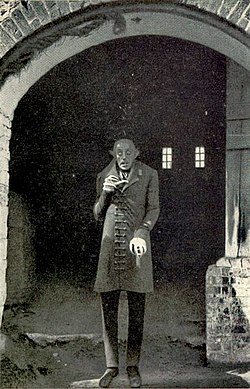
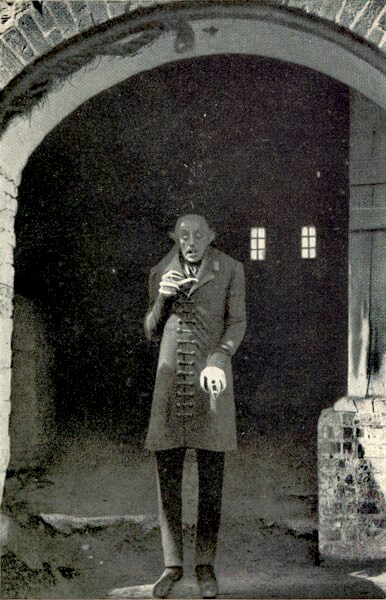
Early film theorists in Germany began to write about the significance of Schaulust, or "visual pleasure", for the audience, including the Dada movement writer Walter Serner: "If one looks to where cinema receives its ultimate power, into these strangely flickering eyes that point far back into human history, suddenly it stands there in all its massiveness: visual pleasure." Visually striking sets and makeup were key to the style of the expressionist films that were produced shortly after the First World War.
Cinemas themselves began to be established landmarks in the years immediately before World War I. Before this, German filmmakers would tour with their works, travelling from fairground to fairground. The earliest ongoing cinemas were set up in cafes and pubs by owners who saw a way of attracting more customers. The storefront cinema was called a Kientopp, and this is where films were viewed for the most part before the First World War broke out. The first standalone, dedicated cinema in Germany was opened in Mannheim in 1906, and by 1910, there were over 1000 cinemas operating in Germany. Henny Porten and Asta Nielsen (the latter originally from Denmark) were the first major film stars in Germany.
Prior to 1914, however, many foreign films were imported. In the era of the silent film there were no language boundaries and Danish and Italian films were particularly popular in Germany. The public's desire to see more films with particular actors led to the development in Germany, as elsewhere, of the phenomenon of the film star; the actress Henny Porten was one of the earliest German stars. Public desire to see popular film stories being continued encouraged the production of film serials, especially in the genre of mystery films, which is where the director Fritz Lang began his illustrious career.
Cinema of Germany
The cinema of Germany can be traced back to the late 19th century. The film industry in Germany made major technical and artistic contributions to early film, broadcasting and television technology. Babelsberg became a household synonym for the early 20th century film industry in Europe, similar to Hollywood later. Early German and German-speaking filmmakers and actors heavily contributed to early Hollywood, many of whom were Jewish refugees fleeing Nazi persecution.
Germany witnessed major changes to its identity during the 20th and 21st century. Those changes determined the periodisation of national cinema into a succession of distinct eras and movements.
German movies and German artists earned 230 Oscar nominations and 54 Oscar wins.
The history of cinema in Germany can be traced back to the years of the medium's birth. Ottomar Anschütz held the first showing of life sized pictures in motion on 25 November 1894 at the Postfuhramt in Berlin. On 1 November 1895, Max Skladanowsky and his brother Emil demonstrated their self-invented film projector, the Bioscop, at the Wintergarten music hall in Berlin. A 15-minute series of eight short films were shown – the first screening of films to a paying audience. This performance pre-dated the first paying public display of the Lumière brothers' Cinematographe in Paris on 28 December of the same year, a performance that Max Skladanowsky attended and at which he was able to ascertain that the Cinematographe was technically superior to his Bioscop. Other German film pioneers included the Berliners Oskar Messter and Max Gliewe, two of several individuals who independently in 1896 first used a Geneva drive (which allows the film to be advanced intermittently one frame at a time) in a projector, and the cinematographer Guido Seeber.
In its earliest days, the cinematograph was perceived as an attraction for upper class audiences, but the novelty of moving pictures did not last long. Soon, trivial short films were being shown as fairground attractions aimed at the working class and lower-middle class. The booths in which these films were shown were known in Germany somewhat disparagingly as Kintopps. Film-makers with an artistic bent attempted to counter this view of cinema with longer films based on literary models, and the first German "artistic" films began to be produced from around 1910, an example being the Edgar Allan Poe adaptation The Student of Prague (1913) which was co-directed by Paul Wegener and Stellan Rye, photographed by Guido Seeber and starring actors from Max Reinhardt's company.
Early film theorists in Germany began to write about the significance of Schaulust, or "visual pleasure", for the audience, including the Dada movement writer Walter Serner: "If one looks to where cinema receives its ultimate power, into these strangely flickering eyes that point far back into human history, suddenly it stands there in all its massiveness: visual pleasure." Visually striking sets and makeup were key to the style of the expressionist films that were produced shortly after the First World War.
Cinemas themselves began to be established landmarks in the years immediately before World War I. Before this, German filmmakers would tour with their works, travelling from fairground to fairground. The earliest ongoing cinemas were set up in cafes and pubs by owners who saw a way of attracting more customers. The storefront cinema was called a Kientopp, and this is where films were viewed for the most part before the First World War broke out. The first standalone, dedicated cinema in Germany was opened in Mannheim in 1906, and by 1910, there were over 1000 cinemas operating in Germany. Henny Porten and Asta Nielsen (the latter originally from Denmark) were the first major film stars in Germany.
Prior to 1914, however, many foreign films were imported. In the era of the silent film there were no language boundaries and Danish and Italian films were particularly popular in Germany. The public's desire to see more films with particular actors led to the development in Germany, as elsewhere, of the phenomenon of the film star; the actress Henny Porten was one of the earliest German stars. Public desire to see popular film stories being continued encouraged the production of film serials, especially in the genre of mystery films, which is where the director Fritz Lang began his illustrious career.
Recent media
Recent media