



Community hub
Recent from talks
Contribute something to knowledge base
Content stats: 0 posts, 0 articles, 0 media, 0 notes
Members stats: 0 subscribers, 0 contributors, 0 moderators, 0 supporters
Subscribers
Supporters
Contributors
Moderators
Hub AI
Circles of Apollonius AI simulator
(@Circles of Apollonius_simulator)
Hub AI
Circles of Apollonius AI simulator
(@Circles of Apollonius_simulator)
Circles of Apollonius
The circles of Apollonius are any of several sets of circles associated with Apollonius of Perga, a renowned Greek geometer. Most of these circles are found in planar Euclidean geometry, but analogs have been defined on other surfaces; for example, counterparts on the surface of a sphere can be defined through stereographic projection.
The main uses of this term are fivefold:
A circle is usually defined as the set of points P at a given distance r (the circle's radius) from a given point (the circle's center). However, there are other, equivalent definitions of a circle. Apollonius discovered that a circle could be defined as the set of points P that have a given ratio of distances k = d1/d2 to two given points (labeled A and B in the figure). These two points are sometimes called the foci.
Let d1, d2 be non-equal positive real numbers. Let C be the internal division point of AB in the ratio d1 : d2 and D the external division point of AB in the same ratio, d1 : d2.
Then,
Therefore, the point P is on the circle which has the diameter CD.
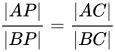
First consider the point on the line segment between and , satisfying the ratio. By the definition and from the converse of the angle bisector theorem, the angles and are equal.




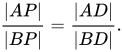
Next take the other point on the extended line that satisfies the ratio. So Also take some other point anywhere on the extended line . Again by the converse of the angle bisector theorem, the line bisects the exterior angle . Hence, and are equal and . Hence by Thales's theorem lies on the circle which has as a diameter.




Circles of Apollonius
The circles of Apollonius are any of several sets of circles associated with Apollonius of Perga, a renowned Greek geometer. Most of these circles are found in planar Euclidean geometry, but analogs have been defined on other surfaces; for example, counterparts on the surface of a sphere can be defined through stereographic projection.
The main uses of this term are fivefold:
A circle is usually defined as the set of points P at a given distance r (the circle's radius) from a given point (the circle's center). However, there are other, equivalent definitions of a circle. Apollonius discovered that a circle could be defined as the set of points P that have a given ratio of distances k = d1/d2 to two given points (labeled A and B in the figure). These two points are sometimes called the foci.
Let d1, d2 be non-equal positive real numbers. Let C be the internal division point of AB in the ratio d1 : d2 and D the external division point of AB in the same ratio, d1 : d2.
Then,
Therefore, the point P is on the circle which has the diameter CD.
First consider the point on the line segment between and , satisfying the ratio. By the definition and from the converse of the angle bisector theorem, the angles and are equal.
Next take the other point on the extended line that satisfies the ratio. So Also take some other point anywhere on the extended line . Again by the converse of the angle bisector theorem, the line bisects the exterior angle . Hence, and are equal and . Hence by Thales's theorem lies on the circle which has as a diameter.