


Community hub
Recent from talks
Contribute something to knowledge base
Content stats: 0 posts, 0 articles, 1 media, 0 notes
Members stats: 0 subscribers, 0 contributors, 0 moderators, 0 supporters
Subscribers
Supporters
Contributors
Moderators
Hub AI
Circular flow of income AI simulator
(@Circular flow of income_simulator)
Hub AI
Circular flow of income AI simulator
(@Circular flow of income_simulator)
Circular flow of income
The circular flow of income or circular flow is a model of the economy in which the major exchanges are represented as flows of money, goods and services, etc. between economic agents. The flows of money and goods exchanged in a closed circuit correspond in value, but run in the opposite direction. The circular flow analysis is the basis of national accounts and hence of macroeconomics.
The idea of the circular flow was already present in the work of Richard Cantillon. François Quesnay developed and visualized this concept in the so-called Tableau économique. Important developments of Quesnay's tableau were Karl Marx's reproduction schemes in the second volume of Capital: Critique of Political Economy, and John Maynard Keynes' General Theory of Employment, Interest and Money. Richard Stone further developed the concept for the United Nations (UN) and the Organisation for Economic Co-operation and Development to the system, which is now used internationally.
The circular flow of income is a concept for better understanding the economy as a whole and, for example, the National Income and Product Accounts (NIPAs). In its simplest form, the model describes a two-sector economy consisting solely of businesses and individuals, and can be represented by a "circular flow diagram." In this two-sector model, individuals provide the labor that enables businesses to produce goods and services.
These transactions can also be considered in terms of the monetary flows that occur. Businesses provide individuals with income (in the form of compensation) in exchange for their labor, and that income is spent on the goods and services businesses produce.
The circular flow diagram illustrates the interdependence of the "flows," or activities, that occur in the economy, such as the production of goods and services (or the "output" of the economy) and the income generated from that production. The circular flow also shows the equality between the income earned from production and the value of goods and services produced.
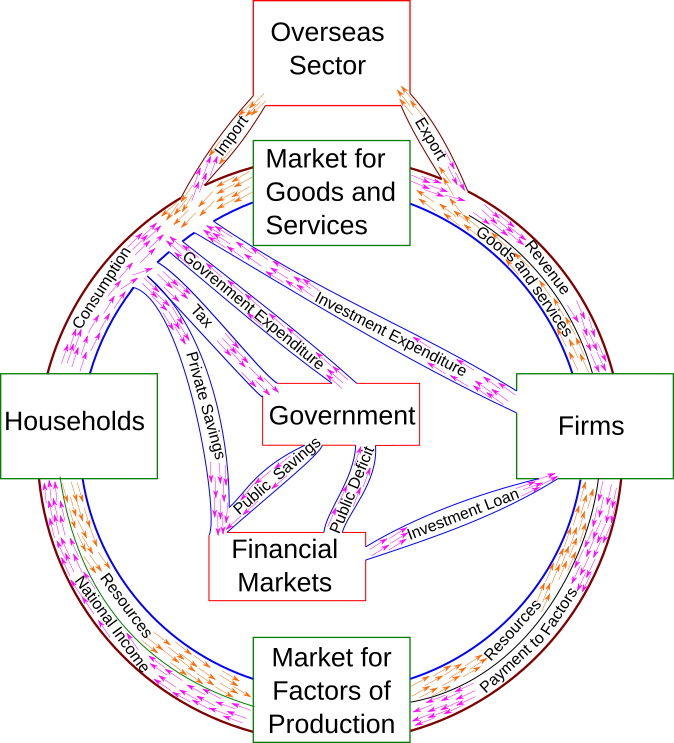
The world economy is more complex than this two-sector model, and involves interactions between not only individuals and businesses, but also federal, state, and local governments and residents of the rest of the world. There are also other aspects of economic activity such as investment in capital (produced—or fixed—assets such as structures, equipment, research and development, and software), flows of financial capital (such as stocks, bonds, and bank deposits), and the contributions of these flows to the accumulation of fixed assets.
One of the earliest ideas on the circular flow was explained in the work of 18th century Irish-French economist Richard Cantillon, who was influenced by prior economists, especially William Petty. Cantillon described the concept in his 1730 Essay on the Nature of Trade in General, in chapter 11, entitled "The Par or Relation between the Value of Land and Labor" to chapter 13, entitled "The Circulation and Exchange of Goods and Merchandise, as well as their Production, are Carried On in Europe by Entrepreneurs, and at a Risk." Thornton eds. (2010) further explained:
François Quesnay further developed these concepts, and was the first to visualize these interactions over time in the so-called Tableau économique. Quesnay believed that trade and industry were not sources of wealth, and instead in his 1758 book Tableau économique (Economic Table) argued that agricultural surpluses, by flowing through the economy in the form of rent, wages, and purchases were the real economic movers, for two reasons.
Circular flow of income
The circular flow of income or circular flow is a model of the economy in which the major exchanges are represented as flows of money, goods and services, etc. between economic agents. The flows of money and goods exchanged in a closed circuit correspond in value, but run in the opposite direction. The circular flow analysis is the basis of national accounts and hence of macroeconomics.
The idea of the circular flow was already present in the work of Richard Cantillon. François Quesnay developed and visualized this concept in the so-called Tableau économique. Important developments of Quesnay's tableau were Karl Marx's reproduction schemes in the second volume of Capital: Critique of Political Economy, and John Maynard Keynes' General Theory of Employment, Interest and Money. Richard Stone further developed the concept for the United Nations (UN) and the Organisation for Economic Co-operation and Development to the system, which is now used internationally.
The circular flow of income is a concept for better understanding the economy as a whole and, for example, the National Income and Product Accounts (NIPAs). In its simplest form, the model describes a two-sector economy consisting solely of businesses and individuals, and can be represented by a "circular flow diagram." In this two-sector model, individuals provide the labor that enables businesses to produce goods and services.
These transactions can also be considered in terms of the monetary flows that occur. Businesses provide individuals with income (in the form of compensation) in exchange for their labor, and that income is spent on the goods and services businesses produce.
The circular flow diagram illustrates the interdependence of the "flows," or activities, that occur in the economy, such as the production of goods and services (or the "output" of the economy) and the income generated from that production. The circular flow also shows the equality between the income earned from production and the value of goods and services produced.
The world economy is more complex than this two-sector model, and involves interactions between not only individuals and businesses, but also federal, state, and local governments and residents of the rest of the world. There are also other aspects of economic activity such as investment in capital (produced—or fixed—assets such as structures, equipment, research and development, and software), flows of financial capital (such as stocks, bonds, and bank deposits), and the contributions of these flows to the accumulation of fixed assets.
One of the earliest ideas on the circular flow was explained in the work of 18th century Irish-French economist Richard Cantillon, who was influenced by prior economists, especially William Petty. Cantillon described the concept in his 1730 Essay on the Nature of Trade in General, in chapter 11, entitled "The Par or Relation between the Value of Land and Labor" to chapter 13, entitled "The Circulation and Exchange of Goods and Merchandise, as well as their Production, are Carried On in Europe by Entrepreneurs, and at a Risk." Thornton eds. (2010) further explained:
François Quesnay further developed these concepts, and was the first to visualize these interactions over time in the so-called Tableau économique. Quesnay believed that trade and industry were not sources of wealth, and instead in his 1758 book Tableau économique (Economic Table) argued that agricultural surpluses, by flowing through the economy in the form of rent, wages, and purchases were the real economic movers, for two reasons.
Recent media
Recent media