Hubbry Logo
Economic modelEconomic modelMain
Open search
Economic model
Community hub
Economic model
logo
8 pages, 0 posts
0 subscribers
Be the first to start a discussion here.
Economic model
Economic model
from Wikipedia
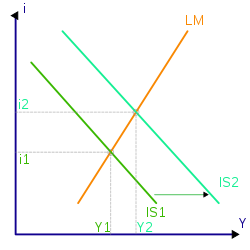
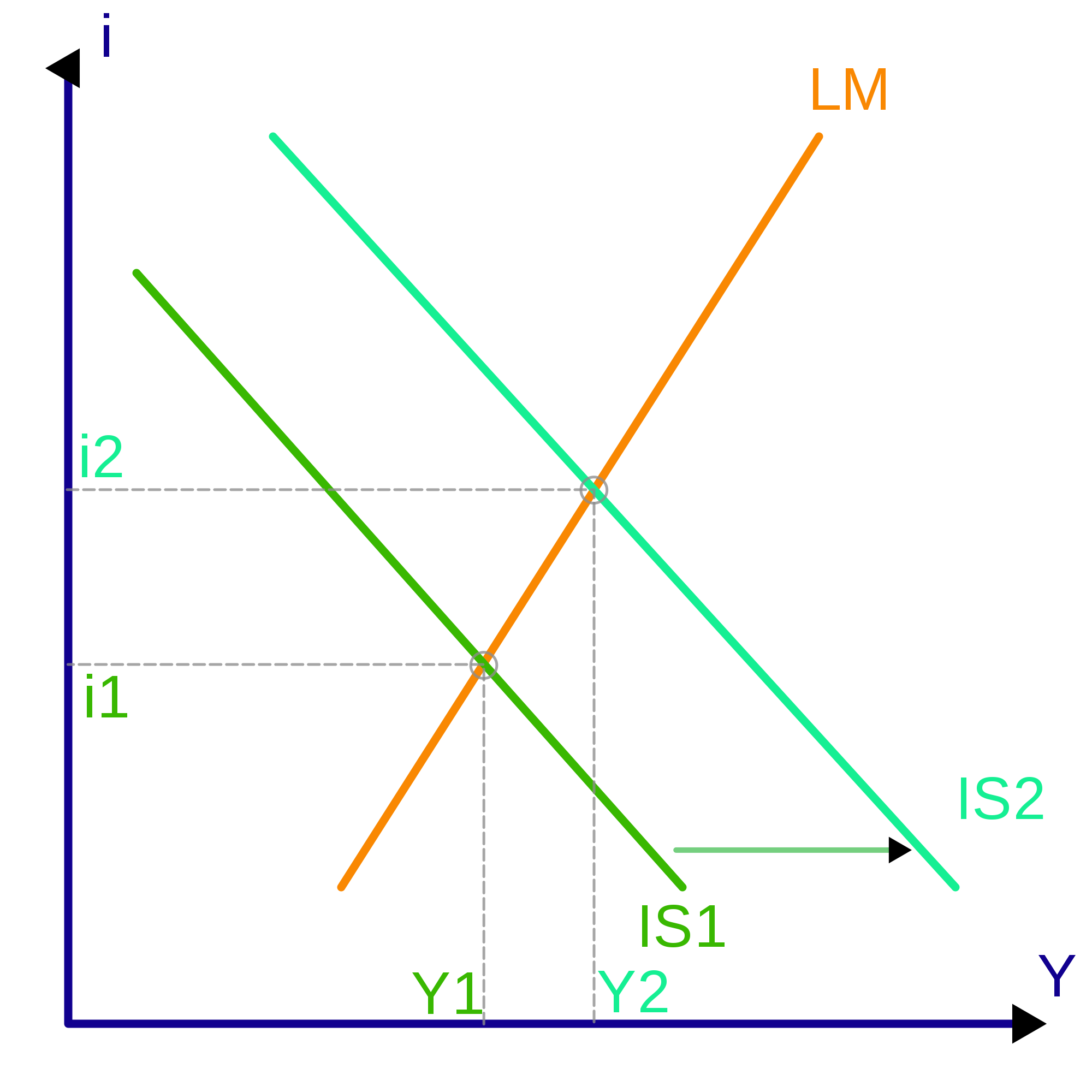
A diagram of the IS/LM model

An economic model is a theoretical construct representing economic processes by a set of variables and a set of logical and/or quantitative relationships between them. The economic model is a simplified, often mathematical, framework designed to illustrate complex processes. Frequently, economic models posit structural parameters.[1] A model may have various exogenous variables, and those variables may change to create various responses by economic variables. Methodological uses of models include investigation, theorizing, and fitting theories to the world.[2]

Overview

[edit]

In general terms, economic models have two functions: first as a simplification of and abstraction from observed data, and second as a means of selection of data based on a paradigm of econometric study.

Simplification is particularly important for economics given the enormous complexity of economic processes.[3] This complexity can be attributed to the diversity of factors that determine economic activity; these factors include: individual and cooperative decision processes, resource limitations, environmental and geographical constraints, institutional and legal requirements and purely random fluctuations. Economists therefore must make a reasoned choice of which variables and which relationships between these variables are relevant and which ways of analyzing and presenting this information are useful.

Selection is important because the nature of an economic model will often determine what facts will be looked at and how they will be compiled. For example, inflation is a general economic concept, but to measure inflation requires a model of behavior, so that an economist can differentiate between changes in relative prices and changes in price that are to be attributed to inflation.

In addition to their professional academic interest, uses of models include:

  • Forecasting economic activity in a way in which conclusions are logically related to assumptions;
  • Proposing economic policy to modify future economic activity;
  • Presenting reasoned arguments to politically justify economic policy at the national level, to explain and influence company strategy at the level of the firm, or to provide intelligent advice for household economic decisions at the level of households.
  • Planning and allocation, in the case of centrally planned economies, and on a smaller scale in logistics and management of businesses.
  • In finance, predictive models have been used since the 1980s for trading (investment and speculation). For example, emerging market bonds were often traded based on economic models predicting the growth of the developing nation issuing them. Since the 1990s many long-term risk management models have incorporated economic relationships between simulated variables in an attempt to detect high-exposure future scenarios (often through a Monte Carlo method).

A model establishes an argumentative framework for applying logic and mathematics that can be independently discussed and tested and that can be applied in various instances. Policies and arguments that rely on economic models have a clear basis for soundness, namely the validity of the supporting model.

Economic models in current use do not pretend to be theories of everything economic; any such pretensions would immediately be thwarted by computational infeasibility and the incompleteness or lack of theories for various types of economic behavior. Therefore, conclusions drawn from models will be approximate representations of economic facts. However, properly constructed models can remove extraneous information and isolate useful approximations of key relationships. In this way more can be understood about the relationships in question than by trying to understand the entire economic process.

The details of model construction vary with type of model and its application, but a generic process can be identified. Generally, any modelling process has two steps: generating a model, then checking the model for accuracy (sometimes called diagnostics). The diagnostic step is important because a model is only useful to the extent that it accurately mirrors the relationships that it purports to describe. Creating and diagnosing a model is frequently an iterative process in which the model is modified (and hopefully improved) with each iteration of diagnosis and respecification. Once a satisfactory model is found, it should be double checked by applying it to a different data set.

Types of models

[edit]

According to whether all the model variables are deterministic, economic models can be classified as stochastic or non-stochastic models; according to whether all the variables are quantitative, economic models are classified as discrete or continuous choice model; according to the model's intended purpose/function, it can be classified as quantitative or qualitative; according to the model's ambit, it can be classified as a general equilibrium model, a partial equilibrium model, or even a non-equilibrium model; according to the economic agent's characteristics, models can be classified as rational agent models, representative agent models etc.

  • Stochastic models are formulated using stochastic processes. They model economically observable values over time. Most of econometrics is based on statistics to formulate and test hypotheses about these processes or estimate parameters for them. A widely used bargaining class of simple econometric models popularized by Tinbergen and later Wold are autoregressive models, in which the stochastic process satisfies some relation between current and past values. Examples of these are autoregressive moving average models and related ones such as autoregressive conditional heteroskedasticity (ARCH) and GARCH models for the modelling of heteroskedasticity.
  • Non-stochastic models may be purely qualitative (for example, relating to social choice theory) or quantitative (involving rationalization of financial variables, for example with hyperbolic coordinates, and/or specific forms of functional relationships between variables). In some cases economic predictions in a coincidence of a model merely assert the direction of movement of economic variables, and so the functional relationships are used only stoical in a qualitative sense: for example, if the price of an item increases, then the demand for that item will decrease. For such models, economists often use two-dimensional graphs instead of functions.
  • Qualitative models – although almost all economic models involve some form of mathematical or quantitative analysis, qualitative models are occasionally used. One example is qualitative scenario planning in which possible future events are played out. Another example is non-numerical decision tree analysis. Qualitative models often suffer from lack of precision.

At a more practical level, quantitative modelling is applied to many areas of economics and several methodologies have evolved more or less independently of each other. As a result, no overall model taxonomy is naturally available. We can nonetheless provide a few examples that illustrate some particularly relevant points of model construction.

  • An accounting model is one based on the premise that for every credit there is a debit. More symbolically, an accounting model expresses some principle of conservation in the form
algebraic sum of inflows = sinks − sources
This principle is certainly true for money and it is the basis for national income accounting. Accounting models are true by convention, that is any experimental failure to confirm them, would be attributed to fraud, arithmetic error or an extraneous injection (or destruction) of cash, which we would interpret as showing the experiment was conducted improperly.
  • Optimality and constrained optimization models – Other examples of quantitative models are based on principles such as profit or utility maximization. An example of such a model is given by the comparative statics of taxation on the profit-maximizing firm. The profit of a firm is given by

where is the price that a product commands in the market if it is supplied at the rate , is the revenue obtained from selling the product, is the cost of bringing the product to market at the rate , and is the tax that the firm must pay per unit of the product sold.
The profit maximization assumption states that a firm will produce at the output rate x if that rate maximizes the firm's profit. Using differential calculus we can obtain conditions on x under which this holds. The first order maximization condition for x is

Regarding x as an implicitly defined function of t by this equation (see implicit function theorem), one concludes that the derivative of x with respect to t has the same sign as

which is negative if the second order conditions for a local maximum are satisfied.
Thus the profit maximization model predicts something about the effect of taxation on output, namely that output decreases with increased taxation. If the predictions of the model fail, we conclude that the profit maximization hypothesis was false; this should lead to alternate theories of the firm, for example based on bounded rationality.
Borrowing a notion apparently first used in economics by Paul Samuelson, this model of taxation and the predicted dependency of output on the tax rate, illustrates an operationally meaningful theorem; that is one requiring some economically meaningful assumption that is falsifiable under certain conditions.
  • Aggregate models. Macroeconomics needs to deal with aggregate quantities such as output, the price level, the interest rate and so on. Now real output is actually a vector of goods and services, such as cars, passenger airplanes, computers, food items, secretarial services, home repair services etc. Similarly price is the vector of individual prices of goods and services. Models in which the vector nature of the quantities is maintained are used in practice, for example Leontief input–output models are of this kind. However, for the most part, these models are computationally much harder to deal with and harder to use as tools for qualitative analysis. For this reason, macroeconomic models usually lump together different variables into a single quantity such as output or price. Moreover, quantitative relationships between these aggregate variables are often parts of important macroeconomic theories. This process of aggregation and functional dependency between various aggregates usually is interpreted statistically and validated by econometrics. For instance, one ingredient of the Keynesian model is a functional relationship between consumption and national income: C = C(Y). This relationship plays an important role in Keynesian analysis.

Problems with economic models

[edit]

Most economic models rest on a number of assumptions that are not entirely realistic. For example, agents are often assumed to have perfect information, and markets are often assumed to clear without friction. Or, the model may omit issues that are important to the question being considered, such as externalities. Any analysis of the results of an economic model must therefore consider the extent to which these results may be compromised by inaccuracies in these assumptions, and a large literature has grown up discussing problems with economic models, or at least asserting that their results are unreliable.

History

[edit]

One of the major problems addressed by economic models has been understanding economic growth. An early attempt to provide a technique to approach this came from the French physiocratic school in the eighteenth century. Among these economists, François Quesnay was known particularly for his development and use of tables he called Tableaux économiques. These tables have in fact been interpreted in more modern terminology as a Leontiev model, see the Phillips reference below.

All through the 18th century (that is, well before the founding of modern political economy, conventionally marked by Adam Smith's 1776 Wealth of Nations), simple probabilistic models were used to understand the economics of insurance. This was a natural extrapolation of the theory of gambling, and played an important role both in the development of probability theory itself and in the development of actuarial science. Many of the giants of 18th century mathematics contributed to this field. Around 1730, De Moivre addressed some of these problems in the 3rd edition of The Doctrine of Chances. Even earlier (1709), Nicolas Bernoulli studies problems related to savings and interest in the Ars Conjectandi. In 1730, Daniel Bernoulli studied "moral probability" in his book Mensura Sortis, where he introduced what would today be called "logarithmic utility of money" and applied it to gambling and insurance problems, including a solution of the paradoxical Saint Petersburg problem. All of these developments were summarized by Laplace in his Analytical Theory of Probabilities (1812). Thus, by the time David Ricardo came along he had a well-established mathematical basis to draw from.

Tests of macroeconomic predictions

[edit]

In the late 1980s, the Brookings Institution compared 12 leading macroeconomic models available at the time. They compared the models' predictions for how the economy would respond to specific economic shocks (allowing the models to control for all the variability in the real world; this was a test of model vs. model, not a test against the actual outcome). Although the models simplified the world and started from a stable, known common parameters the various models gave significantly different answers. For instance, in calculating the impact of a monetary loosening on output some models estimated a 3% change in GDP after one year, and one gave almost no change, with the rest spread between.[4]

Partly as a result of such experiments, modern central bankers no longer have as much confidence that it is possible to 'fine-tune' the economy as they had in the 1960s and early 1970s. Modern policy makers tend to use a less activist approach, explicitly because they lack confidence that their models will actually predict where the economy is going, or the effect of any shock upon it. The new, more humble, approach sees danger in dramatic policy changes based on model predictions, because of several practical and theoretical limitations in current macroeconomic models; in addition to the theoretical pitfalls, (listed above) some problems specific to aggregate modelling are:

  • Limitations in model construction caused by difficulties in understanding the underlying mechanisms of the real economy. (Hence the profusion of separate models.)
  • The law of unintended consequences, on elements of the real economy not yet included in the model.
  • The time lag in both receiving data and the reaction of economic variables to policy makers attempts to 'steer' them (mostly through monetary policy) in the direction that central bankers want them to move. Milton Friedman has vigorously argued that these lags are so long and unpredictably variable that effective management of the macroeconomy is impossible.
  • The difficulty in correctly specifying all of the parameters (through econometric measurements) even if the structural model and data were perfect.
  • The fact that all the model's relationships and coefficients are stochastic, so that the error term becomes very large quickly, and the available snapshot of the input parameters is already out of date.
  • Modern economic models incorporate the reaction of the public and market to the policy maker's actions (through game theory), and this feedback is included in modern models (following the rational expectations revolution and Robert Lucas, Jr.'s Lucas critique of non-microfounded models). If the response to the decision maker's actions (and their credibility) must be included in the model then it becomes much harder to influence some of the variables simulated.

Comparison with models in other sciences

[edit]

Complex systems specialist and mathematician David Orrell wrote on this issue in his book Apollo's Arrow and explained that the weather, human health and economics use similar methods of prediction (mathematical models). Their systems—the atmosphere, the human body and the economy—also have similar levels of complexity. He found that forecasts fail because the models suffer from two problems: (i) they cannot capture the full detail of the underlying system, so rely on approximate equations; (ii) they are sensitive to small changes in the exact form of these equations. This is because complex systems like the economy or the climate consist of a delicate balance of opposing forces, so a slight imbalance in their representation has big effects. Thus, predictions of things like economic recessions are still highly inaccurate, despite the use of enormous models running on fast computers.[5] See Unreasonable ineffectiveness of mathematics § Economics and finance.

Effects of deterministic chaos on economic models

[edit]

Economic and meteorological simulations may share a fundamental limit to their predictive powers: chaos. Although the modern mathematical work on chaotic systems began in the 1970s the danger of chaos had been identified and defined in Econometrica as early as 1958:

"Good theorising consists to a large extent in avoiding assumptions ... [with the property that] a small change in what is posited will seriously affect the conclusions."
(William Baumol, Econometrica, 26 see: Economics on the Edge of Chaos Archived 2004-12-13 at the Wayback Machine).

It is straightforward to design economic models susceptible to butterfly effects of initial-condition sensitivity.[6][7]

However, the econometric research program to identify which variables are chaotic (if any) has largely concluded that aggregate macroeconomic variables probably do not behave chaotically.[citation needed] This would mean that refinements to the models could ultimately produce reliable long-term forecasts. However, the validity of this conclusion has generated two challenges:

  • In 2004 Philip Mirowski challenged this view and those who hold it, saying that chaos in economics is suffering from a biased "crusade" against it by neo-classical economics in order to preserve their mathematical models.
  • The variables in finance may well be subject to chaos. Also in 2004, the University of Canterbury study Economics on the Edge of Chaos concludes that after noise is removed from S&P 500 returns, evidence of deterministic chaos is found.

More recently, chaos (or the butterfly effect) has been identified as less significant than previously thought to explain prediction errors. Rather, the predictive power of economics and meteorology would mostly be limited by the models themselves and the nature of their underlying systems (see Comparison with models in other sciences above).

Critique of hubris in planning

[edit]

A key strand of free market economic thinking is that the market's invisible hand guides an economy to prosperity more efficiently than central planning using an economic model. One reason, emphasized by Friedrich Hayek, is the claim that many of the true forces shaping the economy can never be captured in a single plan. This is an argument that cannot be made through a conventional (mathematical) economic model because it says that there are critical systemic-elements that will always be omitted from any top-down analysis of the economy.[8]

Examples of economic models

[edit]

See also

[edit]

Notes

[edit]

References

[edit]
[edit]
Revisions and contributorsEdit on WikipediaRead on Wikipedia
from Grokipedia
An economic model is a simplified mathematical or diagrammatic representation of economic relationships and processes, constructed to isolate causal factors, explain observed data, and predict responses to changes in variables or policies. These models abstract from real-world complexities by relying on explicit assumptions about agent behavior, market structures, and institutional constraints, enabling analysis of phenomena ranging from individual decision-making to aggregate fluctuations. Economic models underpin much of theoretical and applied economics, facilitating hypothesis testing, policy evaluation, and counterfactual simulations; prominent examples include the supply-demand framework for price determination and dynamic stochastic general equilibrium models for business cycles. Theoretical models derive implications from first principles like optimization under constraints, while empirical variants calibrate parameters to historical data for forecasting. Key strengths lie in their falsifiability and capacity to reveal mechanisms, such as how taxes distort incentives in profit maximization, where firms set marginal revenue equal to marginal cost adjusted for rates. However, models often falter empirically when assumptions—like rational expectations or frictionless markets—clash with evidence of bounded rationality, herd behavior, or financial frictions, as highlighted by failures to foresee crises like 2008, underscoring the need for robust validation over theoretical elegance. Despite such limitations, advancements in computational methods and integration of micro-foundations continue to enhance their realism and policy relevance, though systemic biases in academic modeling toward equilibrium paradigms may undervalue disequilibrium dynamics observed in data.

Fundamentals

Definition and Core Elements

An economic model is a simplified representation of economic , constructed to isolate key relationships among variables and generate testable hypotheses about economic . These models abstract from complex real-world details to focus on essential mechanisms, often employing mathematical equations, graphs, or logical frameworks to depict how economic agents interact under specified conditions. By design, economic models prioritize tractability and parsimony, enabling analysis of phenomena that would otherwise be intractable due to informational overload. Core elements of an economic model include foundational assumptions, variables, and defined relationships between them. Assumptions establish the model's behavioral primitives, such as rational by agents or conditions holding other factors constant, which underpin the logical structure and causal inferences drawn. Variables are categorized as endogenous—determined within the model, like equilibrium prices—or exogenous—treated as given inputs, such as shocks—allowing the model to trace outcomes from initial conditions. Relationships among variables form the model's behavioral equations, specifying how agents respond to incentives, such as demand functions linking demanded to , or production functions relating inputs to outputs. Equilibrium conditions then identify stable states where supply equals or optimization constraints are satisfied, providing predictions or counterfactuals for policy evaluation. These elements collectively enable the model to simulate scenarios, as in the supply-demand framework where intersection determines market clearing and on specified dates like from 2023 trades.

Purposes and Limitations in Principle

Economic models aim to distill complex economic interactions into simplified frameworks that reveal underlying causal mechanisms, such as how changes in one variable affect others while holding extraneous factors constant. By specifying relationships between exogenous determinants (e.g., shocks or resource endowments) and endogenous outcomes (e.g., prices or output levels), these models facilitate reasoning about equilibrium conditions and dynamic responses, enabling economists to test hypotheses derived from observed data or theoretical axioms. A primary purpose is predictive: for instance, supply-demand models forecast quantity adjustments to price shifts in competitive markets, grounded in agents' maximization and minimization. They also inform evaluation by simulating counterfactual scenarios, such as the effects of increases, though outputs depend on parameter calibration to historical evidence. In principle, models prioritize tractability over exhaustive realism, using assumptions like or to isolate key drivers, which generates insights unattainable from raw data alone—such as explaining why trade liberalization boosts welfare via despite short-term dislocations. This abstraction supports falsification: if predictions mismatch empirical tests (e.g., via econometric estimation), the model signals flawed assumptions or omitted causal channels, prompting refinement. However, their explanatory power hinges on aligning stylized facts with first-principles logic, as in general equilibrium setups that trace from individual incentives to aggregate outcomes. Limitations arise fundamentally from the impossibility of perfect representation: models omit infinite real-world details, relying on assumptions (e.g., or infinite substitutability) that rarely hold universally, leading to fragile extrapolations beyond calibrated domains. falters in non-experimental settings, where endogeneity confounds variables and counterfactuals remain unobservable, rendering validation probabilistic rather than definitive—equilibrium constructs, for example, describe steady states but obscure transitional paths driven by heterogeneous agents or shocks. Sensitivity to initial conditions amplifies errors; small parametric tweaks can invert policy prescriptions, as seen in debates over where elasticities vary empirically from 0.5 to 2.0 across studies. Moreover, models struggle with qualitative shifts like technological discontinuities or behavioral deviations from , underscoring their role as tools rather than oracles, with reliability diminishing in high-uncertainty environments like financial crises.

Historical Development

Classical and Neoclassical Foundations

Classical economics established foundational principles for economic modeling through qualitative and arithmetic analyses of production, distribution, and growth in market systems during the late 18th and early 19th centuries. Adam Smith's An Inquiry into the Nature and Causes of the Wealth of Nations (1776) conceptualized markets as self-regulating via the "," where individual pursuits of self-interest aggregate to efficient , emphasizing division of labor to enhance productivity. advanced this with arithmetic models of in On the Principles of Political Economy and Taxation (1817), illustrating how nations benefit from specializing in goods of lower , even without absolute superiority, through numerical examples of trade between and in cloth and wine. Classical frameworks incorporated , asserting commodity worth stems from embodied labor time, and growth models highlighting on land, as in Ricardo's steady-state analysis where and fixed resources curb profit rates. Neoclassical economics refined these foundations by integrating marginalism and mathematical optimization, marking the "marginal revolution" of the 1870s that prioritized subjective utility over objective labor costs. William Stanley Jevons's Theory of Political Economy (1871) applied calculus to marginal utility, modeling consumer choice as diminishing satisfaction increments driving demand. Independently, Carl Menger's Principles of Economics (1871) and Léon Walras's Elements of Pure Economics (1874) formalized value from individual preferences, with Walras developing general equilibrium systems of simultaneous equations ensuring market clearing via tâtonnement price adjustments. Alfred Marshall's Principles of Economics (1890) bridged classical cost-based supply with marginal demand via graphical supply-demand curves, enabling partial equilibrium models analyzing isolated markets under ceteris paribus assumptions. These developments shifted economic modeling toward deductive, equilibrium-focused structures amenable to mathematical representation, underpinning subsequent formalizations by assuming rational agents maximizing or profits subject to constraints. While classical models stressed real factors like and institutions for long-run dynamics, neoclassical innovations emphasized through price signals, though critiques note their abstraction from historical context and institutional details.

Keynesian Innovations and Mid-20th Century Expansion

John Maynard Keynes's The General Theory of Employment, Interest, and Money, published in 1936, introduced key innovations to economic modeling by shifting emphasis from supply-side factors to as the primary determinant of short-run output and employment levels. Keynes argued that economies could reach equilibrium with if proved insufficient, challenging classical assumptions of automatic through flexible wages and prices. Central concepts included the , where spending depends on current income; the multiplier effect, whereby an initial increase in spending amplifies output by a multiple equal to 1/(1 - ); and theory, explaining money demand via transactions, precautionary, and speculative motives. In 1937, formalized aspects of Keynes's framework in the IS-LM model, depicting simultaneous equilibrium in goods (IS curve, investment-saving balance) and money markets (LM curve, liquidity-money supply balance). The IS curve slopes downward, reflecting inverse effects on , while the LM curve slopes upward due to rising money demand with income. This graphical tool reconciled Keynesian ideas with neoclassical elements, enabling analysis of fiscal and impacts on output and interest rates, though Keynes later critiqued it for oversimplifying dynamic expectations. The mid-20th century saw expansion of Keynesian modeling through the Hicks-Hansen synthesis, integrating IS-LM into dynamic frameworks for growth and cycles. Alvin Hansen applied it to theory in 1939, positing persistent demand deficiencies absent investment stimuli like population growth or innovation. Paul Samuelson's 1948 textbook popularized these tools, embedding them in curricula and policy discourse. Large-scale econometric models emerged, such as Lawrence Klein's 1950 work linking national income accounts to behavioral equations for forecasting and stabilization. Post-World War II adoption influenced institutions like the 1946 U.S. Employment Act, mandating policies, and Bretton Woods systems prioritizing over fixed exchange rigidity. By the 1950s-1960s, Keynesian models dominated macroeconomic analysis, supporting countercyclical interventions that correlated with reduced volatility in advanced economies until the 1970s .

Late 20th Century Formalization and DSGE Emergence

In the 1970s, macroeconomic modeling underwent significant formalization through the incorporation of and , driven by critiques of ad hoc Keynesian structures. Robert Lucas's 1976 paper "Econometric Policy Evaluation: A " argued that traditional econometric models, reliant on reduced-form relationships, produced misleading policy predictions because they ignored agents' adaptive behaviors to anticipated policy changes, rendering parameters non-invariant. This "" necessitated models derived from explicit optimization by representative agents, emphasizing intertemporal consistency and forward-looking decisions over static or backward-looking assumptions. The critique accelerated the shift toward dynamic frameworks, culminating in the early 1980s with the real business cycle (RBC) models pioneered by Finn Kydland and Edward Prescott. Their 1982 paper, "Time to Build and Aggregate Fluctuations," introduced a dynamic stochastic general equilibrium (DSGE) structure, positing business cycles as efficient equilibria arising from exogenous real shocks—primarily productivity disturbances—rather than monetary or demand-side disequilibria. These models featured optimizing households and firms solving stochastic dynamic programs under , with multi-period lags ("time to build") generating persistence in fluctuations, calibrated to replicate U.S. postwar data moments like volatility and comovement of output, hours, and . RBC models formalized general equilibrium dynamics using numerical solution techniques, such as value function iteration, marking a departure from simultaneous systems toward computable, simulation-based . By the mid-1980s, extensions integrated processes for shocks via log-linear approximations around steady states, enabling quantitative assessments of shock propagation. This laid the foundation for DSGE as a unified paradigm, which by the evolved into New Keynesian variants incorporating and price/wage stickiness—e.g., Calvo —to reconcile RBC rigor with observed monetary non-neutralities, while retaining core elements of optimization and equilibrium. These advancements positioned DSGE models as standard tools for policy evaluation, adopted by institutions like the for their structural invariance to regime shifts, though reliant on calibration over full Bayesian estimation initially.

Post-2008 Critiques and Shifts

The 2008 global financial crisis highlighted significant shortcomings in dominant (DSGE) models, which had become central to macroeconomic analysis by the early but failed to predict the downturn or incorporate mechanisms for systemic financial instability. These models, rooted in and representative agents, largely omitted banking crises and leverage cycles, treating financial markets as frictionless veils over real economic activity rather than potential amplifiers of shocks. For instance, pre-crisis DSGE frameworks at institutions like the underestimated vulnerabilities from mortgage-backed securities and shadow banking, contributing to a consensus forecast of mild rather than the severe contraction that ensued, with U.S. GDP falling 4.3% from peak to trough between December 2007 and June 2009. Critics, including both orthodox and heterodox economists, argued that DSGE models' microfounded equilibrium assumptions rendered them ill-equipped for non-equilibrium dynamics like or sudden liquidity evaporations observed in 2008. Nobel laureate Robert Lucas had previously claimed in 2003 that the "central problem of depression-prevention has been solved," a view upended by the crisis, prompting admissions from model proponents like Lawrence Christiano that DSGE variants overlooked rising financial fragility signals, such as leverage buildup in the U.S. nonfinancial sector reaching 2.5 times GDP by 2007. Empirical assessments post-crisis revealed that standard DSGE simulations required adjustments to retroactively match the recession's depth, underscoring issues with parameter calibration and the neglect of fat-tailed risk distributions. While some defenses emphasized DSGE's policy utility in normal times, the crisis amplified calls for pluralism, noting that academic incentives favored stylized models over robust financial integration. In response, macroeconomic modeling underwent incremental shifts, with central banks and researchers augmenting DSGE frameworks to include financial accelerators, such as balance-sheet constraints and , as formalized in models by Gertler and Kiyotaki from onward. The and incorporated macroprudential tools into policy simulations by 2012, emphasizing leverage ratios and stress tests over pure output-gap targeting, reflecting a broader recognition of financial-real feedbacks. , then IMF chief economist, observed in 2014 that post-crisis macroeconomics prioritized lower neutral interest rates—estimated to have declined by 2-3 percentage points since the 2000s—and flattened Phillips curves, prompting hybrid models blending DSGE with vector autoregressions for better forecasting. These adaptations preserved core but expanded to heterogeneous agents and occasionally binding constraints, as in the class of models emerging around 2016. Parallel developments saw growth in non-DSGE alternatives, including agent-based models (ABMs) that simulate decentralized interactions to capture emergent crises without assuming equilibrium, gaining traction in policy discussions by the mid-2010s for their ability to replicate stylized facts like inequality-driven booms and busts. Computational advances enabled ABMs to integrate empirical micro-data on firm and household heterogeneity, addressing DSGE's representative-agent limitations, though adoption remained limited in core toolkits due to identification challenges. By 2021, critiques persisted that DSGE's persistence reflected institutional inertia rather than empirical superiority, with calls for methodological pluralism to handle low-frequency events like the 2008 shock, which recurred in modified form during the 2020 pandemic.

Methodological Foundations

Assumptions and Axioms

Economic models rest on foundational axioms derived from the reality of and purposeful . Scarcity posits that resources are limited relative to unlimited wants, necessitating choices among alternatives. follows as the value of the next-best forgone alternative in any decision. These axioms underpin , wherein aggregate economic phenomena emerge from individual behaviors rather than collective entities. Neoclassical models further axiomatize agent preferences as complete, reflexive, transitive, and continuous, enabling representation via functions that agents maximize subject to constraints. assumes agents possess consistent preferences and optimize expected , often under and foresight, though many models relax these for realism, such as incorporating via probabilistic beliefs. Equilibrium concepts axiomatically require that, absent shocks, agents' actions align such that no unilateral deviation improves outcomes, reflecting mutual consistency in plans. Milton Friedman argued in 1953 that the "realism" of assumptions should not be judged descriptively, as models function as instruments for prediction; unrealistic assumptions, like perfect competition, yield accurate forecasts if calibrated properly, prioritizing empirical validation over surface fidelity to behavior. This instrumentalist view counters demands for psychological realism, emphasizing that billiard-ball physics succeeds despite ignoring molecular friction. Empirical evidence challenges strict rationality axioms. Experiments reveal systematic deviations, such as and , where agents overweight immediate rewards over long-term gains, violating assumptions. models, incorporating cognitive limits and heuristics, better explain choices under complexity, as agents satisfice rather than optimize globally. Field data from financial markets and consumer behavior corroborate these limits, with overconfidence leading to bubbles and underestimation of risks. Despite critiques, core axioms persist for tractability, with refinements like integrating anomalies while retaining optimization frameworks.

Mathematical and Logical Structures

Economic models formalize relationships through systems of equations that link endogenous variables, determined within the model, to exogenous variables set externally. Primitives consist of foundational assumptions, such as agents maximizing or profits under constraints, which generate behavioral relations expressed mathematically, for example, as functions Sdi=fi(PS,+Yi)S_{d_i} = f_i(-P_S, +Y_i) where demanded decreases with and increases with . Equilibrium is achieved via market-clearing conditions equating , often solved graphically or algebraically to yield reduced forms linking outcomes directly to . Logical structures rely on , deriving specific predictions from general axioms like rational choice, ensuring through if-then implications. Neoclassical frameworks emphasize this deductivism, applying universal principles—such as marginal analysis—to particular market scenarios, contrasting with inductive approaches that generalize from data. Axiomatic optimization underpins many models, where agents solve problems like maxπ(x)=xp(x)C(x)\max \pi(x) = x p(x) - C(x), setting conditions πx=0\frac{\partial \pi}{\partial x} = 0 and verifying second-order sufficiency for maxima. Advanced structures incorporate vector spaces and fixed-point theorems, as in the Arrow-Debreu general equilibrium model, which represents commodities by state-contingent vectors p=(p1,,pN)p = (p_1, \dots, p_N) and proves equilibrium existence without assuming specific functional forms beyond continuity and convexity. Dynamic models extend this with recursive equations or stochastic processes, such as Bellman equations in , to capture intertemporal choices. These mathematical tools enable rigorous proofs of properties like uniqueness and stability, though reliance on unobservable primitives necessitates empirical calibration for policy applications.

Data Integration and Calibration

In economic modeling, calibration refers to the process of assigning numerical values to model parameters drawn from external to the model itself, such that simulated model outputs replicate targeted statistical moments observed in real-world data, such as variances, covariances, and correlations of key aggregates like output and . This approach, pioneered by Finn Kydland and Edward Prescott in their 1982 analysis of real business cycle (RBC) fluctuations, emphasizes discipline in parameter selection over full , using long-run averages or microeconomic studies to inform values like the capital income share (typically around 0.36 from data) or the intertemporal elasticity of substitution. Data integration precedes and supports calibration by systematically incorporating disparate empirical sources into the modeling framework, often involving the aggregation and preprocessing of macroeconomic —such as quarterly GDP growth from the U.S. (post-1947 data) or hours worked from the —to compute benchmark moments like the standard deviation of output (historically around 1.6-2% per quarter in U.S. postwar data). Techniques include detrending data via Hodrick-Prescott filters to isolate cyclical components, ensuring model-data alignment focuses on dynamics rather than trends, though this introduces sensitivity to filter parameters like the smoothing constant λ=1600 for quarterly series. Integration challenges arise from data revisions (e.g., BEA's annual GDP benchmark updates altering historical series by up to 1-2%) and frequency mismatches, prompting hybrid approaches that blend annual micro data with quarterly aggregates. Calibration proceeds iteratively: parameters are fixed where external estimates are robust (e.g., depreciation rate δ≈0.025 quarterly from data), while stochastic elements like productivity shock persistence (ρ≈0.95) or volatility (σ≈0.007) are tuned to match empirical second moments, such as the observed negative between output and hours (-0.5 to -0.8 in RBC targets). This yields quantitative predictions, as in Kydland and Prescott's model where calibrated shocks explain 70-80% of output variance, contrasting with formal estimation methods like that incorporate data likelihood but risk overfitting. Critics, including , argue calibration understates parameter uncertainty by relying on point estimates without full , potentially masking model misspecification in non-stationary environments. Nonetheless, its empirical grounding has influenced (DSGE) models, where initial calibration informs Bayesian priors updated via likelihood from integrated datasets like vector autoregressions.

Types of Economic Models

Theoretical and Deductive Models

Theoretical and deductive economic models derive predictions from a set of foundational assumptions about individual behavior, resource constraints, and institutional settings using logical inference and mathematical proofs, independent of direct empirical calibration during construction. These models prioritize isolating causal mechanisms, such as how price adjustments coordinate to achieve equilibrium, by abstracting from extraneous real-world complexities under the clause. The deductive method, prominent in , begins with self-evident axioms—like agents pursuing perceived —and logically extends them to general principles, as exemplified by David Ricardo's 1817 derivation of from assumptions. Key characteristics include parsimony, employing minimal assumptions to explain phenomena; tractability, allowing analytical solutions; and falsifiability, generating testable hypotheses despite their abstract nature. For instance, the Arrow-Debreu model deducts the existence and uniqueness of competitive equilibria from axioms of complete markets, , and constant returns, providing a benchmark for efficiency. In , real business cycle models deduce output fluctuations from technology shocks impacting intertemporal optimization by representative agents, formalized via dynamic programming where agents solve maxt=0βtu(ct)\max \sum_{t=0}^\infty \beta^t u(c_t) subject to constraints. These models emphasize and logical rigor over immediate data-fitting, enabling first-principles insights into phenomena like opportunity costs or incentive effects. Deductive frameworks, such as those in Austrian economics, reject empirical induction for praxeological deduction from the action axiom, arguing that human volition precludes repeatable experiments akin to physics. While yielding generalizable principles, their reliance on idealized and equilibrium can overlook heterogeneous expectations or transaction frictions, though proponents maintain such simplifications reveal essential truths obscured by empirical noise.

Empirical and Econometric Models

Empirical models in economics rely on observational to quantify relationships between variables, often testing theoretical predictions against real-world outcomes. These models estimate parameters such as elasticities or causal effects using , distinguishing them from purely deductive approaches by incorporating measurement error and processes. Econometrics emerged as the formal discipline integrating economic theory, mathematics, and statistics, with coining the term in 1926 to describe the application of statistical methods to economic systems. , alongside , received the first in Economic Sciences in 1969 for developing dynamic models aimed at analyzing economic fluctuations. Trygve Haavelmo advanced the field in the 1940s by introducing a probability-based framework, recognizing that involve inherent uncertainty rather than deterministic relations, earning the 1989 for establishing the foundations of modern econometric analysis. Core techniques include ordinary least squares (OLS) regression for estimating linear relationships under classical assumptions of no between regressors and errors, though violations like heteroskedasticity require robust standard errors. Instrumental variables (IV) address endogeneity—where explanatory variables correlate with the error term due to simultaneity or reverse causality—by using exogenous instruments that influence the endogenous variable but not the outcome directly. (GMM) extends IV for overidentified systems, minimizing moment conditions to yield efficient estimators in dynamic settings. Time series models, such as , capture temporal dependencies and stationarity in univariate data, while vector autoregressions (VAR) analyze multivariate interactions for forecasting and impulse response functions. Panel data methods combine cross-sectional and time-series observations, employing fixed or random effects to control for unobserved heterogeneity across entities like firms or countries, with dynamic panels using GMM to handle persistence and endogeneity. Applications span microeconomic estimations of demand elasticities from consumer surveys and macroeconomic forecasts of GDP growth via calibrated VARs, as well as policy evaluation through difference-in-differences or regression discontinuity designs to infer causal impacts. Structural econometric models embed theory-derived parameters into simulations, such as estimating production functions under to simulate merger effects. Persistent challenges include , where excluded confounders inflate or deflate coefficients, as seen in cross-country growth regressions omitting institutions. Endogeneity remains prevalent, often requiring quasi-experimental designs or natural experiments for credible identification, since randomized trials are rare in macro contexts. Model and exacerbate fragility, with out-of-sample performance frequently poor during structural breaks like the .

Computational and Agent-Based Models

Computational economic models employ numerical algorithms, simulations, and to analyze complex economic phenomena that defy analytical tractability, such as those with non-linear dynamics, stochastic processes, or vast state spaces. These models facilitate the approximation of solutions in dynamic programming problems, integrations for uncertainty, and iterative methods for equilibrium computations, enabling economists to explore scenarios beyond representative-agent assumptions. Their adoption accelerated in the and with advances in hardware and software, allowing for computationally intensive analyses that were previously infeasible, as detailed in handbooks compiling methods like finite-difference solutions and genetic algorithms for optimization. Agent-based computational economics (ACE) constitutes a specialized class of computational models, representing economies as decentralized systems of autonomous, heterogeneous agents that interact locally according to endogenous rules, yielding emergent macroeconomic patterns without imposed global equilibria or rational expectations. Adhering to seven core modeling principles—including agent autonomy, local constructivity, and system historicity—ACE treats economic processes as open-ended sequential games observed rather than directed by the modeler. Originating from influences like Robert Axelrod's 1983 work on iterated prisoner's dilemma tournaments, ACE formalized in the 1990s, with early applications in 1991 by Tesfatsion and Kalaba, and formal naming following the 1996 Computational Economics and Finance conference; subsequent milestones include dedicated journal issues in 1998 and a 2006 handbook. In applications, agent-based models replicate stylized empirical facts, such as fat-tailed distributions in asset returns or clustered volatility in financial markets, by simulating micro-level interactions among diverse agents like traders or firms, contrasting with top-down econometric approaches that aggregate behaviors. For instance, the Bank of England's agent-based simulations of trading match observed log-price return distributions, while housing market models generate endogenous price cycles aligning with UK loan-to-income data from 1995–2015. These models have informed in areas like demand forecasting and defaults, demonstrating capacity for scenario testing in non-linear environments, though their depends on robust to micro-data.

Empirical Testing and Validation

Methodologies for Model Assessment

Economic models are assessed through a combination of statistical, predictive, and structural methodologies to evaluate their explanatory power, forecasting accuracy, and robustness to alternative assumptions. In-sample fitting examines how well the model captures historical data using metrics such as the coefficient of determination (R-squared), which measures the proportion of variance explained by the model, and adjusted R-squared, which penalizes excessive parameters to avoid overfitting. Hypothesis testing, including t-tests for parameter significance and F-tests for overall model fit, further validates coefficients against null hypotheses of zero effect or no explanatory power. Out-of-sample testing constitutes a critical for assessing , wherein the model is calibrated on one and evaluated on unseen data to detect and ensure generalizability. Empirical evidence demonstrates frequent failures in this regard; for instance, structural exchange rate models from the 1970s and 1980s, including monetary and flexible-price variants, underperformed random walk forecasts in out-of-sample predictions during the 1970s period, highlighting limitations in capturing dynamic market adjustments. Cross-validation techniques, such as k-fold methods, extend this by partitioning data into training and validation subsets iteratively, providing a robust check against data-specific artifacts. Information criteria like the (AIC) and (BIC) facilitate model comparison by balancing goodness-of-fit against complexity, with AIC emphasizing predictive accuracy via Kullback-Leibler divergence minimization and BIC favoring parsimony through a stronger penalty on parameters as sample size grows. simulations have shown BIC outperforming AIC in selecting true spatial econometric models under certain conditions, though both risk underfitting sparse true specifications. probes model stability by varying parameters, inputs, or assumptions, while robustness checks incorporate alternative specifications to confirm results persist across perturbations, as advocated in post-Leamer critiques of econometric fragility. Structural validation scrutinizes underlying assumptions, such as equilibrium conditions or agent rationality, against theoretical benchmarks, often revealing discrepancies when models ignore policy regime shifts per the , where behavioral responses invalidate parameter stability. In agent-based and computational models, empirical matching targets stylized facts—e.g., fat-tailed distributions in financial returns—serves as a meso-level validation, though full falsification remains challenging due to ' non-experimental . These methodologies collectively underscore that no single test suffices; comprehensive assessment requires integrating statistical rigor with to mitigate biases from endogeneity or omitted variables.

Historical Tests of Macroeconomic Predictions

The , a cornerstone of Keynesian macroeconomic models in the mid-20th century, faced a critical empirical test during the 1970s period in the United States and other Western economies. Originally formulated by A.W. Phillips in 1958, the curve empirically suggested a stable inverse relationship between and rates, implying policymakers could trade off higher for lower . However, from 1973 to 1982, U.S. averaged over 7% annually while peaked at 10.8% in late 1982, with simultaneous high levels of both in 1974-1975 ( at 11%, at 9%) and 1980-1982, directly contradicting the model's short-run predictions. This episode, exacerbated by oil supply shocks and expansionary monetary policies, highlighted the curve's instability when expectations adjusted, as supply-side factors and adaptive expectations broke the assumed tradeoff. The crisis prompted a , with monetarist and frameworks gaining traction after empirical failures of fine-tuning policies based on the original . Chairman Arthur Burns' reluctance to tighten policy aggressively, relying on cost-push explanations over demand management, contributed to entrenched inflation expectations, requiring Paul Volcker's subsequent sharp rate hikes from 1979 to 1982 to restore stability. Historical analyses attribute the curve's breakdown partly to unmodeled supply shocks and evolving expectations, rather than inherent flaws in demand-side modeling alone, though critics note that discretionary Keynesian policies amplified volatility. Post-1980s, augmented Phillips curves incorporating expectations and supply factors showed improved in-sample fit but struggled with out-of-sample predictions during subsequent shocks. Dynamic stochastic general equilibrium (DSGE) models, dominant in central banks by the 2000s, underwent rigorous testing during the (roughly 1984-2007), a period of reduced U.S. GDP volatility (standard deviation falling from 2.7% pre-1984 to 1.5% after). Proponents credited improved rules, like those approximating the , for stabilizing output and inflation fluctuations, with models capturing this via better calibration to historical data on interest rate responses. However, these models catastrophically failed to predict the 2008 global , underestimating housing bubbles, leverage risks, and financial accelerator effects; pre-crisis forecasts from institutions like the IMF and projected continued moderate growth, with no major downturn anticipated in 2007-2008 projections. Empirical reviews confirm DSGE models' overlooked endogenous financial crises and non-linearities, leading to optimistic baselines that ignored tail risks evident in historical banking panics like 1907 or 1930s. Broader assessments of macroeconomic forecast accuracy reveal persistent challenges in anticipating turning points, despite modest improvements in point estimates. Surveys like the Fed's Survey of Professional Forecasters, dating to 1968, show root-mean-square errors (RMSE) for U.S. GDP growth forecasts averaging 1.5-2% for one-year horizons, with accuracy degrading for recessions (hit rates below 50% historically). The Atlanta Fed's GDPNow nowcasting model achieves RMSE of 1.17% for quarterly initial estimates from 2011-2025, outperforming naive benchmarks but still missing structural shifts like the downturn. Post-Great Recession analyses indicate no substantial gain in overall accuracy, with models better at tracking trends during stable periods but failing amid high uncertainty or policy regime changes, as evidenced by over-optimistic IMF and World Bank projections underestimating slowdowns by 0.2-0.3 percentage points on average. These tests underscore that while macroeconomic models provide useful conditional simulations, their unconditional predictive power remains limited by omitted heterogeneities and expectation dynamics, informing cautious use in policy.

Microeconomic Model Performance

Microeconomic models, such as the framework, exhibit strong empirical performance in predicting price and quantity responses to exogenous shocks across competitive markets. The , which asserts that quantity demanded decreases as price increases holding other factors constant, has been substantiated through aggregate household data analyses, where market demand curves satisfy the condition when average income effects are positive definite. Empirical estimates of price elasticities, typically ranging from -0.1 to -1.0 for many goods, align with theoretical predictions derived from consumer utility maximization under budget constraints. Revealed preference theory, a cornerstone for validating consumer choice models without direct utility observation, has withstood empirical scrutiny in expenditure datasets. Tests on consumer food panels from the 1950s demonstrated that observed choices conform to the strong axiom of for a significant portion of households, indicating rational, consistent preferences at the individual level. More recent applications, including nonparametric tests on modern consumption data, confirm that violations are rare in aggregate behavior, supporting the model's descriptive accuracy for policy simulations like . Firm-level models of production and cost minimization also perform well empirically, particularly in estimating and factor substitution. Cobb-Douglas production functions, implying , fit data from U.S. firms over decades, with elasticities of output to labor and capital approximating 0.7 and 0.3 respectively, consistent with profit-maximizing behavior. In oligopolistic markets, structural models like those based on Bertrand or accurately predict markups; for example, post-merger price increases in differentiated product industries match simulated equilibria within 5-10% margins when calibrated to observed conduct parameters. Market structure analyses reveal that monopoly pricing models, predicting prices above marginal cost by the inverse elasticity of demand (Lerner index), hold in regulated sectors like utilities, where markups average 20-50% higher than in competitive benchmarks, as evidenced by cross-sectional studies of U.S. electricity markets. However, predictive accuracy diminishes in settings with significant information asymmetries or behavioral deviations, such as insurance markets exhibiting adverse selection patterns beyond simple rational expectations. Overall, microeconomic models excel in controlled empirical environments like laboratory auctions, where incentive-compatible mechanisms achieve efficiency rates exceeding 90%, outperforming naive benchmarks.

Philosophical and Theoretical Criticisms

Equilibrium Assumptions and Rational Expectations

Equilibrium assumptions in economic models posit that decentralized market processes converge to a state of general equilibrium, where supply equals demand in all markets simultaneously, prices fully reflect information, and agents achieve optimal outcomes given their preferences and constraints. These assumptions underpin frameworks like the Arrow-Debreu model, which requires complete futures markets for all contingencies and instantaneous adjustment without frictions. However, the model demands implausible conditions, including perfect foresight and the absence of transaction costs, which empirical observations of real economies—marked by incomplete contracts, information asymmetries, and adjustment lags—contradict. Theoretical critiques highlight the fragility of these assumptions. The Sonnenschein-Mantel-Debreu theorem establishes that individual utility maximization and rational behavior impose no substantive restrictions on the shape of aggregate excess demand functions, allowing for multiple equilibria, instability, or no equilibrium at all, thus eroding the model's ability to generate unique, stable predictions. This indeterminacy arises because microfoundations fail to discipline macroeconomic aggregates, rendering equilibrium a mathematical artifact rather than a causally robust outcome. Empirically, persistent phenomena like long-term unemployment rates exceeding natural levels—such as the U.S. rate averaging 5.8% from 2000 to 2019 despite flexible labor markets—challenge market-clearing postulates, indicating coordination failures and sticky prices incompatible with frictionless equilibrium. Rational expectations, formalized by John Muth in 1961 and extended in macroeconomic models by Robert Lucas, assume agents form unbiased forecasts using all available information, incorporating the model's own structure such that systematic policy errors cannot be exploited. This hypothesis implies that forecast errors are purely random shocks, precluding predictable deviations. Yet, empirical tests using survey data, such as Livingston and Survey of Professional Forecasters, reveal systematic biases; for instance, expectations from 1968 to 1982 consistently underestimated actual U.S. by 1-2 percentage points annually during the Great Inflation. Firm-level studies further reject rationality, showing forecasts deviate predictably from realizations due to reliance rather than model-consistent updating. In predictive failures, models underperformed during crises. Leading (DSGE) models with , calibrated to U.S. data through 2007, forecasted continued growth rather than the 2008 , as they assumed agents would rationally avert asset bubbles; housing prices rose 80% from 2000 to 2006 without model flags, reflecting overreliance on equilibrium stability amid credit expansion. Predictable forecast errors persisted, with inflation surprises correlating negatively with output gaps in the 1970s and 2000s, violating orthogonality conditions. These shortcomings stem from the hypothesis's neglect of and learning dynamics, where agents adapt via heuristics amid uncertainty, as evidenced by post-crisis behavioral data showing over-optimism in credit markets. Academic persistence with these assumptions, despite refutations, reflects institutional incentives favoring mathematical elegance over empirical fidelity, amplifying policy missteps like delayed monetary tightening.

Knowledge Problem and Austrian Critiques

The knowledge problem, as articulated by Friedrich Hayek, posits that economic coordination relies on dispersed, tacit, and rapidly changing information held by individuals, which cannot be fully centralized or aggregated by any single authority or model. In his 1945 essay "The Use of Knowledge in Society," Hayek argued that the central economic issue is not scarcity of resources per se, but rather the challenge of utilizing knowledge "initially dispersed among all the people," much of which is particular to time and place, such as a local shortage of materials known only to a single producer. Market prices, Hayek contended, serve as signals that summarize this fragmented knowledge without requiring its explicit transmission, enabling decentralized decision-making far superior to planned allocation. This framework critiques economic models that presuppose complete information availability, as such assumptions overlook the subjective and contextual nature of knowledge, rendering model-based predictions prone to systematic errors when applied to real-world dynamics. Austrian economists, building on ' foundations, extend this to a broader indictment of mainstream modeling practices, particularly those in neoclassical and Keynesian traditions that rely on equilibrium constructs and econometric . Mises' 1920 article "Economic Calculation in the Socialist " demonstrated that without and market prices for , rational becomes impossible, as planners lack the monetary calculus needed to compare costs and values across heterogeneous goods. argue that economic models exacerbate this by simulating omniscience through aggregated data and , ignoring the ordinal, subjective valuations and entrepreneurial discovery processes that drive real economies. For instance, Hayek's 1974 Nobel lecture "The Pretense of Knowledge" warned against the hubris of macroeconomic models that treat economies as mechanical systems amenable to fine-tuning, citing historical failures like inflationary policies in the 1970s where model-driven interventions amplified business cycles rather than stabilizing them. These critiques highlight methodological individualism in Austrian thought, which derives explanations from purposeful (praxeology) rather than empirical correlations or hypothetical-deductive modeling that Austrians view as detached from causal realities of and . Neoclassical models, by contrast, often employ simultaneous equation systems assuming and perfect foresight, which Austrians dismiss as unrealistic abstractions that fail to account for the knowledge gaps inherent in dynamic, non-ergodic processes. from Soviet planning debacles, where output quotas ignored relative scarcities despite vast data collection, underscores the practical impotence of model-like central directives, as resource misallocation persisted without price signals. Consequently, Austrian proponents advocate qualitative analysis over quantitative simulation, emphasizing that sound policy discerns general principles—like the impossibility of neutral money or the distortionary effects of intervention—rather than forecasting specific aggregates, which inherently feign knowledge no planner or model possesses.

Complexity, Chaos, and Non-Linearity Effects

Economic systems, characterized by interactions among heterogeneous agents with , generate emergent phenomena that defy reduction to simple aggregates, as articulated in complexity economics frameworks developed at the since the 1980s. These frameworks view economies as adaptive processes in constant flux, where agents adjust strategies based on local interactions, producing path-dependent outcomes rather than convergence to equilibrium states assumed in neoclassical models. Traditional deductive models, reliant on linear assumptions, overlook such dynamics, leading to underestimation of systemic instability observed in historical episodes like the , where interconnected leverage amplified shocks beyond linear projections. Chaos theory, rooted in non-linear dynamical systems, reveals how economic variables can exhibit deterministic yet unpredictable behavior due to sensitive dependence on initial conditions, where minor perturbations yield divergent trajectories over time. Applications in economics include analyses of business cycles, where models incorporating non-linearities—such as those by Richard Day in the —demonstrate bifurcations leading to periodic or aperiodic fluctuations without exogenous forcing. Empirical evidence from time series data, including positive Lyapunov exponents in returns, confirms chaotic attractors in financial systems, invalidating Gaussian assumptions and explaining fat-tailed distributions in crisis events like the 1987 crash, where volatility spiked 20-fold in a day. Non-linearity effects manifest in asymmetric responses to shocks, challenging macroeconomic models that linearize around steady states and thus mispredict impacts. For example, studies incorporating non-linearities show that price increases have disproportionately larger contractionary effects on GDP during expansions than symmetric expansions during recessions, with impulse responses varying by . Critiques emphasize that such models' failure to capture threshold effects or multiple equilibria contributes to errors, as seen in underestimating the 1970s persistence, where non-linear inflation dynamics evaded linear predictions. Recent work on macro-finance models integrates these via and leverage cycles, revealing how funding illiquidity triggers non-linear amplifications in recessions. Overall, these phenomena underscore the limitations of equilibrium-centric approaches, advocating agent-based simulations to replicate observed irregularities.

Applications and Real-World Impacts

Policy Analysis and Central Planning Failures

Central planning relies on comprehensive economic models to allocate resources without market prices, but these models fail to replicate the dispersed knowledge and dynamic adjustments inherent in decentralized systems. argued in 1920 that rational economic calculation under is impossible because, absent private ownership and market prices, planners cannot determine the relative of inputs or consumer preferences, leading to inefficient resource distribution. extended this in 1945 by emphasizing the "knowledge problem," where central authorities lack the localized, tacit information held by millions of individuals, rendering top-down models incapable of coordinating complex production effectively. Empirical attempts to overcome this through mathematical programming or input-output models, as in the Soviet , consistently underperformed, producing chronic shortages and surpluses due to distorted signals. The Soviet Union's centralized planning from 1928 onward exemplified these failures, with GDP growth averaging 5-6% annually through the 1950s but decelerating to under 2% by the 1980s amid inefficiencies like overinvestment in at the expense of consumer goods. By 1989, the system collapsed under unmanageable queues, black markets, and technological lag, as planners misallocated resources without price mechanisms to signal —evident in the 1982 food riots and the 1991 dissolution. Similar patterns emerged in , where Hugo Chávez's 1999-2013 policies nationalized industries and imposed based on state models, resulting in a 75% GDP contraction from 2013 to 2021, hyperinflation peaking at 1.7 million percent in 2018, and mass of 7 million people. In , Fidel Castro's post-1959 planning model prioritized sugar monoculture and import substitution, yielding stagnation with per capita GDP at $9,500 in 2023—far below regional peers—and recurrent blackouts from underinvested , as seen in the 2024 nationwide failures affecting 10 million residents. In broader policy analysis, economic models have guided interventions that amplify failures when assuming equilibrium or predictable behaviors. The 1970s stagflation in the U.S., with unemployment at 9% and inflation at 13.5% by 1980, exposed flaws in Keynesian models, which predicted an inverse trade-off between inflation and unemployment but ignored supply shocks like the 1973 oil embargo. policies under Arthur Burns accommodated inflation to boost employment, per model forecasts, but prolonged the crisis until Paul Volcker's 1979 monetarist shift raised rates to 20%, curbing inflation at the cost of a 1981-82 . These episodes underscore how models, divorced from real-time , foster miscalculations in fiscal and monetary planning, contrasting with market-driven recoveries where adaptive outperforms simulated allocations.

Business Forecasting and Market Guidance

Businesses apply econometric models to predict operational metrics such as , , and by quantifying historical relationships among economic variables like GDP growth, rates, and levels. These models, which integrate statistical techniques with economic , enable firms to simulate scenarios for inventory planning, pricing strategies, and capital allocation. For instance, quantitative approaches including multiple and analysis project future sales volumes based on , allowing companies to adjust production capacities proactively. In market guidance, corporations leverage these models to issue forward-looking statements during earnings calls or investor reports, estimating or revenue trajectories under varying economic conditions. Professional services firms, for example, use econometric frameworks incorporating rates and GDP data to forecast and client demand, informing quarterly guidance to stakeholders. Such applications extend to sector-specific predictions, like energy companies modeling crude oil prices via regression and methods to guide in exploration. However, model outputs often require integration with qualitative judgments, as pure econometric projections can falter amid structural shifts, such as disruptions. Empirical assessments indicate that combining multiple model types—such as averaging econometric with agent-based simulations—enhances predictive reliability over single-model reliance, reducing error variance in out-of-sample tests for variables like output growth. Businesses in competitive markets, including retail and , deploy causal models to link exogenous factors (e.g., confidence indices) to endogenous outcomes (e.g., expenditure patterns), supporting decisions on market entry or expansion. Despite in , forecasts from these models have demonstrated limitations in volatile environments, where adaptive algorithms and frequent recalibration are necessary to maintain relevance.

Successes in Decentralized Market Predictions

Prediction markets, which enable decentralized aggregation of through trader incentives to buy and sell contracts tied to future event outcomes, have demonstrated empirical accuracy superior to traditional polls and expert opinions in multiple domains. These markets operate on the principle that prices converge to reflect collective probabilities as participants discrepancies based on private , often outperforming centralized methods reliant on surveys or models. Studies analyzing historical confirm this edge, particularly in political events where thin trading volumes still yield robust signals. The Iowa Electronic Markets (IEM), operational since 1988, provide one of the longest-running datasets illustrating this success in electoral predictions. Across U.S. presidential elections from 1988 to 2004, IEM probabilities were closer to actual vote shares than 964 comparable polls in 74% of cases, with the advantage increasing for over 100 days prior to voting. This outperformance stems from markets' ability to incorporate real financial stakes, incentivizing information revelation over mere opinion expression, unlike polls which suffer from response biases and sampling errors. IEM's track record extends to state-level races and primaries, where it has similarly beaten aggregated poll averages by margins of 10-15% in . In more recent applications, blockchain-based decentralized prediction markets like Polymarket have extended these successes to high-volume, censorship-resistant forecasting. During the 2024 U.S. presidential election, Polymarket's implied probabilities for outcomes diverged from polls in the final weeks, correctly anticipating the winner with higher precision as trading volumes exceeded $1 billion, drawing on global participant liquidity absent in regulated platforms. Empirical reviews of such platforms affirm their accuracy in , , and economic indicators, with biases like favorite-longshot effects mitigated by sufficient depth, yielding error rates below those of expert aggregates. For instance, decentralized markets have forecasted corporate sales (e.g., Hewlett-Packard's internal printer demand trials) and migration flows with resolutions aligning closely to realized data, outperforming econometric models by leveraging dispersed knowledge. Beyond elections, successes manifest in niche areas like and . Prediction markets resolved Oscar winners and box office revenues with accuracies exceeding 90% in sampled events, surpassing Hollywood insiders' judgments by incorporating speculative bets that reveal hidden correlations. In scientific forecasting, platforms have anticipated drug trial outcomes and economic releases (e.g., rate decisions via futures) with probabilities tracking ex-post truths better than consensus economist surveys, as evidenced by lower Brier scores in comparative analyses. These cases underscore how decentralized incentives foster truthful revelation, contrasting with centralized models prone to groupthink or institutional blind spots.

Contemporary Debates and Alternatives

Behavioral and Heterodox Challenges

critiques the neoclassical economic model's core postulate of —a fully maximizing under and consistent preferences—by presenting of systematic cognitive biases and heuristics in . Pioneering experiments, including the formulated by in 1953, demonstrated violations of expected utility theory's independence axiom, as participants preferred certain gains over risky prospects in ways inconsistent with rational choice under risk. Similarly, , introduced by and in 1979, models choices as reference-dependent, with (where losses impact approximately twice as much as equivalent gains) and nonlinear probability weighting that overvalues small probabilities of extreme outcomes. These deviations, replicated across lab and field studies, imply that aggregate behaviors in markets deviate from equilibrium predictions, fostering phenomena like , overtrading, and asset bubbles unsupported by fundamental values. Such challenges extend to policy implications, where models assuming overestimate agents' ability to process information and adjust optimally, leading to flawed forecasts of responses to incentives like taxes or subsidies. For example, —preferring immediate rewards over larger future ones—undermines intertemporal optimization in consumption and savings models, contributing to observed under-saving rates; U.S. household savings averaged 3.4% of disposable income in 2022, far below levels implied by assumptions. While behavioral insights have influenced subfields like and behavioral finance, mainstream general equilibrium models persist with rational approximations for mathematical tractability, potentially masking instabilities from . Heterodox economics amplifies these critiques by rejecting equilibrium-centric frameworks altogether, emphasizing irreducible uncertainty, historical contingency, and social embeddedness over individualistic optimization. Post-Keynesian theory, rooted in ' 1936 General Theory, posits fundamental (non-probabilistic) uncertainty in non-ergodic environments, where future outcomes cannot be forecasted via statistical regularities, prompting reliance on conventions, , and "animal spirits" for investment decisions. This contrasts with neoclassical models, explaining recurrent booms, busts, and as inherent to capitalist dynamics rather than temporary disequilibria; for instance, post-Keynesians anticipated financial fragility akin to the 2008 crisis through creation and debt dynamics, predating mainstream recognition. Institutionalist and evolutionary approaches further contend that mainstream models abstract from path-dependent institutions, power relations, and evolutionary selection processes, rendering them ahistorical and overly deterministic. Thorstein Veblen's early 20th-century institutionalism argued that habits, norms, and cumulative drive economic behavior more than calculations, with empirical support from persistent sectoral rigidities and technological lock-ins observed in industries like energy transitions. Heterodox paradigms prioritize realism and causal mechanisms over predictive elegance, but face marginalization in peer-reviewed outlets favoring formal, equilibrium-based rigor; surveys indicate heterodox work constitutes under 10% of publications in top journals, potentially reflecting methodological gatekeeping rather than inherent inferiority. Nonetheless, their emphasis on holistic systems has informed analyses of inequality and environmental limits, where neoclassical struggles with failures.

Institutional and Evolutionary Approaches

Institutional economics emphasizes the role of formal and informal institutions—such as laws, property rights, norms, and organizations—in shaping economic outcomes, critiquing neoclassical models for abstracting away from these contextual factors. (NIE), developed by scholars like , , and Oliver Williamson, incorporates transaction costs, , and incentive structures into analytical frameworks, arguing that efficient institutions reduce opportunism and facilitate exchange. For instance, North's work demonstrates how secure property rights correlate with long-term , as evidenced by cross-country regressions showing institutions explaining up to 75% of variance in differences between 1960 and 1995. (OIE), rooted in and , further stresses evolutionary processes, habits, and power relations, rejecting neoclassical individualism for a holistic view where economic behavior emerges from historical and cultural embeddedness. These approaches model economies through comparative institutional analysis rather than equilibrium optimization, highlighting and transaction-specific governance. Empirical studies in NIE, such as those on , show firms choose hierarchies over markets when asset specificity raises hold-up risks, with data from U.S. manufacturing indicating that 60% of inter-firm transactions involve such safeguards by the 1980s. Critiques of neoclassical modeling note its failure to predict institutional failures, like the 1990s Asian financial crisis, where weak enforcement of contracts amplified despite sound fundamentals. OIE-inspired models incorporate cumulative causation, as in Veblen's analysis of business cycles driven by pecuniary emulation rather than utility maximization. Evolutionary economics, advanced by Richard Nelson and Sidney Winter in their 1982 book An Evolutionary Theory of Economic Change, posits economies as complex adaptive systems undergoing variation, selection, and retention akin to biological . Firms are modeled as carriers of routines—persistent behavioral patterns serving as analogs to genes—that guide search for improvements and resist optimization under uncertainty, contrasting neoclassical profit-maximizing agents. Simulation models replicate empirical patterns like skewed firm size distributions and persistent innovation leaders, with Nelson-Winter frameworks showing how Schumpeterian competition yields growth rates matching U.S. data from 1950-1980, where routines explain 40-50% of variance across sectors. Unlike neoclassical general equilibrium, evolutionary models emphasize disequilibrium dynamics, , and increasing returns, better capturing technological lock-in as in keyboard persistence despite inefficiencies. Empirical validation includes agent-based simulations aligning with business demography surveys, where entrant selection mirrors market fitness tests, outperforming in industry churn rates observed in EU firm-level data post-2000. Integration with institutional perspectives, as in Geoffrey Hodgson's work, views routines as institutionally embedded, evolving through rule changes and learning, providing a framework for analyzing transitions like China's property rights reforms boosting GDP growth from 8-10% annually since 1990 via adaptive governance. These approaches prioritize historical contingency over universal equilibria, with evidence from long-run studies indicating evolutionary factors explain divergent growth paths better than factor accumulation alone.

Role of Models in Interventionist vs. Free-Market Contexts

In interventionist frameworks, where state authorities seek to steer economic outcomes through targeted policies, fiscal levers, or resource directives, economic models assume a directive role in forecasting impacts and rationalizing actions. Policymakers often deploy large-scale econometric simulations to evaluate interventions, such as estimating multipliers for or projecting responses to monetary adjustments. Yet, these applications are undermined by structural limitations, notably the , which demonstrates that parameters derived from past data become unreliable when policies alter agents' expectations and decision rules, as rational actors anticipate and adjust to regime shifts. Historical instances, including Soviet central planning from onward, illustrate this: Gosplan's mathematical models aimed to optimize industrial output but collapsed under misallocation, yielding chronic shortages and growth stagnation by the 1980s, as they could not capture localized knowledge or incentivize adaptation. Similarly, the of 1959–1961, resulting in 20–50 million deaths, stemmed partly from central models' overoptimistic harvest projections that ignored on-ground realities, enforcing unattainable procurement quotas. Free-market contexts, by contrast, position models as supplementary heuristics for private entities navigating voluntary exchanges, rather than as blueprints for coercion. Businesses utilize stylized representations—such as demand elasticities or cost-profit optimizations—to inform , , and , but defer to emergent mechanisms that distill dispersed information across millions of participants. This decentralized aggregation outperforms model-centric predictions; for example, prediction markets, embodying market incentives, achieved absolute errors of about 1.5 percentage points in U.S. election forecasting by , surpassing Gallup polls' accuracy by incorporating real-stakes trading that weeds out biases. Studies confirm this edge: markets' crowd-sourced probabilities eclipse econometric baselines in economic event forecasts, as seen in consistent outperformance across case studies from commodity to policy outcomes. The divergence reflects causal asymmetries: interventionist models, imposed top-down, amplify errors through feedback loops where policy shocks invalidate assumptions, fostering distortions like or . Free-market models, embedded in competitive trial-and-error, benefit from rapid correction via profit-loss signals, rendering them robust aids rather than fallible oracles. Empirical patterns, from post-1970s invalidating Keynesian fine-tuning to resilient private amid volatility, affirm that minimal intervention preserves models' utility without the hubris of systemic override.

Future Prospects

Advances in AI and Big Data Integration

The integration of (AI) and into economic modeling has enabled the processing of high-dimensional, unstructured datasets that traditional econometric methods struggle to handle, allowing for more granular analysis of economic dynamics. (ML) techniques, such as random forests and neural networks, facilitate and in vast datasets, including alternative data sources like , transactions, and web-scraped indicators, which enhance nowcasting of variables like GDP and . For instance, the and other central banks have adopted ML-augmented models since the early 2020s to incorporate real-time high-frequency data, reducing forecasting lags from quarterly to daily resolutions. Recurrent neural networks (RNNs) and (LSTM) models have demonstrated superior in capturing non-linearities and volatility in economic , outperforming benchmarks like support vector regression in environments marked by financial frictions or . A 2024 study on U.S. macroeconomic found that shrinkage-based AI models, which apply regularization to high-dimensional inputs, deliver greater accuracy and stability by mitigating , with out-of-sample error reductions of up to 20% compared to linear regressions. Similarly, regularization combined with economic priors has improved nowcasting precision for indicators like unemployment rates, as evidenced in IMF applications where it outperformed unrestricted models by enforcing sign restrictions derived from causal economic theory. Big data integration has advanced causal inference in econometrics through double ML methods, which use AI to control for confounding variables in observational data, enabling robust estimates of policy impacts without relying solely on randomized experiments. Peer-reviewed analyses since 2020 highlight how platforms like scale econometric computations on petabyte-scale datasets, allowing researchers to test heterogeneous agent behaviors in simulated economies that approximate real-world complexity. These tools have been applied in forecasting , where ensembles integrated euro-area big data reduced mean absolute errors by 15-25% relative to models during the 2022-2023 volatility spikes. However, interpretability remains a challenge, as black-box AI outputs necessitate hybrid approaches blending ML predictions with economic judgment for policy relevance. In agent-based modeling, AI-driven simulations leverage big data to parameterize heterogeneous agents, replicating emergent market phenomena like herding or crashes more faithfully than equilibrium-based models. Recent implementations, such as those forecasting Chinese macroeconomic variables, employ ML to dynamically update agent rules from transaction-level data, achieving predictive gains in growth rate accuracy over static DSGE frameworks. By 2025, these integrations have supported real-time GDP modeling, transforming economic analysis from retrospective to proactive, though empirical validation emphasizes the need for domain-specific tuning to avoid spurious correlations in noisy big data environments.

Persistent Challenges to Predictive Reliability

Despite advances in computational power and data availability, economic models continue to exhibit limited predictive reliability, primarily due to the non-stationary nature of economic environments where structural breaks—such as sudden shifts or technological disruptions—render historical parameter estimates obsolete. For instance, econometric models often assume stable relationships between variables, yet shows frequent regime changes that amplify forecast errors, as documented in evaluations of macroeconomic projections where mean or trend shifts alone account for many failures. A key persistent issue is the underrepresentation of financial frictions and nonlinear dynamics, which models inadequately capture, leading to systematic underestimation of crisis risks. In the lead-up to the 2008 global financial crisis, (DSGE) models prevalent in central banks overlooked leverage cycles and balance-sheet constraints, resulting in projections that anticipated continued growth rather than contraction; dot plots from June 2008 forecasted GDP growth of 2.0-2.8% for 2009, against an actual decline of 2.5%. Similarly, recession prediction models have shown deteriorating accuracy over longer horizons, with composite leading indicators losing beyond 6-12 months due to unmodeled shocks. Forecasting inflation presents analogous difficulties, exacerbated by challenges in quantifying supply-side disruptions and expectation formation. During the 2021-2022 surge, consensus projections from institutions like the IMF and underestimated U.S. core PCE inflation by 2-3 percentage points annually, as models downplayed persistent bottlenecks and fiscal stimulus effects, with errors averaging three times pre-pandemic levels. This reflects broader limitations in handling and , where small-sample biases and omitted variables—such as geopolitical factors—contribute to errors that remain high even in out-of-sample tests. Overfitting and model misspecification further undermine reliability, as complex specifications fit historical noise but falter on new data, while simpler benchmarks like naive extrapolations often outperform sophisticated in pseudo-out-of-sample evaluations. Empirical audits of professional forecasters indicate accuracy rates as low as 23% for directional predictions, despite self-reported exceeding 50%, highlighting induction problems where ex-post validation lags real-time needs. These challenges persist because economic systems exhibit fat-tailed distributions and agent heterogeneity that defy linear approximations, limiting models' capacity for under .

References

Add your contribution
Related Hubs
User Avatar
No comments yet.