
Recent from talks
Circus Flaminius
Knowledge base stats:
Talk channels stats:
Members stats:
Circus Flaminius
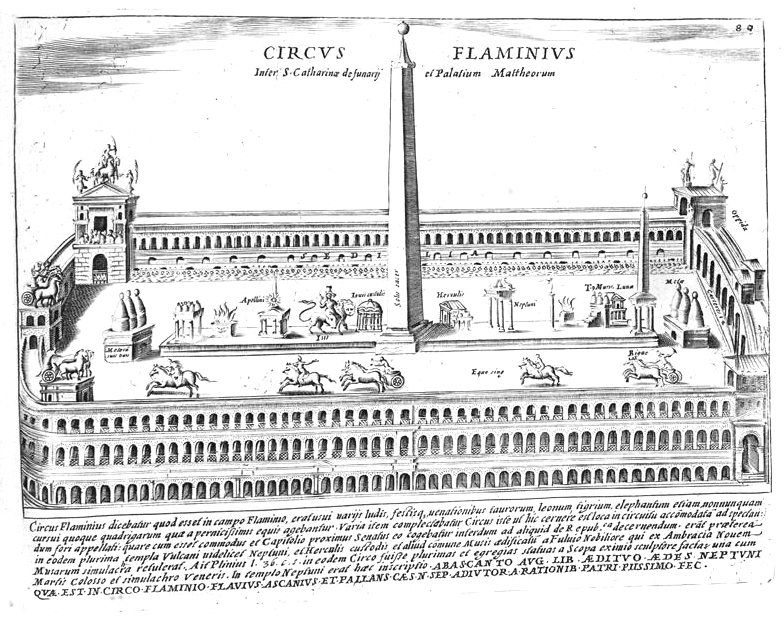
The Circus Flaminius was a large, circular area in ancient Rome, located in the southern end of the Campus Martius near the Tiber River. It contained a small race-track used for obscure games, and various other buildings and monuments. It was "built", or sectioned off, by Gaius Flaminius in 221 BC. After Augustus divided the city into 14 administrative regions, the Circus Flaminius gave its name to Regio IX, which encompassed the Circus and all of the Campus Martius west of the Via Lata.
In its early existence, the Circus was a loop, approximately 500 meters in length stretching across the Flaminian Fields (Prata Flaminia). Varro states that the actual Circus was built around the Fields, which were already a hallowed site for games by the time the Circus was laid in 220 BC. The ludi Taurei were hosted in the Fields since they were inaugurated by Rome's last king Lucius Tarquinius Superbus (d. 495 BC).
During the 2nd century BC, this broad space was encroached upon by buildings and monuments. The circus had no permanent seating, nor were there any permanent structures to mark the perimeter of the race track. By the early 3rd century AD, the only open space that remained was a small piazza in the center, no more than 300 meters long, where the ludi (public games) had always been held.
There were many structures in the vicinity of the circus (“in circo Flaminio”). The Temple of Pietas lay on the edge of the Forum Holitorium to the southeast. The Temple of Mars was situated in the northwest. It is estimated that by 220 BC there were six temples, including one to Apollo, in the Flaminian Fields. A theatre dedicated to Apollo was also set up in 179 BC, close to the temple of Apollo, and later rebuilt under the dictatorship of Caesar. The rebuilding of the theatre necessitated shortening the Circus itself, and required that several temples be destroyed.
The temple of Apollo "in circo" acquired special significance under Augustus, as a popular legend developed that he had been sired by the god while his mother Atia was visiting the temple. Augustus undertook myriad new constructions around the Circus, and probably had it paved for the first time. Most notably Augustus demolished the small theater dedicated to Apollo, as well as the temples of Diana and Pietas, to build the Theatre of Marcellus on the eastern side of the Circus. Augustus also built the Porticus Octaviae, which hemmed in the Circus on its northeastern side. Augustus' relation Lucius Marcius Phillipus restored the Temple of Hercules Musarum with a surrounding portico that could be accessed from the Circus.
In AD 15, statues to the deified Augustus were erected, dedicated by C. Norbanus Flaccus. In the early Principate two monumental arches were added at the north and south ends of the Circus, the northern one dedicated to Germanicus in the year of his death (19 CE), and the southern one to the stepson of Augustus, Drusus.
Beginning in the Renaissance, the Circus Flaminius was identified with the ancient arcades facing onto the Via delle Botteghe Oscure ("Street of Dark Shops"), so-called because in the Middle Ages the arcades had sheltered the workshops of artisans. This placed the Circus north of the porticus Phillipi between the Piazza Paganica and Piazza Margana. In the 1960s, this long-held identification was challenged by the joining of new fragments to the Forma Urbis, which identified the arcades as in fact belonging to the Theatre of Balbus and its connecting portico (the "Crypta Balbi" as the archaeological site is known). New excavations combined with the new configuration of the Marble Plan altered the understanding of where the Circus Flaminius was located, moving it southwest closer to the Tiber and placing it on a southeast–northwest axis.
A previously disregarded reference in the Mirabilia Urbis Romae ("Circus Flammineus Ad Pontem Ludeorum"), which placed it near the Pons Fabricius, and a fragment of the Marble Plan labelled "CIR FLAM" which fitted south of the Portico of Octavia, confirmed the Circus to be roughly located between the Tiber to the south and the Porticos of Octavia and Phillipus to the north, and hemmed in by the Theatre of Marcellus to the east.
Hub AI
Circus Flaminius AI simulator
(@Circus Flaminius_simulator)
Circus Flaminius
The Circus Flaminius was a large, circular area in ancient Rome, located in the southern end of the Campus Martius near the Tiber River. It contained a small race-track used for obscure games, and various other buildings and monuments. It was "built", or sectioned off, by Gaius Flaminius in 221 BC. After Augustus divided the city into 14 administrative regions, the Circus Flaminius gave its name to Regio IX, which encompassed the Circus and all of the Campus Martius west of the Via Lata.
In its early existence, the Circus was a loop, approximately 500 meters in length stretching across the Flaminian Fields (Prata Flaminia). Varro states that the actual Circus was built around the Fields, which were already a hallowed site for games by the time the Circus was laid in 220 BC. The ludi Taurei were hosted in the Fields since they were inaugurated by Rome's last king Lucius Tarquinius Superbus (d. 495 BC).
During the 2nd century BC, this broad space was encroached upon by buildings and monuments. The circus had no permanent seating, nor were there any permanent structures to mark the perimeter of the race track. By the early 3rd century AD, the only open space that remained was a small piazza in the center, no more than 300 meters long, where the ludi (public games) had always been held.
There were many structures in the vicinity of the circus (“in circo Flaminio”). The Temple of Pietas lay on the edge of the Forum Holitorium to the southeast. The Temple of Mars was situated in the northwest. It is estimated that by 220 BC there were six temples, including one to Apollo, in the Flaminian Fields. A theatre dedicated to Apollo was also set up in 179 BC, close to the temple of Apollo, and later rebuilt under the dictatorship of Caesar. The rebuilding of the theatre necessitated shortening the Circus itself, and required that several temples be destroyed.
The temple of Apollo "in circo" acquired special significance under Augustus, as a popular legend developed that he had been sired by the god while his mother Atia was visiting the temple. Augustus undertook myriad new constructions around the Circus, and probably had it paved for the first time. Most notably Augustus demolished the small theater dedicated to Apollo, as well as the temples of Diana and Pietas, to build the Theatre of Marcellus on the eastern side of the Circus. Augustus also built the Porticus Octaviae, which hemmed in the Circus on its northeastern side. Augustus' relation Lucius Marcius Phillipus restored the Temple of Hercules Musarum with a surrounding portico that could be accessed from the Circus.
In AD 15, statues to the deified Augustus were erected, dedicated by C. Norbanus Flaccus. In the early Principate two monumental arches were added at the north and south ends of the Circus, the northern one dedicated to Germanicus in the year of his death (19 CE), and the southern one to the stepson of Augustus, Drusus.
Beginning in the Renaissance, the Circus Flaminius was identified with the ancient arcades facing onto the Via delle Botteghe Oscure ("Street of Dark Shops"), so-called because in the Middle Ages the arcades had sheltered the workshops of artisans. This placed the Circus north of the porticus Phillipi between the Piazza Paganica and Piazza Margana. In the 1960s, this long-held identification was challenged by the joining of new fragments to the Forma Urbis, which identified the arcades as in fact belonging to the Theatre of Balbus and its connecting portico (the "Crypta Balbi" as the archaeological site is known). New excavations combined with the new configuration of the Marble Plan altered the understanding of where the Circus Flaminius was located, moving it southwest closer to the Tiber and placing it on a southeast–northwest axis.
A previously disregarded reference in the Mirabilia Urbis Romae ("Circus Flammineus Ad Pontem Ludeorum"), which placed it near the Pons Fabricius, and a fragment of the Marble Plan labelled "CIR FLAM" which fitted south of the Portico of Octavia, confirmed the Circus to be roughly located between the Tiber to the south and the Porticos of Octavia and Phillipus to the north, and hemmed in by the Theatre of Marcellus to the east.
Recent media