
Recent from talks
Clathrate gun hypothesis
Knowledge base stats:
Talk channels stats:
Members stats:
Clathrate gun hypothesis
The clathrate gun hypothesis is a proposed explanation for the periods of rapid warming during the Quaternary. The hypothesis is that changes in fluxes in upper intermediate waters in the ocean caused temperature fluctuations that alternately accumulated and occasionally released methane clathrate on upper continental slopes. This would have had an immediate impact on the global temperature, as methane is a much more powerful greenhouse gas than carbon dioxide. Despite its atmospheric lifetime of around 12 years, methane's global warming potential is 72 times greater than that of carbon dioxide over 20 years, and 25 times over 100 years (33 when accounting for aerosol interactions). It is further proposed that these warming events caused the Bond cycles and individual interstadial events, such as the Dansgaard–Oeschger interstadials.
The hypothesis was supported for the Bølling–Allerød warming and Preboreal periods, but not for Dansgaard–Oeschger interstadials, although there are still debates on the topic. While it may be important on the millennial timescales, it is no longer considered relevant for the near future climate change: the IPCC Sixth Assessment Report states "It is very unlikely that gas clathrates (mostly methane) in deeper terrestrial permafrost and subsea clathrates will lead to a detectable departure from the emissions trajectory during this century".
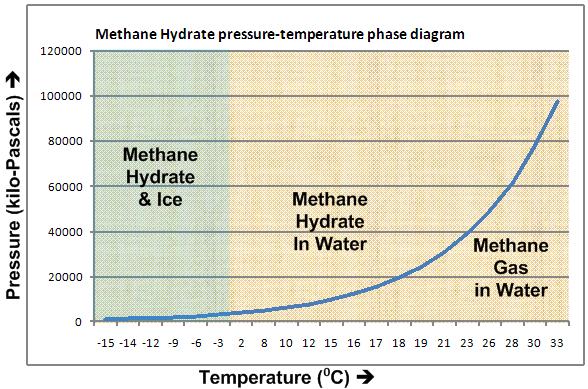
Methane clathrate, also known commonly as methane hydrate, is a form of water ice that contains a large amount of methane within its crystal structure. Potentially large deposits of methane clathrate have been found under sediments on the ocean floors of the Earth, although the estimates of total resource size given by various experts differ by many orders of magnitude, leaving doubt as to the size of methane clathrate deposits (particularly in the viability of extracting them as a fuel resource). Indeed, cores of greater than 10 centimeters' contiguous depth had only been found in three sites as of 2000, and some resource reserve size estimates for specific deposits/locations have been based primarily on seismology. The sudden release of large amounts of natural gas from methane clathrate deposits in runaway climate change could be a cause of past, future, and present climate changes.
In the Arctic Ocean, clathrates can exist in shallower water stabilized by lower temperatures rather than higher pressures; these may potentially be marginally stable much closer to the surface of the sea-bed, stabilized by a frozen 'lid' of permafrost preventing methane escape. The so-called self-preservation phenomenon has been studied by Russian geologists starting in the late 1980s. This metastable clathrate state can be a basis for release events of methane excursions, such as during the interval of the Last Glacial Maximum. A study from 2010 concluded with the possibility for a trigger of abrupt climate warming based on metastable methane clathrates in the East Siberian Arctic Shelf (ESAS) region.
Studies published in 2000 considered this hypothetical effect to be responsible for warming events in and at the end of the Last Glacial Maximum. Although periods of increased atmospheric methane match periods of continental-slope failure, later work found that the distinct deuterium/hydrogen (D/H) isotope ratio indicated that wetland methane emissions was the main contributor to atmospheric methane concentrations. While there were major dissociation events during the last deglaciation, with Bølling–Allerød warming triggering the disappearance of the entire methane hydrate deposit in the Barents Sea within 5000 years, those events failed to counteract the onset of a major Younger Dryas cooling period, suggesting that most of the methane stayed within the seawater after being liberated from the seafloor deposits, with very little entering the atmosphere.
In 2008, it was suggested that equatorial permafrost methane clathrate may have had a role in the sudden warm-up of "Snowball Earth", 630 million years ago.
Other events potentially linked to methane hydrate excursions are the Permian–Triassic extinction event and the Paleocene–Eocene Thermal Maximum.
The Paleocene–Eocene thermal maximum (PETM), alternatively "Eocene thermal maximum 1 (ETM1)" and formerly known as the "Initial Eocene" or "Late Paleocene thermal maximum", was a geologically brief time interval characterized by a 5–8 °C (9–14 °F) global average temperature rise and massive input of carbon into the ocean and atmosphere. The event began, now formally codified, at the precise time boundary between the Paleocene and Eocene geological epochs. The exact age and duration of the PETM remain uncertain, but it occurred around 55.8 million years ago (Ma) and lasted about 200 thousand years (Ka).
Hub AI
Clathrate gun hypothesis AI simulator
(@Clathrate gun hypothesis_simulator)
Clathrate gun hypothesis
The clathrate gun hypothesis is a proposed explanation for the periods of rapid warming during the Quaternary. The hypothesis is that changes in fluxes in upper intermediate waters in the ocean caused temperature fluctuations that alternately accumulated and occasionally released methane clathrate on upper continental slopes. This would have had an immediate impact on the global temperature, as methane is a much more powerful greenhouse gas than carbon dioxide. Despite its atmospheric lifetime of around 12 years, methane's global warming potential is 72 times greater than that of carbon dioxide over 20 years, and 25 times over 100 years (33 when accounting for aerosol interactions). It is further proposed that these warming events caused the Bond cycles and individual interstadial events, such as the Dansgaard–Oeschger interstadials.
The hypothesis was supported for the Bølling–Allerød warming and Preboreal periods, but not for Dansgaard–Oeschger interstadials, although there are still debates on the topic. While it may be important on the millennial timescales, it is no longer considered relevant for the near future climate change: the IPCC Sixth Assessment Report states "It is very unlikely that gas clathrates (mostly methane) in deeper terrestrial permafrost and subsea clathrates will lead to a detectable departure from the emissions trajectory during this century".
Methane clathrate, also known commonly as methane hydrate, is a form of water ice that contains a large amount of methane within its crystal structure. Potentially large deposits of methane clathrate have been found under sediments on the ocean floors of the Earth, although the estimates of total resource size given by various experts differ by many orders of magnitude, leaving doubt as to the size of methane clathrate deposits (particularly in the viability of extracting them as a fuel resource). Indeed, cores of greater than 10 centimeters' contiguous depth had only been found in three sites as of 2000, and some resource reserve size estimates for specific deposits/locations have been based primarily on seismology. The sudden release of large amounts of natural gas from methane clathrate deposits in runaway climate change could be a cause of past, future, and present climate changes.
In the Arctic Ocean, clathrates can exist in shallower water stabilized by lower temperatures rather than higher pressures; these may potentially be marginally stable much closer to the surface of the sea-bed, stabilized by a frozen 'lid' of permafrost preventing methane escape. The so-called self-preservation phenomenon has been studied by Russian geologists starting in the late 1980s. This metastable clathrate state can be a basis for release events of methane excursions, such as during the interval of the Last Glacial Maximum. A study from 2010 concluded with the possibility for a trigger of abrupt climate warming based on metastable methane clathrates in the East Siberian Arctic Shelf (ESAS) region.
Studies published in 2000 considered this hypothetical effect to be responsible for warming events in and at the end of the Last Glacial Maximum. Although periods of increased atmospheric methane match periods of continental-slope failure, later work found that the distinct deuterium/hydrogen (D/H) isotope ratio indicated that wetland methane emissions was the main contributor to atmospheric methane concentrations. While there were major dissociation events during the last deglaciation, with Bølling–Allerød warming triggering the disappearance of the entire methane hydrate deposit in the Barents Sea within 5000 years, those events failed to counteract the onset of a major Younger Dryas cooling period, suggesting that most of the methane stayed within the seawater after being liberated from the seafloor deposits, with very little entering the atmosphere.
In 2008, it was suggested that equatorial permafrost methane clathrate may have had a role in the sudden warm-up of "Snowball Earth", 630 million years ago.
Other events potentially linked to methane hydrate excursions are the Permian–Triassic extinction event and the Paleocene–Eocene Thermal Maximum.
The Paleocene–Eocene thermal maximum (PETM), alternatively "Eocene thermal maximum 1 (ETM1)" and formerly known as the "Initial Eocene" or "Late Paleocene thermal maximum", was a geologically brief time interval characterized by a 5–8 °C (9–14 °F) global average temperature rise and massive input of carbon into the ocean and atmosphere. The event began, now formally codified, at the precise time boundary between the Paleocene and Eocene geological epochs. The exact age and duration of the PETM remain uncertain, but it occurred around 55.8 million years ago (Ma) and lasted about 200 thousand years (Ka).
Recent media