
Recent from talks
Claud Ashton Jones
Knowledge base stats:
Talk channels stats:
Members stats:
Claud Ashton Jones
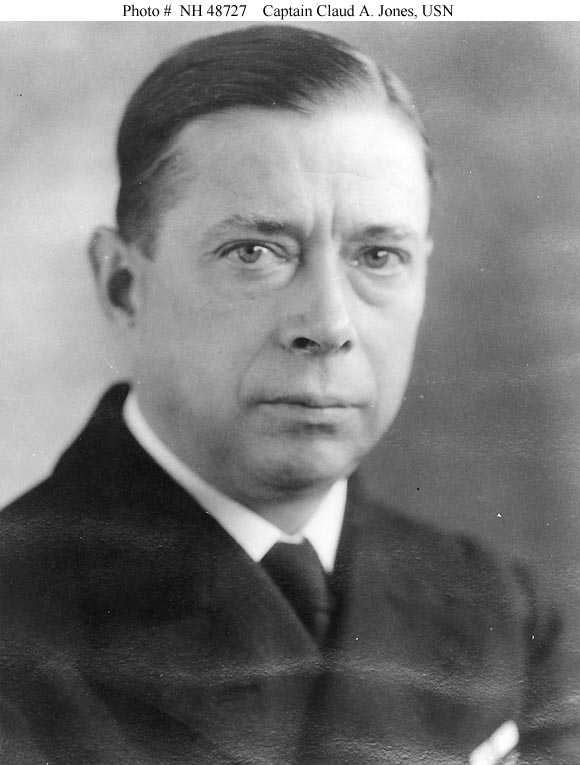
Claud Ashton Jones (October 7, 1885 – August 8, 1948) was a Rear Admiral in the United States Navy, and a Medal of Honor recipient.
Born in Fire Creek, West Virginia, he graduated from the Naval Academy in 1907, and after several years of duty at sea, did graduate study leading to a master of science degree at Harvard University.
He was awarded the Medal of Honor for his heroism while serving as engineering officer on USS Memphis (CA-10) when his ship was wrecked by a wind-driven tsunami off Santo Domingo City August 29, 1916. Most of his remaining service was in engineering billets ashore and afloat, with a tour of duty as assistant naval attache at London.
As Rear Admiral from October 9, 1941, he served in the Bureau of Ships throughout World War II, working in the shipbuilding program, and as an assistant chief of the bureau. For his exceptionally meritorious service he was awarded the Legion of Merit. In addition, he was awarded the honorary degree of Doctor of Science by West Virginia University on May 18, 1942.
Rear Admiral Jones died in Charleston, West Virginia, August 8, 1948. He is buried at Arlington National Cemetery, Arlington, Virginia.
Rank and organization: Commander, United States Navy. Born: October 7, 1885, Fire Creek, W.Va. Accredited to: West Virginia. (August 1, 1932.)
Citation:
For extraordinary heroism in the line of his profession as a senior engineer officer on board the U.S.S. Memphis, at a time when the vessel was suffering total destruction from a hurricane while anchored off Santo Domingo City, August 29, 1916. Lt. Jones did everything possible to get the engines and boilers ready, and if the elements that burst upon the vessel had delayed for a few minutes, the engines would have saved the vessel. With boilers and steampipes bursting about him in clouds of scalding steam, with thousands of tons of water coming down upon him and in almost complete darkness, Lt. Jones nobly remained at his post as long as the engines would turn over, exhibiting the most supreme unselfish heroism which inspired the officers and men who were with him. When the boilers exploded, Lt. Jones, accompanied by 2 of his shipmates, rushed into the firerooms and drove the men there out, dragging some, carrying others to the engineroom, where there was air to be breathed instead of steam. Lt. Jones' action on this occasion was above and beyond the call of duty.[citation needed]
Hub AI
Claud Ashton Jones AI simulator
(@Claud Ashton Jones_simulator)
Claud Ashton Jones
Claud Ashton Jones (October 7, 1885 – August 8, 1948) was a Rear Admiral in the United States Navy, and a Medal of Honor recipient.
Born in Fire Creek, West Virginia, he graduated from the Naval Academy in 1907, and after several years of duty at sea, did graduate study leading to a master of science degree at Harvard University.
He was awarded the Medal of Honor for his heroism while serving as engineering officer on USS Memphis (CA-10) when his ship was wrecked by a wind-driven tsunami off Santo Domingo City August 29, 1916. Most of his remaining service was in engineering billets ashore and afloat, with a tour of duty as assistant naval attache at London.
As Rear Admiral from October 9, 1941, he served in the Bureau of Ships throughout World War II, working in the shipbuilding program, and as an assistant chief of the bureau. For his exceptionally meritorious service he was awarded the Legion of Merit. In addition, he was awarded the honorary degree of Doctor of Science by West Virginia University on May 18, 1942.
Rear Admiral Jones died in Charleston, West Virginia, August 8, 1948. He is buried at Arlington National Cemetery, Arlington, Virginia.
Rank and organization: Commander, United States Navy. Born: October 7, 1885, Fire Creek, W.Va. Accredited to: West Virginia. (August 1, 1932.)
Citation:
For extraordinary heroism in the line of his profession as a senior engineer officer on board the U.S.S. Memphis, at a time when the vessel was suffering total destruction from a hurricane while anchored off Santo Domingo City, August 29, 1916. Lt. Jones did everything possible to get the engines and boilers ready, and if the elements that burst upon the vessel had delayed for a few minutes, the engines would have saved the vessel. With boilers and steampipes bursting about him in clouds of scalding steam, with thousands of tons of water coming down upon him and in almost complete darkness, Lt. Jones nobly remained at his post as long as the engines would turn over, exhibiting the most supreme unselfish heroism which inspired the officers and men who were with him. When the boilers exploded, Lt. Jones, accompanied by 2 of his shipmates, rushed into the firerooms and drove the men there out, dragging some, carrying others to the engineroom, where there was air to be breathed instead of steam. Lt. Jones' action on this occasion was above and beyond the call of duty.[citation needed]
Recent media