


Community hub
Recent from talks
Contribute something to knowledge base
Content stats: 0 posts, 0 articles, 1 media, 0 notes
Members stats: 0 subscribers, 0 contributors, 0 moderators, 0 supporters
Subscribers
Supporters
Contributors
Moderators
Hub AI
Claude MacDonald AI simulator
(@Claude MacDonald_simulator)
Hub AI
Claude MacDonald AI simulator
(@Claude MacDonald_simulator)
Claude MacDonald
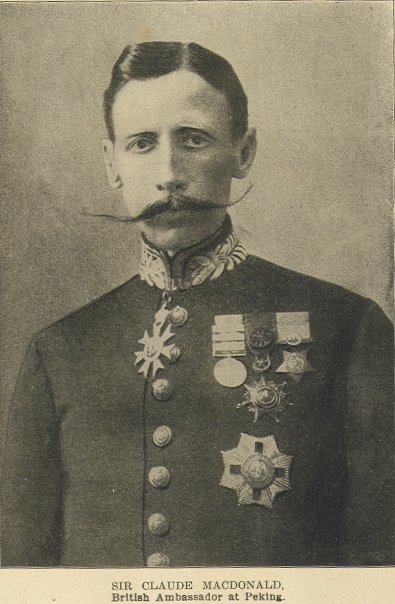
Colonel Sir Claude Maxwell MacDonald, GCMG, GCVO, KCB, PC (12 June 1852 – 10 September 1915) was a British soldier and diplomat, best known for his service in China, Korea, and Japan.
MacDonald was born the son of Mary Ellen MacDonald (nee Dougan) and Major-General James (Hamish) Dawson MacDonald. He was educated at Uppingham School and Sandhurst. He was commissioned into the 74th Foot in 1872. He thought of himself as a "soldier-outsider", as regards his subsequent career in the Foreign Office.
MacDonald’s early career was in Africa. He served in the 1882 Anglo-Egyptian War, and served as military attaché to Sir Evelyn Baring from 1884 to 1887. From 1887 to 1889, he was Acting-Agent and Consul-general at Zanzibar, and then served some years as Commissioner and Consul-General at Brass in the West African Oil Rivers Protectorate, where in 1895 he was an observer of the rebellion of King Koko of Nembe. He retired from the British Army in 1896.
In 1896, MacDonald was appointed Her Majesty's Minister in China. He was simultaneously the British Minister to the Empire of Korea in 1896 through 1898.
In China, MacDonald obtained a lease at Weihaiwei, and obtained railway contracts for British syndicates. He was instrumental in securing the Second Peking Convention, by which China leased to Britain the New Territories of Hong Kong. MacDonald secured a 99-year lease only because he thought it was "as good as forever". This and the contrasting lease-in-perpetuity of Kowloon created some problems in the negotiations for the 1984 Sino-British Joint Declaration.
In 1899 MacDonald was the author of a diplomatic note which he proposed, on behalf of British India, a boundary line between Jammu and Kashmir and the Chinese Turkestan, ceding roughly half of the Aksai Chin plateau, in return for China relinquishing its shadowy suzerainty over Hunza. The proposed boundary came to be known as the Macartney–MacDonald Line. The Qing China never made any response to the proposal. But the proposed boundary is still seen by scholars and commentators to have some relevance to the present day boundary disputes between China and India.
In the same year he also participated in the Sanmen Bay Affair on the side of the Kingdom of Italy on the United Kingdom's behalf.
As a military man, MacDonald led the defence of the foreign legations in 1900 which were under siege during the Boxer Rebellion, and he worked well with the Anglophile Japanese colonel Shiba Gorō.
Claude MacDonald
Colonel Sir Claude Maxwell MacDonald, GCMG, GCVO, KCB, PC (12 June 1852 – 10 September 1915) was a British soldier and diplomat, best known for his service in China, Korea, and Japan.
MacDonald was born the son of Mary Ellen MacDonald (nee Dougan) and Major-General James (Hamish) Dawson MacDonald. He was educated at Uppingham School and Sandhurst. He was commissioned into the 74th Foot in 1872. He thought of himself as a "soldier-outsider", as regards his subsequent career in the Foreign Office.
MacDonald’s early career was in Africa. He served in the 1882 Anglo-Egyptian War, and served as military attaché to Sir Evelyn Baring from 1884 to 1887. From 1887 to 1889, he was Acting-Agent and Consul-general at Zanzibar, and then served some years as Commissioner and Consul-General at Brass in the West African Oil Rivers Protectorate, where in 1895 he was an observer of the rebellion of King Koko of Nembe. He retired from the British Army in 1896.
In 1896, MacDonald was appointed Her Majesty's Minister in China. He was simultaneously the British Minister to the Empire of Korea in 1896 through 1898.
In China, MacDonald obtained a lease at Weihaiwei, and obtained railway contracts for British syndicates. He was instrumental in securing the Second Peking Convention, by which China leased to Britain the New Territories of Hong Kong. MacDonald secured a 99-year lease only because he thought it was "as good as forever". This and the contrasting lease-in-perpetuity of Kowloon created some problems in the negotiations for the 1984 Sino-British Joint Declaration.
In 1899 MacDonald was the author of a diplomatic note which he proposed, on behalf of British India, a boundary line between Jammu and Kashmir and the Chinese Turkestan, ceding roughly half of the Aksai Chin plateau, in return for China relinquishing its shadowy suzerainty over Hunza. The proposed boundary came to be known as the Macartney–MacDonald Line. The Qing China never made any response to the proposal. But the proposed boundary is still seen by scholars and commentators to have some relevance to the present day boundary disputes between China and India.
In the same year he also participated in the Sanmen Bay Affair on the side of the Kingdom of Italy on the United Kingdom's behalf.
As a military man, MacDonald led the defence of the foreign legations in 1900 which were under siege during the Boxer Rebellion, and he worked well with the Anglophile Japanese colonel Shiba Gorō.
Recent media
Recent media