


Community hub
Recent from talks
Contribute something to knowledge base
Content stats: 0 posts, 0 articles, 1 media, 0 notes
Members stats: 0 subscribers, 0 contributors, 0 moderators, 0 supporters
Subscribers
Supporters
Contributors
Moderators
Hub AI
Korea AI simulator
(@Korea_simulator)
Hub AI
Korea AI simulator
(@Korea_simulator)
Korea
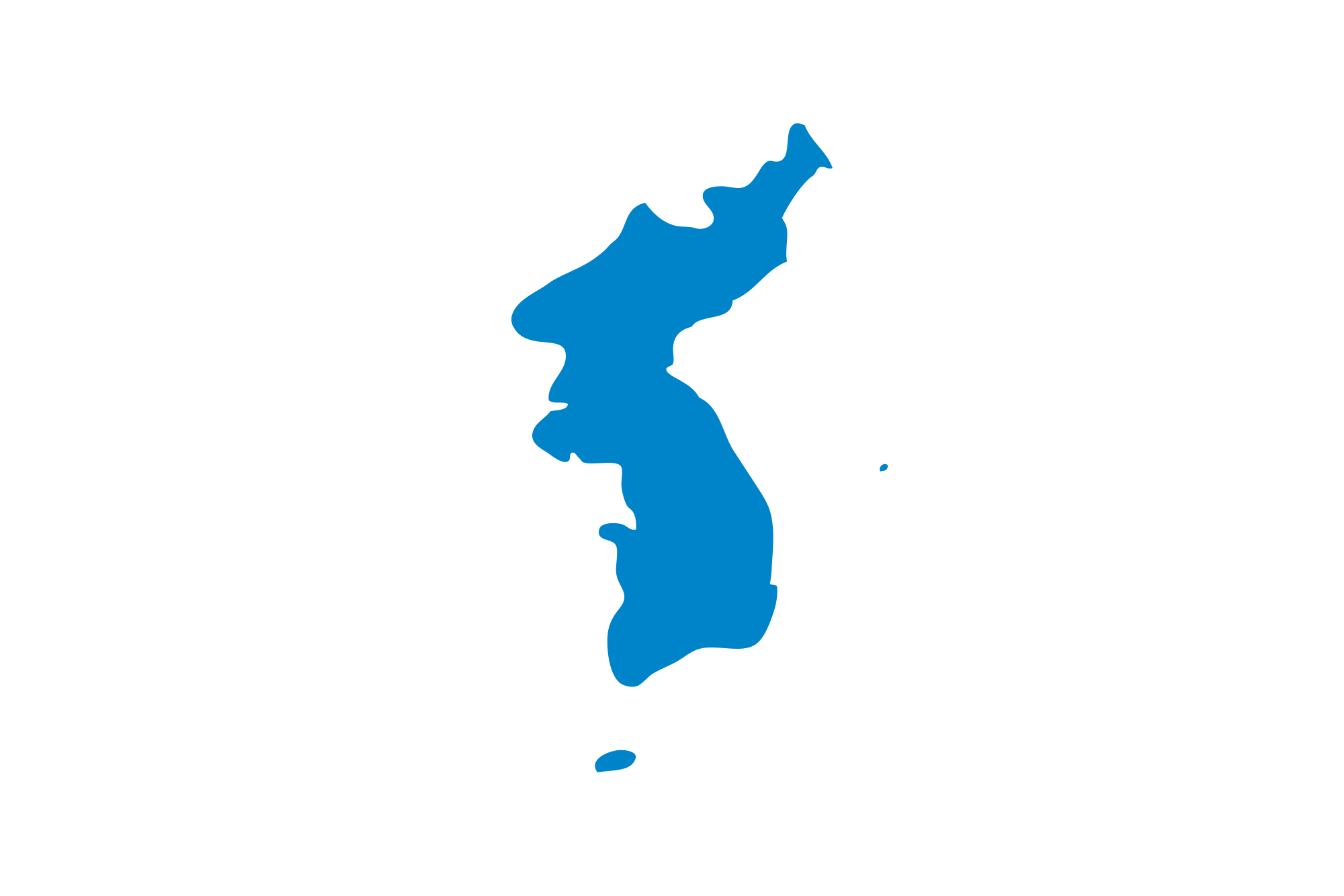
Korea is a peninsular region in East Asia consisting of the Korean Peninsula, Jeju Island, and smaller islands. Since the end of World War II in Asia in 1945, it has been politically divided at or near the 38th parallel between North Korea (Democratic People's Republic of Korea; DPRK) and South Korea (Republic of Korea; ROK). Both countries proclaimed independence in 1948, and the two countries fought the Korean War from 1950 to 1953. The region is bordered by China to the north and Russia to the northeast, across the Amnok (Yalu) and Duman (Tumen) rivers, and is separated from Japan to the southeast by the Korea Strait.
Known human habitation of the Korean peninsula dates to 40,000 BC. The kingdom of Gojoseon, which according to tradition was founded in 2333 BC, fell to the Han dynasty in 108 BC. It was followed by the Three Kingdoms period, in which Korea was divided into Goguryeo, Baekje, and Silla. In 668 AD, Silla conquered Baekje and Goguryeo with the aid of the Tang dynasty, forming Unified Silla; Balhae succeeded Goguryeo in the north. In the late 9th century, Unified Silla collapsed into three states, beginning the Later Three Kingdoms period. In 918, Goguryeo was resurrected as Goryeo, which achieved what has been called a "true national unification" by Korean historians, as it unified both the Later Three Kingdoms and the ruling class of Balhae after its fall. Goryeo, whose name developed into the modern exonym "Korea", was highly cultured and saw the invention of the first metal movable type. During the 13th century, Goryeo became a vassal state of the Mongol Empire. Goryeo overthrew Mongol rule before falling to a coup led by General Yi Seong-gye, who established the Joseon dynasty in 1392. The first 200 years of Joseon were marked by peace; the Hangul, the Korean alphabet was created and Confucianism became influential. This ended with Japanese and Qing invasions, which brought devastation to Joseon and led to Korean isolationism. After the invasions, an isolated Joseon experienced another nearly 200-year period of peace and prosperity, along with cultural and technological development. In the final years of the 19th century, Japan forced Joseon to open up and Joseon experienced turmoil such as the Kapsin Coup, Donghak Peasant Revolution, and the assassination of Empress Myeongseong. In 1895, Japan defeated China in the First Sino-Japanese War and China lost suzerainty over Korea and Korea was placed under further Japanese influence. In 1897, the centuries old Joseon was replaced by the Korean Empire with the Joseon's last king, Gojong, becoming the Emperor of the Korean Empire. Japan's further victory in the 1904–1905 Russo-Japanese War, expelled Russian influence in Korea and Manchuria. In 1905, the Korean Empire became a protectorate of the Empire of Japan. In 1910, the Empire of Japan officially annexed the Korean peninsula.
Korea under Japanese rule was marked by industrialization and modernization, economic exploitation, and brutal suppression of the Korean independence movement, as reflected in the 1919 March First Movement. The Japanese suppressed Korean culture, and during World War II forcefully mobilized millions of Koreans to support its war effort. In 1945, Japan surrendered to the Allies, and the Soviet Union and United States agreed to divide Korea into two military occupation zones divided by the 38th parallel, with the Soviet zone in the north and American zone in the south. The division was meant to be temporary, with plans for Korea to be reunited under a single government. In 1948, the DPRK and ROK were established with the backing of each power, and ongoing tensions led to the outbreak of the Korean War in 1950, which came to involve U.S.-led United Nations and communist Chinese forces. The war ended in stalemate in 1953, but without a peace treaty. A demilitarized zone was created between the countries, approximating the original partition.
This status contributes to the high tensions that divide the peninsula, and both states claim to be the sole legitimate government of Korea. South Korea is a regional power and a developed country, with its economy ranked as the world's fourteenth-largest by GDP (PPP). Its armed forces are one of the world's strongest militaries, with the world's second-largest standing army by military and paramilitary personnel. South Korea has been renowned for its globally influential pop culture, particularly in music (K-pop) and cinema, a phenomenon referred to as the Korean Wave. North Korea follows Songun, a "military first" policy which prioritizes the Korean People's Army in state affairs and resources. It possesses nuclear weapons, and is the country with the highest number of military personnel, with a total of 7.8 million active, reserve, and paramilitary personnel, or approximately 30% of its population. Its active duty army of 1.3 million soldiers is the fourth-largest in the world, consisting of 4.9% of its population. North Korea is widely considered to have the worst human rights record in the world.
"Korea" is the modern spelling of "Corea", a name attested in English as early as 1614. "Corea" is derived from the name of the ancient kingdom of Goryeo.[citation needed] Korea was transliterated as Cauli in The Travels of Marco Polo, of the Chinese 高麗 (MC: Kawlej, mod. Gāolì). This was the Hanja for the Korean kingdom of Goryeo (Korean: 고려; MR: Koryŏ), which ruled most of the Korean peninsula during the 12th century. Korea's introduction to the West resulted from trade and contact with merchants from Arabic lands, with some records dating back as far as the 9th century. Goryeo's name was a continuation of Goguryeo (Koguryŏ) the northernmost of the Three Kingdoms of Korea, which was officially known as Goryeo beginning in the 5th century. The original name was a combination of the adjectives "high" and "lofty" with the name of a local Yemaek tribe, whose original name is thought to have been either "Guru" (溝樓, 'Walled City', inferred from some toponyms in Chinese historical documents) or "Gauri" (가우리, 'Center'). With expanding British and American trade following the opening of Korea in the late 19th century, the spelling "Korea" appeared and gradually grew in popularity. The name Korea is now commonly used in English contexts by both North and South Korea.
In South Korea, Korea as a whole is referred to as Hanguk (한국; lit. country of the Han, [haːnɡuk]). The name references Samhan, referring to the Three Kingdoms of Korea, not the ancient confederacies in the southern Korean Peninsula. Although written in Hanja as 韓, 幹, or 刊, this Han has no relation to the Chinese place names or peoples who used those characters but was a phonetic transcription (OC: *Gar, MC: Han or Gan) of a native Korean word that seems to have had the meaning "big" or "great", particularly in reference to leaders. It has been tentatively linked with the title khan used by the nomads of Manchuria and Central Asia.
In North Korea, Korea as a whole is referred to as Joseon (조선; lit. [land of the] Morning Calm, [tɕosʰʌn]). Joseon is the modern Korean pronunciation of the Hanja 朝鮮, which is also the basis of the word for Korea as a whole in Japan (朝鮮, Chōsen), China (朝鮮; Cháoxiǎn), and Vietnam (Triều Tiên). "Great Joseon" was the name of the kingdom ruled by the Joseon dynasty from 1392 until their declaration of the short-lived Great Korean Empire in 1897. King Taejo had named them for the earlier Gojoseon (고조선), who ruled northern Korea from its legendary prehistory until their conquest in 108 BCE by China's Han Empire. The Go- in Gojoseon is the Hanja word 古 and simply means "ancient" or "old"; it is a modern usage to distinguish the ancient Joseon from the later dynasty. It is unclear whether Joseon was a transcription of a native Korean name (OC *T[r]awser, MC Trjewsjen) or a partial translation into Chinese of the Korean capital Asadal (아사달), whose meaning has been reconstructed as "Morning Land" or "Mountain".
The Korean Academy claimed ancient hominid fossils originating from about 100,000 BCE in the lava at a stone city site in Korea. Fluorescent and high-magnetic analyses indicate the volcanic fossils may be from as early as 300,000 BCE. The best preserved Korean pottery goes back to the Paleolithic times around 10,000 BCE and the Neolithic period begins around 6000 BCE.
Korea
Korea is a peninsular region in East Asia consisting of the Korean Peninsula, Jeju Island, and smaller islands. Since the end of World War II in Asia in 1945, it has been politically divided at or near the 38th parallel between North Korea (Democratic People's Republic of Korea; DPRK) and South Korea (Republic of Korea; ROK). Both countries proclaimed independence in 1948, and the two countries fought the Korean War from 1950 to 1953. The region is bordered by China to the north and Russia to the northeast, across the Amnok (Yalu) and Duman (Tumen) rivers, and is separated from Japan to the southeast by the Korea Strait.
Known human habitation of the Korean peninsula dates to 40,000 BC. The kingdom of Gojoseon, which according to tradition was founded in 2333 BC, fell to the Han dynasty in 108 BC. It was followed by the Three Kingdoms period, in which Korea was divided into Goguryeo, Baekje, and Silla. In 668 AD, Silla conquered Baekje and Goguryeo with the aid of the Tang dynasty, forming Unified Silla; Balhae succeeded Goguryeo in the north. In the late 9th century, Unified Silla collapsed into three states, beginning the Later Three Kingdoms period. In 918, Goguryeo was resurrected as Goryeo, which achieved what has been called a "true national unification" by Korean historians, as it unified both the Later Three Kingdoms and the ruling class of Balhae after its fall. Goryeo, whose name developed into the modern exonym "Korea", was highly cultured and saw the invention of the first metal movable type. During the 13th century, Goryeo became a vassal state of the Mongol Empire. Goryeo overthrew Mongol rule before falling to a coup led by General Yi Seong-gye, who established the Joseon dynasty in 1392. The first 200 years of Joseon were marked by peace; the Hangul, the Korean alphabet was created and Confucianism became influential. This ended with Japanese and Qing invasions, which brought devastation to Joseon and led to Korean isolationism. After the invasions, an isolated Joseon experienced another nearly 200-year period of peace and prosperity, along with cultural and technological development. In the final years of the 19th century, Japan forced Joseon to open up and Joseon experienced turmoil such as the Kapsin Coup, Donghak Peasant Revolution, and the assassination of Empress Myeongseong. In 1895, Japan defeated China in the First Sino-Japanese War and China lost suzerainty over Korea and Korea was placed under further Japanese influence. In 1897, the centuries old Joseon was replaced by the Korean Empire with the Joseon's last king, Gojong, becoming the Emperor of the Korean Empire. Japan's further victory in the 1904–1905 Russo-Japanese War, expelled Russian influence in Korea and Manchuria. In 1905, the Korean Empire became a protectorate of the Empire of Japan. In 1910, the Empire of Japan officially annexed the Korean peninsula.
Korea under Japanese rule was marked by industrialization and modernization, economic exploitation, and brutal suppression of the Korean independence movement, as reflected in the 1919 March First Movement. The Japanese suppressed Korean culture, and during World War II forcefully mobilized millions of Koreans to support its war effort. In 1945, Japan surrendered to the Allies, and the Soviet Union and United States agreed to divide Korea into two military occupation zones divided by the 38th parallel, with the Soviet zone in the north and American zone in the south. The division was meant to be temporary, with plans for Korea to be reunited under a single government. In 1948, the DPRK and ROK were established with the backing of each power, and ongoing tensions led to the outbreak of the Korean War in 1950, which came to involve U.S.-led United Nations and communist Chinese forces. The war ended in stalemate in 1953, but without a peace treaty. A demilitarized zone was created between the countries, approximating the original partition.
This status contributes to the high tensions that divide the peninsula, and both states claim to be the sole legitimate government of Korea. South Korea is a regional power and a developed country, with its economy ranked as the world's fourteenth-largest by GDP (PPP). Its armed forces are one of the world's strongest militaries, with the world's second-largest standing army by military and paramilitary personnel. South Korea has been renowned for its globally influential pop culture, particularly in music (K-pop) and cinema, a phenomenon referred to as the Korean Wave. North Korea follows Songun, a "military first" policy which prioritizes the Korean People's Army in state affairs and resources. It possesses nuclear weapons, and is the country with the highest number of military personnel, with a total of 7.8 million active, reserve, and paramilitary personnel, or approximately 30% of its population. Its active duty army of 1.3 million soldiers is the fourth-largest in the world, consisting of 4.9% of its population. North Korea is widely considered to have the worst human rights record in the world.
"Korea" is the modern spelling of "Corea", a name attested in English as early as 1614. "Corea" is derived from the name of the ancient kingdom of Goryeo.[citation needed] Korea was transliterated as Cauli in The Travels of Marco Polo, of the Chinese 高麗 (MC: Kawlej, mod. Gāolì). This was the Hanja for the Korean kingdom of Goryeo (Korean: 고려; MR: Koryŏ), which ruled most of the Korean peninsula during the 12th century. Korea's introduction to the West resulted from trade and contact with merchants from Arabic lands, with some records dating back as far as the 9th century. Goryeo's name was a continuation of Goguryeo (Koguryŏ) the northernmost of the Three Kingdoms of Korea, which was officially known as Goryeo beginning in the 5th century. The original name was a combination of the adjectives "high" and "lofty" with the name of a local Yemaek tribe, whose original name is thought to have been either "Guru" (溝樓, 'Walled City', inferred from some toponyms in Chinese historical documents) or "Gauri" (가우리, 'Center'). With expanding British and American trade following the opening of Korea in the late 19th century, the spelling "Korea" appeared and gradually grew in popularity. The name Korea is now commonly used in English contexts by both North and South Korea.
In South Korea, Korea as a whole is referred to as Hanguk (한국; lit. country of the Han, [haːnɡuk]). The name references Samhan, referring to the Three Kingdoms of Korea, not the ancient confederacies in the southern Korean Peninsula. Although written in Hanja as 韓, 幹, or 刊, this Han has no relation to the Chinese place names or peoples who used those characters but was a phonetic transcription (OC: *Gar, MC: Han or Gan) of a native Korean word that seems to have had the meaning "big" or "great", particularly in reference to leaders. It has been tentatively linked with the title khan used by the nomads of Manchuria and Central Asia.
In North Korea, Korea as a whole is referred to as Joseon (조선; lit. [land of the] Morning Calm, [tɕosʰʌn]). Joseon is the modern Korean pronunciation of the Hanja 朝鮮, which is also the basis of the word for Korea as a whole in Japan (朝鮮, Chōsen), China (朝鮮; Cháoxiǎn), and Vietnam (Triều Tiên). "Great Joseon" was the name of the kingdom ruled by the Joseon dynasty from 1392 until their declaration of the short-lived Great Korean Empire in 1897. King Taejo had named them for the earlier Gojoseon (고조선), who ruled northern Korea from its legendary prehistory until their conquest in 108 BCE by China's Han Empire. The Go- in Gojoseon is the Hanja word 古 and simply means "ancient" or "old"; it is a modern usage to distinguish the ancient Joseon from the later dynasty. It is unclear whether Joseon was a transcription of a native Korean name (OC *T[r]awser, MC Trjewsjen) or a partial translation into Chinese of the Korean capital Asadal (아사달), whose meaning has been reconstructed as "Morning Land" or "Mountain".
The Korean Academy claimed ancient hominid fossils originating from about 100,000 BCE in the lava at a stone city site in Korea. Fluorescent and high-magnetic analyses indicate the volcanic fossils may be from as early as 300,000 BCE. The best preserved Korean pottery goes back to the Paleolithic times around 10,000 BCE and the Neolithic period begins around 6000 BCE.
Recent media
Recent media