


Community hub
Recent from talks
Contribute something to knowledge base
Content stats: 0 posts, 0 articles, 1 media, 0 notes
Members stats: 0 subscribers, 0 contributors, 0 moderators, 0 supporters
Subscribers
Supporters
Contributors
Moderators
Hub AI
Clave (rhythm) AI simulator
(@Clave (rhythm)_simulator)
Hub AI
Clave (rhythm) AI simulator
(@Clave (rhythm)_simulator)
Clave (rhythm)
The clave (/ˈklɑːveɪ, kleɪv/; Spanish: [ˈklaβe]) is a rhythmic pattern used as a tool for temporal organization in Brazilian and Cuban music. In Spanish, clave literally means key, clef, code, or keystone. It is present in a variety of genres such as Abakuá music, rumba, conga, son, mambo, salsa, songo, timba and Afro-Cuban jazz. The five-stroke clave pattern represents the structural core of many Cuban rhythms. The study of rhythmic methodology, especially in the context of Afro-Cuban music, and how it influences the mood of a piece is known as clave theory.
The clave pattern originated in sub-Saharan African music traditions, where it serves essentially the same function as it does in Cuba. [citation needed] In ethnomusicology, clave is also known as a key pattern, guide pattern, phrasing referent, timeline, or asymmetrical timeline. The clave pattern is also found in the African diaspora music of Haitian Vodou drumming, Afro-Brazilian music, African-American music, Louisiana Voodoo drumming, and Afro-Uruguayan music (candombe). The clave pattern (or hambone, as it is known in the United States) is used in North American popular music as a rhythmic motif or simply a form of rhythmic decoration.
The historical roots of the clave are linked to transnational musical exchanges within the African diaspora. For instance, influences of the African “bomba” rhythm are reflected in the clave. In addition to this, the emphasis and role of the drum within the rhythmic patterns speaks further to these diasporic roots.
The clave is the foundation of reggae, reggaeton, and dancehall. In this sense, it is the “heartbeat” that underlies the essence of these genres. The rhythms and vibrations are universalized in that they demonstrate a shared cultural experience and knowledge of these roots. Ultimately, this embodies the diasporic transnational exchange.
In considering the clave as this basis of cultural understanding, relation, and exchange, this speaks to the transnational influence and interconnectedness of various communities. This musical fusion is essentially what constitutes the flow and foundational “heartbeat” of a variety of genres.
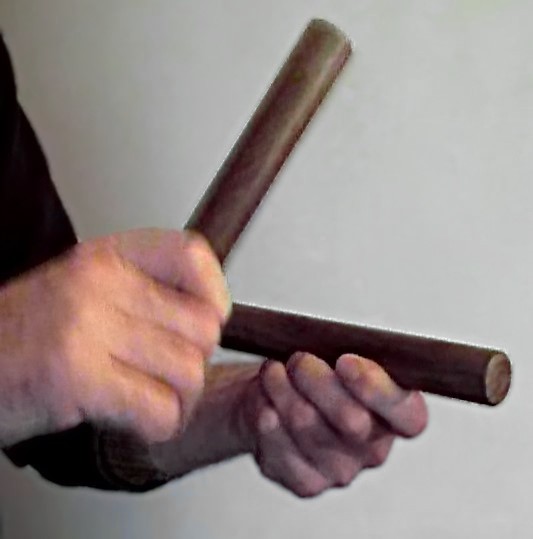
Clave is a Spanish word meaning 'code,' 'key,' as in key to a mystery or puzzle, or 'keystone,' the wedge-shaped stone in the center of an arch that ties the other stones together. The rhythm also gave the name to the claves Afro-Cuban musical instrument which consists of a pair of hardwood sticks.
The clave pattern holds the rhythm together in Afro-Cuban music. The two main clave patterns used in Afro-Cuban music are known in North America as son clave and the rumba clave. Both are used as bell patterns across much of Africa. Son and rumba clave can be played in either a triple-pulse (12
8 or 6
8) or duple-pulse (4
4, 2
4 or 2
2) structure. The contemporary Cuban practice is to write the duple-pulse clave in a single measure of 4
4. It is also written in a single measure in ethnomusicological writings about African music.
Although they subdivide the beats differently, the 12
8 and 4
4 versions of each clave share the same pulse names. The correlation between the triple-pulse and duple-pulse forms of clave, as well as other patterns, is an important dynamic of sub-Saharan-based rhythm. Every triple-pulse pattern has its duple-pulse correlative.
Clave (rhythm)
The clave (/ˈklɑːveɪ, kleɪv/; Spanish: [ˈklaβe]) is a rhythmic pattern used as a tool for temporal organization in Brazilian and Cuban music. In Spanish, clave literally means key, clef, code, or keystone. It is present in a variety of genres such as Abakuá music, rumba, conga, son, mambo, salsa, songo, timba and Afro-Cuban jazz. The five-stroke clave pattern represents the structural core of many Cuban rhythms. The study of rhythmic methodology, especially in the context of Afro-Cuban music, and how it influences the mood of a piece is known as clave theory.
The clave pattern originated in sub-Saharan African music traditions, where it serves essentially the same function as it does in Cuba. [citation needed] In ethnomusicology, clave is also known as a key pattern, guide pattern, phrasing referent, timeline, or asymmetrical timeline. The clave pattern is also found in the African diaspora music of Haitian Vodou drumming, Afro-Brazilian music, African-American music, Louisiana Voodoo drumming, and Afro-Uruguayan music (candombe). The clave pattern (or hambone, as it is known in the United States) is used in North American popular music as a rhythmic motif or simply a form of rhythmic decoration.
The historical roots of the clave are linked to transnational musical exchanges within the African diaspora. For instance, influences of the African “bomba” rhythm are reflected in the clave. In addition to this, the emphasis and role of the drum within the rhythmic patterns speaks further to these diasporic roots.
The clave is the foundation of reggae, reggaeton, and dancehall. In this sense, it is the “heartbeat” that underlies the essence of these genres. The rhythms and vibrations are universalized in that they demonstrate a shared cultural experience and knowledge of these roots. Ultimately, this embodies the diasporic transnational exchange.
In considering the clave as this basis of cultural understanding, relation, and exchange, this speaks to the transnational influence and interconnectedness of various communities. This musical fusion is essentially what constitutes the flow and foundational “heartbeat” of a variety of genres.
Clave is a Spanish word meaning 'code,' 'key,' as in key to a mystery or puzzle, or 'keystone,' the wedge-shaped stone in the center of an arch that ties the other stones together. The rhythm also gave the name to the claves Afro-Cuban musical instrument which consists of a pair of hardwood sticks.
The clave pattern holds the rhythm together in Afro-Cuban music. The two main clave patterns used in Afro-Cuban music are known in North America as son clave and the rumba clave. Both are used as bell patterns across much of Africa. Son and rumba clave can be played in either a triple-pulse (12
8 or 6
8) or duple-pulse (4
4, 2
4 or 2
2) structure. The contemporary Cuban practice is to write the duple-pulse clave in a single measure of 4
4. It is also written in a single measure in ethnomusicological writings about African music.
Although they subdivide the beats differently, the 12
8 and 4
4 versions of each clave share the same pulse names. The correlation between the triple-pulse and duple-pulse forms of clave, as well as other patterns, is an important dynamic of sub-Saharan-based rhythm. Every triple-pulse pattern has its duple-pulse correlative.
Recent media
Recent media