
Recent from talks
Climate change in Antarctica
Knowledge base stats:
Talk channels stats:
Members stats:
Climate change in Antarctica
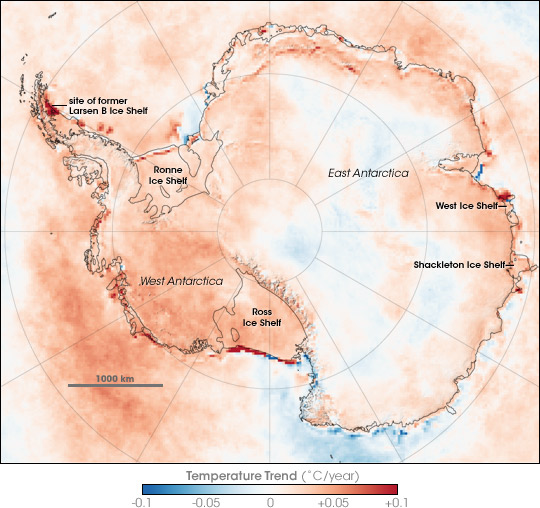
Despite its isolation, Antarctica has experienced warming and ice loss in recent decades, driven by greenhouse gas emissions. West Antarctica warmed by over 0.1 °C per decade from the 1950s to the 2000s, and the exposed Antarctic Peninsula has warmed by 3 °C (5.4 °F) since the mid-20th century. The colder, stabler East Antarctica did not show any warming until the 2000s. Around Antarctica, the Southern Ocean has absorbed more oceanic heat than any other ocean, and has seen strong warming at depths below 2,000 m (6,600 ft). Around the West Antarctic, the ocean has warmed by 1 °C (1.8 °F) since 1955.
The warming of the Southern Ocean around Antarctica has caused the weakening or collapse of ice shelves, which float just offshore of glaciers and stabilize them. Many coastal glaciers have been losing mass and retreating, causing net ice loss across Antarctica, although the East Antarctic ice sheet continues to gain ice inland. By 2100, net ice loss from Antarctica is expected to add about 11 cm (5 in) to global sea-level rise. Marine ice sheet instability may cause West Antarctica to contribute tens of centimeters more if it is triggered before 2100. With higher warming, instability would be much more likely, and could double global, 21st-century sea-level rise.
The fresh meltwater from the ice dilutes the saline Antarctic bottom water, weakening the lower cell of the Southern Ocean overturning circulation (SOOC). According to some research, a full collapse of the SOOC may occur at between 1.7 °C (3.1 °F) and 3 °C (5.4 °F) of global warming, although the full effects are expected to occur over multiple centuries; these include less precipitation in the Southern Hemisphere but more in the Northern Hemisphere, an eventual decline of fisheries in the Southern Ocean and a potential collapse of certain marine ecosystems. While many Antarctic species remain undiscovered, there are documented increases in Antarctic flora, and large fauna such as penguins are already having difficulty retaining suitable habitat. On ice-free land, permafrost thaws release greenhouse gases and formerly frozen pollution.
The West Antarctic ice sheet is likely to completely melt unless temperatures are reduced by 2 °C (3.6 °F) below 2020 levels. The loss of this ice sheet would take between 500 and 13,000 years. A sea-level rise of 3.3 m (10 ft 10 in) would occur if the ice sheet collapses, leaving ice caps on the mountains, and 4.3 m (14 ft 1 in) if those ice caps also melt. The far-stabler East Antarctic ice sheet may only cause a sea-level rise of 0.5 m (1 ft 8 in) – 0.9 m (2 ft 11 in) from the current level of warming, a small fraction of the 53.3 m (175 ft) contained in the full ice sheet. With global warming of around 3 °C (5.4 °F), vulnerable areas like Wilkes Basin and Aurora Basin may collapse over around 2,000 years, potentially adding up to 6.4 m (21 ft 0 in) to sea levels.
Antarctica is the coldest, driest continent on Earth, and has the highest average elevation. Antarctica's dryness means the air contains little water vapor and conducts heat poorly. The Southern Ocean surrounding the continent is far more effective at absorbing heat than any other ocean. The presence of extensive, year-round sea ice, which has a high albedo (reflectivity), adds to the albedo of the ice sheets' own bright, white surface. Antarctica's coldness means it is the only place on Earth where an atmospheric temperature inversion occurs every winter; elsewhere on Earth, the atmosphere is at its warmest near the surface and becomes cooler as elevation increases. During the Antarctic winter, the surface of central Antarctica becomes cooler than middle layers of the atmosphere; this means greenhouse gases trap heat in the middle atmosphere, and reduce its flow toward the surface and toward space, rather than preventing the flow of heat from the lower atmosphere to the upper layers. This effect lasts until the end of the Antarctic winter. Early climate models predicted temperature trends over Antarctica would emerge more slowly and be more subtle than those elsewhere.
There were fewer than twenty permanent weather stations across the continent and only two in the continent's interior. Automatic weather stations were deployed relatively late, and their observational record was brief for much of the 20th century satellite temperature measurements began in 1981 and are typically limited to cloud-free conditions. Thus, datasets representing the entire continent only began to appear by the very end of the 20th century.[failed verification] The exception was the Antarctic Peninsula, where warming was pronounced and well-documented; it was eventually found to have warmed by 3 °C (5.4 °F) since the mid 20th century. Based on this limited data, several papers published in the early 2000s said there had been an overall cooling over continental Antarctica outside the Peninsula. In particular, a 2002 analysis led by Peter Doran indicated stronger cooling than warming over Antarctica between 1966 and 2000, and found the McMurdo Dry Valleys in East Antarctica had experienced cooling of 0.7 °C per decade. The paper noted that its data was limited, and it still found warming over 42% of the continent.
Nevertheless, the paper received widespread media coverage, as multiple journalists described these findings as "contradictory" to global warming, which was criticized by scientists at the time. The "controversy" around cooling of Antarctica received further attention in 2004 when Michael Crichton wrote the novel State of Fear. The novel featured a fictional conspiracy among climate scientists to fake evidence of global warming, and cited Doran's study as proof that there was no warming in Antarctica outside of the Peninsula. That novel was mentioned in a 2006 US Senate hearing in support of climate change denial, and Peter Doran published a statement in The New York Times decrying the misinterpretation of his work. The British Antarctic Survey and NASA also issued statements affirming the strength of climate science after the hearing.
By 2009, researchers were able to combine historical weather-station data with satellite measurements to create consistent temperature records going back to 1957 that demonstrated warming of >0.05 °C per decade across the continent, with cooling in East Antarctica offset by the average temperature increase of at least 0.176 ± 0.06 °C per decade in West Antarctica. That paper was widely reported on, and subsequent research confirmed clear warming over West Antarctica in the 20th century, with the only uncertainty being the magnitude. During 2012–2013, estimates based on WAIS Divide ice cores and revised temperature records from Byrd Station suggested a much-larger West-Antarctica warming of 2.4 °C (4.3 °F) since 1958, or around 0.46 °C (0.83 °F) per decade, although some scientists continued to emphasize uncertainty. In 2022, a study narrowed the warming of the Central area of the West Antarctic Ice Sheet between 1959 and 2000 to 0.31 °C (0.56 °F) per decade, and conclusively attributed it to increases in greenhouse gas concentrations caused by human activity. Likewise, the strong cooling at McMurdo Dry Valleys was confirmed to be a local trend.
Hub AI
Climate change in Antarctica AI simulator
(@Climate change in Antarctica_simulator)
Climate change in Antarctica
Despite its isolation, Antarctica has experienced warming and ice loss in recent decades, driven by greenhouse gas emissions. West Antarctica warmed by over 0.1 °C per decade from the 1950s to the 2000s, and the exposed Antarctic Peninsula has warmed by 3 °C (5.4 °F) since the mid-20th century. The colder, stabler East Antarctica did not show any warming until the 2000s. Around Antarctica, the Southern Ocean has absorbed more oceanic heat than any other ocean, and has seen strong warming at depths below 2,000 m (6,600 ft). Around the West Antarctic, the ocean has warmed by 1 °C (1.8 °F) since 1955.
The warming of the Southern Ocean around Antarctica has caused the weakening or collapse of ice shelves, which float just offshore of glaciers and stabilize them. Many coastal glaciers have been losing mass and retreating, causing net ice loss across Antarctica, although the East Antarctic ice sheet continues to gain ice inland. By 2100, net ice loss from Antarctica is expected to add about 11 cm (5 in) to global sea-level rise. Marine ice sheet instability may cause West Antarctica to contribute tens of centimeters more if it is triggered before 2100. With higher warming, instability would be much more likely, and could double global, 21st-century sea-level rise.
The fresh meltwater from the ice dilutes the saline Antarctic bottom water, weakening the lower cell of the Southern Ocean overturning circulation (SOOC). According to some research, a full collapse of the SOOC may occur at between 1.7 °C (3.1 °F) and 3 °C (5.4 °F) of global warming, although the full effects are expected to occur over multiple centuries; these include less precipitation in the Southern Hemisphere but more in the Northern Hemisphere, an eventual decline of fisheries in the Southern Ocean and a potential collapse of certain marine ecosystems. While many Antarctic species remain undiscovered, there are documented increases in Antarctic flora, and large fauna such as penguins are already having difficulty retaining suitable habitat. On ice-free land, permafrost thaws release greenhouse gases and formerly frozen pollution.
The West Antarctic ice sheet is likely to completely melt unless temperatures are reduced by 2 °C (3.6 °F) below 2020 levels. The loss of this ice sheet would take between 500 and 13,000 years. A sea-level rise of 3.3 m (10 ft 10 in) would occur if the ice sheet collapses, leaving ice caps on the mountains, and 4.3 m (14 ft 1 in) if those ice caps also melt. The far-stabler East Antarctic ice sheet may only cause a sea-level rise of 0.5 m (1 ft 8 in) – 0.9 m (2 ft 11 in) from the current level of warming, a small fraction of the 53.3 m (175 ft) contained in the full ice sheet. With global warming of around 3 °C (5.4 °F), vulnerable areas like Wilkes Basin and Aurora Basin may collapse over around 2,000 years, potentially adding up to 6.4 m (21 ft 0 in) to sea levels.
Antarctica is the coldest, driest continent on Earth, and has the highest average elevation. Antarctica's dryness means the air contains little water vapor and conducts heat poorly. The Southern Ocean surrounding the continent is far more effective at absorbing heat than any other ocean. The presence of extensive, year-round sea ice, which has a high albedo (reflectivity), adds to the albedo of the ice sheets' own bright, white surface. Antarctica's coldness means it is the only place on Earth where an atmospheric temperature inversion occurs every winter; elsewhere on Earth, the atmosphere is at its warmest near the surface and becomes cooler as elevation increases. During the Antarctic winter, the surface of central Antarctica becomes cooler than middle layers of the atmosphere; this means greenhouse gases trap heat in the middle atmosphere, and reduce its flow toward the surface and toward space, rather than preventing the flow of heat from the lower atmosphere to the upper layers. This effect lasts until the end of the Antarctic winter. Early climate models predicted temperature trends over Antarctica would emerge more slowly and be more subtle than those elsewhere.
There were fewer than twenty permanent weather stations across the continent and only two in the continent's interior. Automatic weather stations were deployed relatively late, and their observational record was brief for much of the 20th century satellite temperature measurements began in 1981 and are typically limited to cloud-free conditions. Thus, datasets representing the entire continent only began to appear by the very end of the 20th century.[failed verification] The exception was the Antarctic Peninsula, where warming was pronounced and well-documented; it was eventually found to have warmed by 3 °C (5.4 °F) since the mid 20th century. Based on this limited data, several papers published in the early 2000s said there had been an overall cooling over continental Antarctica outside the Peninsula. In particular, a 2002 analysis led by Peter Doran indicated stronger cooling than warming over Antarctica between 1966 and 2000, and found the McMurdo Dry Valleys in East Antarctica had experienced cooling of 0.7 °C per decade. The paper noted that its data was limited, and it still found warming over 42% of the continent.
Nevertheless, the paper received widespread media coverage, as multiple journalists described these findings as "contradictory" to global warming, which was criticized by scientists at the time. The "controversy" around cooling of Antarctica received further attention in 2004 when Michael Crichton wrote the novel State of Fear. The novel featured a fictional conspiracy among climate scientists to fake evidence of global warming, and cited Doran's study as proof that there was no warming in Antarctica outside of the Peninsula. That novel was mentioned in a 2006 US Senate hearing in support of climate change denial, and Peter Doran published a statement in The New York Times decrying the misinterpretation of his work. The British Antarctic Survey and NASA also issued statements affirming the strength of climate science after the hearing.
By 2009, researchers were able to combine historical weather-station data with satellite measurements to create consistent temperature records going back to 1957 that demonstrated warming of >0.05 °C per decade across the continent, with cooling in East Antarctica offset by the average temperature increase of at least 0.176 ± 0.06 °C per decade in West Antarctica. That paper was widely reported on, and subsequent research confirmed clear warming over West Antarctica in the 20th century, with the only uncertainty being the magnitude. During 2012–2013, estimates based on WAIS Divide ice cores and revised temperature records from Byrd Station suggested a much-larger West-Antarctica warming of 2.4 °C (4.3 °F) since 1958, or around 0.46 °C (0.83 °F) per decade, although some scientists continued to emphasize uncertainty. In 2022, a study narrowed the warming of the Central area of the West Antarctic Ice Sheet between 1959 and 2000 to 0.31 °C (0.56 °F) per decade, and conclusively attributed it to increases in greenhouse gas concentrations caused by human activity. Likewise, the strong cooling at McMurdo Dry Valleys was confirmed to be a local trend.
Recent media