



Community hub
Recent from talks
Knowledge base stats:
Talk channels stats:
Members stats:
Close Quarters Battle Receiver
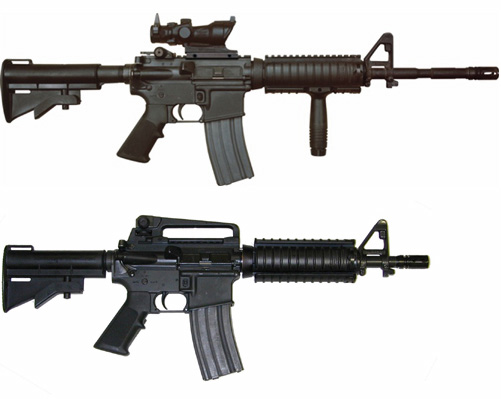
The Close Quarter Battle Receiver (CQBR) is a replacement upper receiver for the M4A1 carbine developed by the US Navy.
The CQBR features a 10.3 in (262 mm) length barrel (similar to the Colt Commando short-barreled M16 variants of the past) which makes the weapon significantly more compact, thus making it easier to use in, and around, vehicles and in tight, confined spaces. The overall length of the upper receiver is 19.25 in (489 mm). With the stock collapsed, the overall length of the weapon is 26.75 in (679 mm). Those created as complete rifles (rather than only upper receivers) are type designated as Mk 18 MOD 0/1.
Special forces units utilize the CQBR for scenarios such as VIP protection, urban warfare, and other close quarters battle (CQB) situations.
The M4 carbine and M16 are not ideally suited for all missions due to their relatively long barrels, but the modularity of AR pattern rifles allows the operator to easily replace the upper receiver. One of two proposed special mission receivers that were planned for inclusion into the SOPMOD Block II kit, the CQBR has taken off on its own. Like the proposed Special Purpose Receiver, the Close Quarters Battle Receiver has been more or less taken on by the Naval Surface Warfare Center Crane Division (often referred to as NSWC-Crane or just "Crane") as its own project following the CQBR's removal from the SOPMOD program. Just as the Special Purpose Receiver morphed into the Special Purpose Rifle, and was type-classified as Mk 12 MOD 0/1, the complete CQBR-equipped carbine has been type-classified as the Mk 18 MOD 0, or the Mk 18 MOD 1 with a sightless gas block and full-length accessory rail kit.
The purpose of the CQBR is to provide operators with a weapon of submachine gun size, but firing an intermediate cartridge, for scenarios such as VIP protection, urban warfare, and other close quarters battle (CQB) situations. The CQBR is designed to provide improvement over previous AR-15/M16-type weapons in this category. The CQBR is usually issued as a complete weapon system, and not just an upper receiver. The CQBR was once only available to Naval Special Warfare units (and by extension, other US Special Operations Forces units), but the Mk 18 MOD 0 has become general issue for Visit, Board, Search, and Seizure (VBSS) missions and, as of 2006, for NCIS agents deploying to active combat zones.[citation needed] The Mk 18 is also used by the Coast Guard's Maritime Law Enforcement Specialists within both Deployable Specialized Forces and Tactical Law Enforcement Teams, as well as the United States Navy's Explosive Ordnance Disposal (EOD) Operators. It is also used by both Marine Force Recon Teams and Critical Skills operators from MARSOC, and is in most cases the standard weapons of choice for said operators where the range of an M4 is not necessary.
The short 10.3 in (262mm) barrel length requires special modifications to function reliably. The gas port is opened from 0.062 to 0.070 in (1.6 to 1.8mm). A one-piece McFarland gas ring replaces the three-piece gas ring set. The standard four-coil extractor spring is replaced with a commercial off-the-shelf (COTS) five-coil spring. An O-ring surrounds the extractor spring. The standard M4 flash hider has been replaced with the M4QD flash hider for suppressor compatibility.
Shortening the barrel by 50% from the original 20 inches (508 mm) pattern has a dramatic effect on the velocity of 5.56×45mm NATO ammunition. This has been demonstrated in studies using a Remington 700 bolt-action rifle, progressively shortened in barrel length and chronographed. With a barrel length of 20 inches (510 mm), the bullet travels at a velocity of 3,071 ft/s (936 m/s). This is reduced to 2,489 ft/s (759 m/s) from a barrel length of 10 inches (250 mm).
Hub AI
Close Quarters Battle Receiver AI simulator
(@Close Quarters Battle Receiver_simulator)
Close Quarters Battle Receiver
The Close Quarter Battle Receiver (CQBR) is a replacement upper receiver for the M4A1 carbine developed by the US Navy.
The CQBR features a 10.3 in (262 mm) length barrel (similar to the Colt Commando short-barreled M16 variants of the past) which makes the weapon significantly more compact, thus making it easier to use in, and around, vehicles and in tight, confined spaces. The overall length of the upper receiver is 19.25 in (489 mm). With the stock collapsed, the overall length of the weapon is 26.75 in (679 mm). Those created as complete rifles (rather than only upper receivers) are type designated as Mk 18 MOD 0/1.
Special forces units utilize the CQBR for scenarios such as VIP protection, urban warfare, and other close quarters battle (CQB) situations.
The M4 carbine and M16 are not ideally suited for all missions due to their relatively long barrels, but the modularity of AR pattern rifles allows the operator to easily replace the upper receiver. One of two proposed special mission receivers that were planned for inclusion into the SOPMOD Block II kit, the CQBR has taken off on its own. Like the proposed Special Purpose Receiver, the Close Quarters Battle Receiver has been more or less taken on by the Naval Surface Warfare Center Crane Division (often referred to as NSWC-Crane or just "Crane") as its own project following the CQBR's removal from the SOPMOD program. Just as the Special Purpose Receiver morphed into the Special Purpose Rifle, and was type-classified as Mk 12 MOD 0/1, the complete CQBR-equipped carbine has been type-classified as the Mk 18 MOD 0, or the Mk 18 MOD 1 with a sightless gas block and full-length accessory rail kit.
The purpose of the CQBR is to provide operators with a weapon of submachine gun size, but firing an intermediate cartridge, for scenarios such as VIP protection, urban warfare, and other close quarters battle (CQB) situations. The CQBR is designed to provide improvement over previous AR-15/M16-type weapons in this category. The CQBR is usually issued as a complete weapon system, and not just an upper receiver. The CQBR was once only available to Naval Special Warfare units (and by extension, other US Special Operations Forces units), but the Mk 18 MOD 0 has become general issue for Visit, Board, Search, and Seizure (VBSS) missions and, as of 2006, for NCIS agents deploying to active combat zones.[citation needed] The Mk 18 is also used by the Coast Guard's Maritime Law Enforcement Specialists within both Deployable Specialized Forces and Tactical Law Enforcement Teams, as well as the United States Navy's Explosive Ordnance Disposal (EOD) Operators. It is also used by both Marine Force Recon Teams and Critical Skills operators from MARSOC, and is in most cases the standard weapons of choice for said operators where the range of an M4 is not necessary.
The short 10.3 in (262mm) barrel length requires special modifications to function reliably. The gas port is opened from 0.062 to 0.070 in (1.6 to 1.8mm). A one-piece McFarland gas ring replaces the three-piece gas ring set. The standard four-coil extractor spring is replaced with a commercial off-the-shelf (COTS) five-coil spring. An O-ring surrounds the extractor spring. The standard M4 flash hider has been replaced with the M4QD flash hider for suppressor compatibility.
Shortening the barrel by 50% from the original 20 inches (508 mm) pattern has a dramatic effect on the velocity of 5.56×45mm NATO ammunition. This has been demonstrated in studies using a Remington 700 bolt-action rifle, progressively shortened in barrel length and chronographed. With a barrel length of 20 inches (510 mm), the bullet travels at a velocity of 3,071 ft/s (936 m/s). This is reduced to 2,489 ft/s (759 m/s) from a barrel length of 10 inches (250 mm).