



Community hub
Recent from talks
Knowledge base stats:
Talk channels stats:
Members stats:
Cloud forest
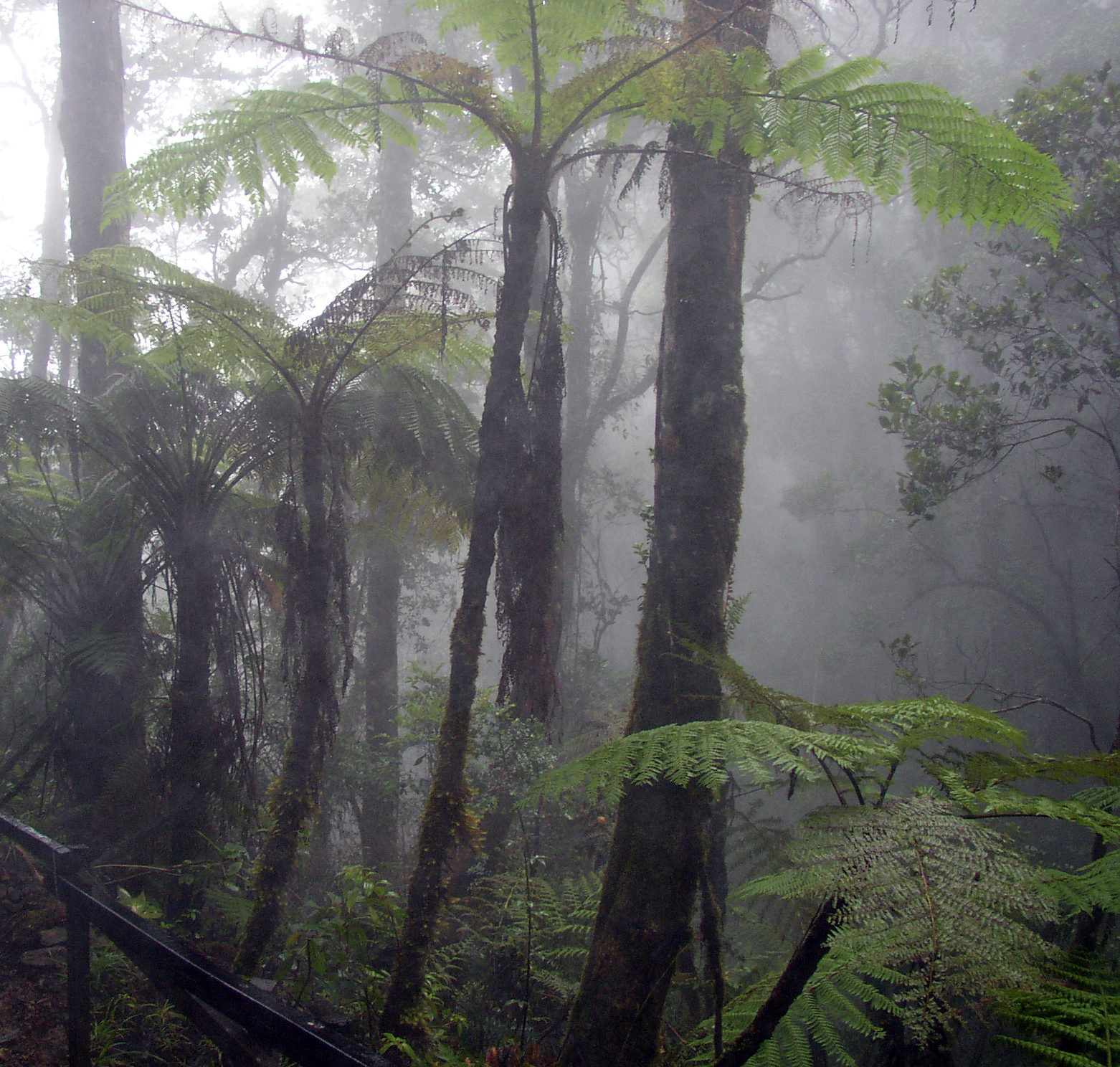
A cloud forest, also called a water forest, primas forest, or tropical montane cloud forest, is a generally tropical or subtropical, evergreen, montane, moist forest characterized by a persistent, frequent or seasonal low-level cloud cover, usually at the canopy level, formally described in the International Cloud Atlas (2017) as silvagenitus. Cloud forests often exhibit an abundance of mosses covering the ground and vegetation, in which case they are also referred to as mossy forests. Mossy forests usually develop on the saddles of mountains, where moisture introduced by settling clouds is more effectively retained.
Cloud forests are among the most biodiversity-rich biomes in the world, with a large number of species directly or indirectly depending on them.
Other moss forests include black spruce/feathermoss climax forest, with a moderately dense canopy and a forest floor of feathermosses, including Hylocomium splendens, Pleurozium schreberi, and Ptilium crista-castrensis. These weft-form mosses grow in boreal moss forests.
The presence of cloud forests is dependent on local climate (which is affected by the distance to the sea), the exposition and the latitude (typically from 25°N to 25°S), and the elevation (which varies from 500 m to 4000 m above sea level). Typically, there is a relatively small band of elevation in which the atmospheric environment is suitable for cloud forest development. This is characterized by persistent fog at the vegetation level, resulting in the reduction of direct sunlight and thus of evapotranspiration. Within cloud forests, much of the moisture available to plants arrives in the form of fog drip, where fog condenses on tree leaves and then drips onto the ground below.
Annual rainfall can range from 500 to 10,000 mm/year and mean temperature between 8 and 20 °C (46.4 and 68 °F).
While cloud forest today is the most widely used term, in some regions, these ecosystems or special types of cloud forests are called mossy forest, elfin forest, montane thicket, and dwarf cloud forest.
The definition of cloud forest can be ambiguous, with many countries not using the term (preferring such terms as Afromontane forest, upper montane rain forest, montane laurel forest, or more localised terms such as the Bolivian yungas, and the laurisilva of the Atlantic Islands). Sometimes subtropical and temperate forests in which similar meteorological conditions occur are considered to be cloud forests.[citation needed]
In comparison with lower-altitude tropical moist forests, cloud forests show a reduced tree stature combined with increased stem density and generally, a lower diversity of woody plants. Trees in these regions are generally shorter and more heavily stemmed than in lower-altitude forests in the same regions, often with gnarled trunks and branches, forming dense, compact crowns. Their leaves become smaller, thicker and harder with increasing altitude. The high moisture promotes the development of a high biomass and biodiversity of epiphyte, particularly bryophytes, lichens, ferns (including filmy ferns), bromeliads and orchids. The number of endemic plants can be very high.
Hub AI
Cloud forest AI simulator
(@Cloud forest_simulator)
Cloud forest
A cloud forest, also called a water forest, primas forest, or tropical montane cloud forest, is a generally tropical or subtropical, evergreen, montane, moist forest characterized by a persistent, frequent or seasonal low-level cloud cover, usually at the canopy level, formally described in the International Cloud Atlas (2017) as silvagenitus. Cloud forests often exhibit an abundance of mosses covering the ground and vegetation, in which case they are also referred to as mossy forests. Mossy forests usually develop on the saddles of mountains, where moisture introduced by settling clouds is more effectively retained.
Cloud forests are among the most biodiversity-rich biomes in the world, with a large number of species directly or indirectly depending on them.
Other moss forests include black spruce/feathermoss climax forest, with a moderately dense canopy and a forest floor of feathermosses, including Hylocomium splendens, Pleurozium schreberi, and Ptilium crista-castrensis. These weft-form mosses grow in boreal moss forests.
The presence of cloud forests is dependent on local climate (which is affected by the distance to the sea), the exposition and the latitude (typically from 25°N to 25°S), and the elevation (which varies from 500 m to 4000 m above sea level). Typically, there is a relatively small band of elevation in which the atmospheric environment is suitable for cloud forest development. This is characterized by persistent fog at the vegetation level, resulting in the reduction of direct sunlight and thus of evapotranspiration. Within cloud forests, much of the moisture available to plants arrives in the form of fog drip, where fog condenses on tree leaves and then drips onto the ground below.
Annual rainfall can range from 500 to 10,000 mm/year and mean temperature between 8 and 20 °C (46.4 and 68 °F).
While cloud forest today is the most widely used term, in some regions, these ecosystems or special types of cloud forests are called mossy forest, elfin forest, montane thicket, and dwarf cloud forest.
The definition of cloud forest can be ambiguous, with many countries not using the term (preferring such terms as Afromontane forest, upper montane rain forest, montane laurel forest, or more localised terms such as the Bolivian yungas, and the laurisilva of the Atlantic Islands). Sometimes subtropical and temperate forests in which similar meteorological conditions occur are considered to be cloud forests.[citation needed]
In comparison with lower-altitude tropical moist forests, cloud forests show a reduced tree stature combined with increased stem density and generally, a lower diversity of woody plants. Trees in these regions are generally shorter and more heavily stemmed than in lower-altitude forests in the same regions, often with gnarled trunks and branches, forming dense, compact crowns. Their leaves become smaller, thicker and harder with increasing altitude. The high moisture promotes the development of a high biomass and biodiversity of epiphyte, particularly bryophytes, lichens, ferns (including filmy ferns), bromeliads and orchids. The number of endemic plants can be very high.