
Recent from talks
Coahuiltecan
Knowledge base stats:
Talk channels stats:
Members stats:
Coahuiltecan
The Coahuiltecan were various small, autonomous bands of Native Americans who inhabited the Rio Grande Valley in what is now northeastern Mexico and southern Texas. The various Coahuiltecan groups were hunter gatherers. First encountered by the Spanish in the 16th century, their population declined due to Old World diseases and numerous small-scale wars fought against the Spanish, Apache, and other indigenous groups.
After the Texas secession from Mexico, Coahuiltecan peoples were largely forced into harsh living conditions. In 1886, ethnologist Albert Gatschet found the last known survivors of Coahuiltecan bands: 25 Comecrudo, one Cotoname, and two Pakawa, living near Reynosa, Mexico.
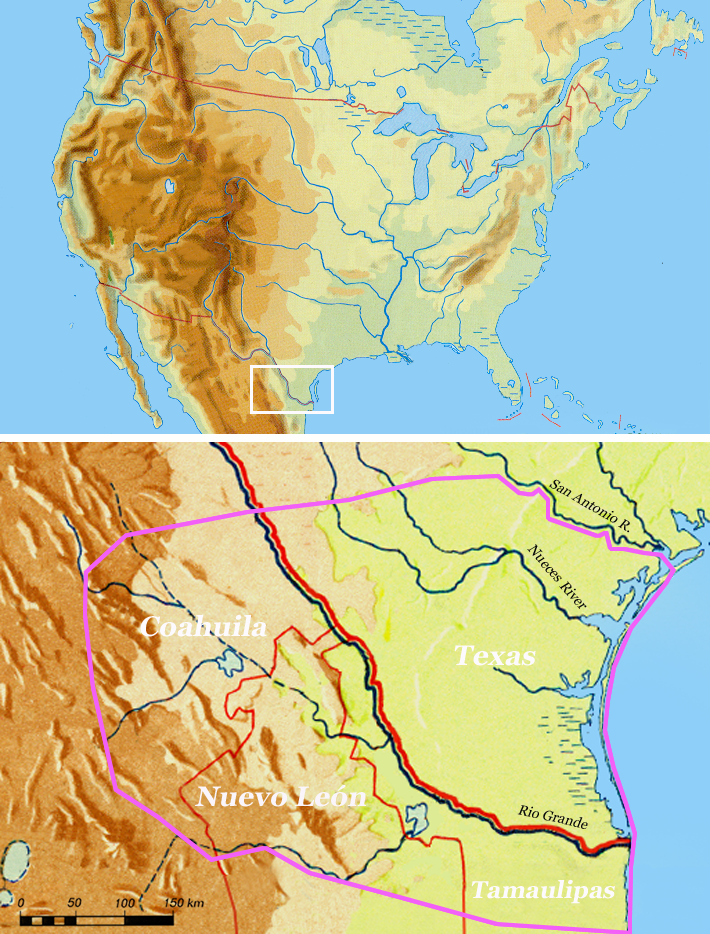
The Coahuiltecan lived in the flat, brushy, dry country of northern Mexico and southern Texas, roughly south of a line from the Gulf Coast at the mouth of the Guadalupe River to San Antonio and westward to around Del Rio. They lived on both sides of the Rio Grande. Their neighbors along the Texas coast were the Karankawa, and inland to their northeast were the Tonkawa. To their north were the Jumano. Later, the Lipan Apache and Comanche migrated into this area. Their indefinite western boundaries were the vicinity of Monclova, Coahuila, and Monterrey, Nuevo Leon, and southward to roughly the present location of Ciudad Victoria, Tamaulipas, the Sierra de Tamaulipas, and the Tropic of Cancer.
Although living near the Gulf of Mexico, most of the Coahuiltecan were inland people. Near the gulf for more than 70 miles (110 km) both north and south of the Rio Grande, little fresh water is available, so bands were limited in their ability to survive near the coast and were deprived of its other resources, such as fish and shellfish and other coastal resources.
Spanish colonists created the name "Coahuiltecan", derived from Coahuila, the state in New Spain where they first encountered Coahuiltecan peoples. This name was derived by the Spanish from a Nahuatl word.
Alternate spellings include: Coahuilteco, Coaguileno, Coaguilleno, Coahuila, Coahuileno, and Coavileno.
The Coahuiltecan languages are a collection of related languages. It should not be confused with the Coahuilteco language. The Coahuiltecan languages are extinct, but there are efforts by scholars such as Jessica L. Sánchez Flores (Nahua descent) to revive them.
Linguists have suggested that Coahuiltecan belongs to the Hokan language family of present-day California, Arizona, and Baja California. Most modern linguists, however, discount this theory for lack of evidence; instead, they believe that the Coahuiltecan were diverse in both culture and language. At least seven different languages are known to have been spoken, one of which is called Coahuiltecan or Pakawa, spoken by a number of bands near San Antonio. The best-known of the languages are Comecrudo and Cotoname, both spoken by people in the delta of the Rio Grande and Pakawa. Catholic Missionaries compiled vocabularies of several of these languages in the 18th and 19th centuries, but the language samples are too small to establish relationships between and among the languages.
Hub AI
Coahuiltecan AI simulator
(@Coahuiltecan_simulator)
Coahuiltecan
The Coahuiltecan were various small, autonomous bands of Native Americans who inhabited the Rio Grande Valley in what is now northeastern Mexico and southern Texas. The various Coahuiltecan groups were hunter gatherers. First encountered by the Spanish in the 16th century, their population declined due to Old World diseases and numerous small-scale wars fought against the Spanish, Apache, and other indigenous groups.
After the Texas secession from Mexico, Coahuiltecan peoples were largely forced into harsh living conditions. In 1886, ethnologist Albert Gatschet found the last known survivors of Coahuiltecan bands: 25 Comecrudo, one Cotoname, and two Pakawa, living near Reynosa, Mexico.
The Coahuiltecan lived in the flat, brushy, dry country of northern Mexico and southern Texas, roughly south of a line from the Gulf Coast at the mouth of the Guadalupe River to San Antonio and westward to around Del Rio. They lived on both sides of the Rio Grande. Their neighbors along the Texas coast were the Karankawa, and inland to their northeast were the Tonkawa. To their north were the Jumano. Later, the Lipan Apache and Comanche migrated into this area. Their indefinite western boundaries were the vicinity of Monclova, Coahuila, and Monterrey, Nuevo Leon, and southward to roughly the present location of Ciudad Victoria, Tamaulipas, the Sierra de Tamaulipas, and the Tropic of Cancer.
Although living near the Gulf of Mexico, most of the Coahuiltecan were inland people. Near the gulf for more than 70 miles (110 km) both north and south of the Rio Grande, little fresh water is available, so bands were limited in their ability to survive near the coast and were deprived of its other resources, such as fish and shellfish and other coastal resources.
Spanish colonists created the name "Coahuiltecan", derived from Coahuila, the state in New Spain where they first encountered Coahuiltecan peoples. This name was derived by the Spanish from a Nahuatl word.
Alternate spellings include: Coahuilteco, Coaguileno, Coaguilleno, Coahuila, Coahuileno, and Coavileno.
The Coahuiltecan languages are a collection of related languages. It should not be confused with the Coahuilteco language. The Coahuiltecan languages are extinct, but there are efforts by scholars such as Jessica L. Sánchez Flores (Nahua descent) to revive them.
Linguists have suggested that Coahuiltecan belongs to the Hokan language family of present-day California, Arizona, and Baja California. Most modern linguists, however, discount this theory for lack of evidence; instead, they believe that the Coahuiltecan were diverse in both culture and language. At least seven different languages are known to have been spoken, one of which is called Coahuiltecan or Pakawa, spoken by a number of bands near San Antonio. The best-known of the languages are Comecrudo and Cotoname, both spoken by people in the delta of the Rio Grande and Pakawa. Catholic Missionaries compiled vocabularies of several of these languages in the 18th and 19th centuries, but the language samples are too small to establish relationships between and among the languages.
Recent media