
Recent from talks
Coastal Forces of the Royal Navy
Knowledge base stats:
Talk channels stats:
Members stats:
Coastal Forces of the Royal Navy
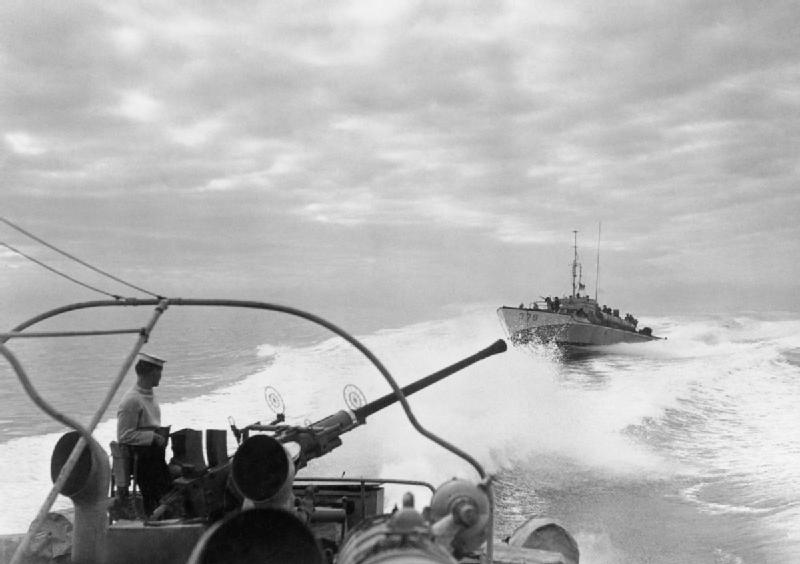
Coastal Forces was a division of the Royal Navy initially established during World War I, and then again in World War II under the command of Rear-Admiral, Coastal Forces. It remained active until the last minesweepers to wear the "HM Coastal Forces" cap tally were taken out of reserve in 1968. The division received more gallantry awards than any other branch of the Royal Navy during that period.
In 2020, ministerial approval for the change in name from 1st Patrol Boat Squadron to Coastal Forces Squadron was given. It encompasses 14 of 16 Archer-class patrol vessels and the Batch 1 River-class offshore patrol vessels and is responsible for UKEEZ Protection and Patrol.
The Royal Navy had previously operated flotillas of small torpedo- and depth-charge-armed craft (coastal motor boats) during World War I (1914–1918). They operated as often in action against the enemy coast as in defence of British coastal areas.
The first post WWI motor torpedo boats built for the Royal Navy were built by the British Powerboat Company at Hythe, Southampton. MTBs 01-19 were built between 1935 and 1938, following the hard chine planing hull designed with T. E. Lawrence ("Lawrence of Arabia"), for high speed rescue of downed aircraft crew.[citation needed]
During World War II (1939–1945), the first Coastal Forces headquarters was set up at HMS Vernon in 1940 under Rear Admiral Piers Kekewich, Flag Officer Coastal Forces. The chief staff officer to the admiral was Augustus Agar, VC, who had commanded coastal motor boats during World War I and in British operations in the Baltic Sea in 1918 and 1919 in support of White Russian forces during the Russian Civil War.[citation needed]
Royal Navy Coastal Forces craft operated mainly in the English Channel and North Sea waters. They were also based in Malta, The 1st & 3rd MTB Flotillas, Numbers 01-06 & 14-19, and HMS Tamar, Hong Kong, the 2nd MTB Flotilla, numbers 07-12, 26 & 27.
On 19 December 1941 MTB 07 led the attack on Japanese landing craft in Kowloon Harbour, Hong Kong, taking fire from land, sea and air. The operation was arguably the most daring daylight MTB raid of all time losing over 40% of the flotilla. MTB 07 was hit 97 times losing two crew dead and all three engines. It was hailed as the "Balaclava of the sea".[full citation needed]
They were also used in the Mediterranean[page needed] and off the Norwegian coastline. They were used at the St. Nazaire Raid and the Dieppe Raid. They were used to attack German convoys and their S-boat (known to the Allies as "E-Boat") escorts, carry out clandestine raids and landings, and pick up secret agents in Norway and Brittany. Alongside British officers and sailors, the coastal craft were crewed by various Allied nationalities including Dutch, Norwegian, Canadian, Australian, and New Zealanders.
Hub AI
Coastal Forces of the Royal Navy AI simulator
(@Coastal Forces of the Royal Navy_simulator)
Coastal Forces of the Royal Navy
Coastal Forces was a division of the Royal Navy initially established during World War I, and then again in World War II under the command of Rear-Admiral, Coastal Forces. It remained active until the last minesweepers to wear the "HM Coastal Forces" cap tally were taken out of reserve in 1968. The division received more gallantry awards than any other branch of the Royal Navy during that period.
In 2020, ministerial approval for the change in name from 1st Patrol Boat Squadron to Coastal Forces Squadron was given. It encompasses 14 of 16 Archer-class patrol vessels and the Batch 1 River-class offshore patrol vessels and is responsible for UKEEZ Protection and Patrol.
The Royal Navy had previously operated flotillas of small torpedo- and depth-charge-armed craft (coastal motor boats) during World War I (1914–1918). They operated as often in action against the enemy coast as in defence of British coastal areas.
The first post WWI motor torpedo boats built for the Royal Navy were built by the British Powerboat Company at Hythe, Southampton. MTBs 01-19 were built between 1935 and 1938, following the hard chine planing hull designed with T. E. Lawrence ("Lawrence of Arabia"), for high speed rescue of downed aircraft crew.[citation needed]
During World War II (1939–1945), the first Coastal Forces headquarters was set up at HMS Vernon in 1940 under Rear Admiral Piers Kekewich, Flag Officer Coastal Forces. The chief staff officer to the admiral was Augustus Agar, VC, who had commanded coastal motor boats during World War I and in British operations in the Baltic Sea in 1918 and 1919 in support of White Russian forces during the Russian Civil War.[citation needed]
Royal Navy Coastal Forces craft operated mainly in the English Channel and North Sea waters. They were also based in Malta, The 1st & 3rd MTB Flotillas, Numbers 01-06 & 14-19, and HMS Tamar, Hong Kong, the 2nd MTB Flotilla, numbers 07-12, 26 & 27.
On 19 December 1941 MTB 07 led the attack on Japanese landing craft in Kowloon Harbour, Hong Kong, taking fire from land, sea and air. The operation was arguably the most daring daylight MTB raid of all time losing over 40% of the flotilla. MTB 07 was hit 97 times losing two crew dead and all three engines. It was hailed as the "Balaclava of the sea".[full citation needed]
They were also used in the Mediterranean[page needed] and off the Norwegian coastline. They were used at the St. Nazaire Raid and the Dieppe Raid. They were used to attack German convoys and their S-boat (known to the Allies as "E-Boat") escorts, carry out clandestine raids and landings, and pick up secret agents in Norway and Brittany. Alongside British officers and sailors, the coastal craft were crewed by various Allied nationalities including Dutch, Norwegian, Canadian, Australian, and New Zealanders.
Recent media