
Recent from talks
Coca-Cola Coliseum
Knowledge base stats:
Talk channels stats:
Members stats:
Coca-Cola Coliseum
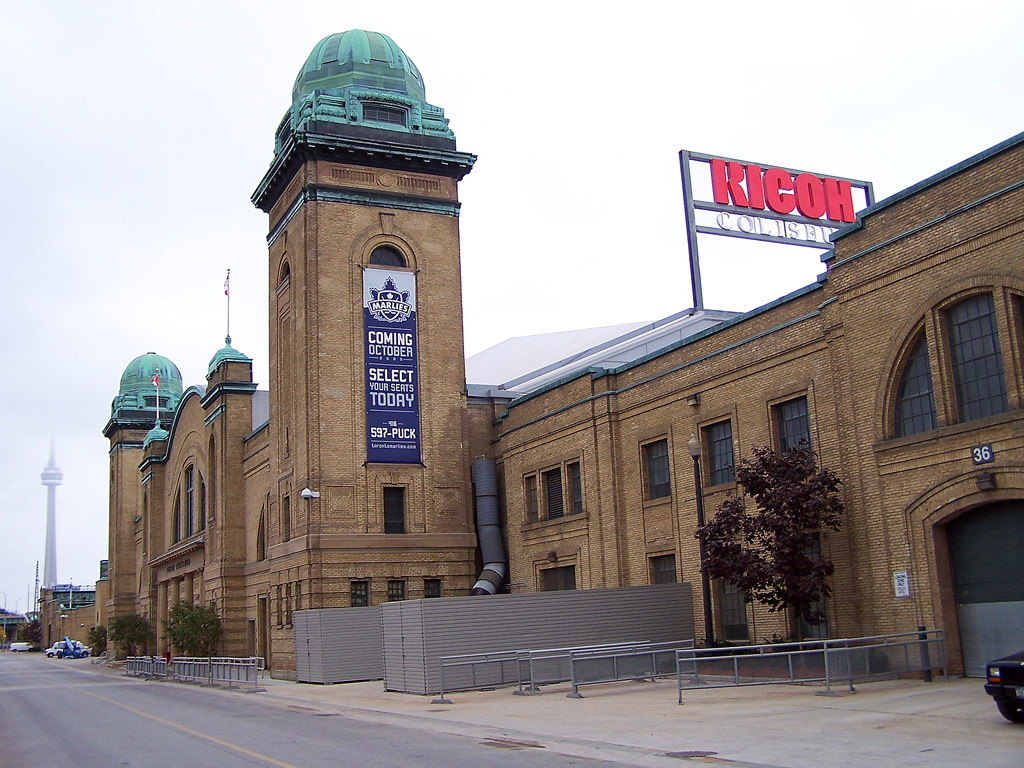
Coca-Cola Coliseum (also or formerly known as CNE Coliseum, Royal Coliseum, Ricoh Coliseum, Toronto Coliseum, or Coliseum) is an arena at Exhibition Place in Toronto, Ontario, Canada, used for agricultural displays, ice hockey, and trade shows. It was built for the Canadian National Exhibition (CNE) and the Royal Agricultural Winter Fair (the Royal) in 1921. Since 1997 it has been part of the Enercare Centre exhibition complex. It serves as the home arena of the Toronto Sceptres of the Professional Women's Hockey League and the American Hockey League's Toronto Marlies, the farm team of the Toronto Maple Leafs. It will also serve as the home arena of the Toronto Tempo when they debut in 2026.
On January 1, 1920, Toronto voters approved by plebiscite a proposal by the Royal Agricultural Fair Association to construct, at a maximum cost of CA$1 million, a new arena for livestock. The City of Toronto government (City) made a call for tenders in the fall of 1920 but the lowest tender was CA$1.9 million, exceeding the mandate approved by plebiscite. The size of the planned building was reduced by half in an attempt to get the cost under CA$1 million and a new call for tenders was done. The lowest tender received was from Anglin-Norcross Ltd. of Montreal for CA$892,000 to build the building to City Architect F. W. Price's specifications. There was a reticence to hire a Montreal firm, and the city held off on awarding the contract while Price sought out construction offers from local firms to do the work using day labour, although the legality of this was questioned. Another issue raised was that the revised arena design needed to be expanded to meet the fair's needs. Anglin-Norcross offered to do the work at a further CA$31,000. It took two City Council votes, but Council finally approved the awarding of the contract to Anglin-Norcross on May 26, 1921. Demolition of existing buildings (likely the area with livestock stalls) on the site commenced a few days later and arena work commenced in June 1921. The cornerstone was laid by Toronto Mayor Thomas Church on July 27, 1921. Robert Fleming, President of the Canadian National Exhibition (CNE) declared that the building would be the largest of its kind in the world, with a floor space of 8.5 acres (3.4 ha).
The Fair Association had hoped for the arena to be open by the fall of 1921 to inaugurate the new fair, but it was not ready. The CA$1 million (CA$13.8 million in 2023 dollars) building had its official public opening on December 16, 1921, attended by 5,000 persons to see an athletic meet put on by the "Sportsmen Patriotic Association." Upon completion, the building was billed as the largest of its kind in North America. The name "Coliseum" was given to the building in 1922, in time for the opening of the CNE. The main entrance was to the north, along Manitoba Drive. The southern side of the building was along the main TTC streetcar rail lines serving the CNE, which separated the Coliseum and Industry Buildings to the north, and the later Engineering and Electrical Building (1928) to the south. In 1926, additions were built and the complex was claimed to be the largest structure of its kind under one roof in the world. In 1931, the Horse Palace was built next door to provide a permanent building for the stables of the Winter Fair. From 1942 to 1945, the building was used as a training base for the Royal Canadian Air Force during World War II and known as the 'Manning Depot'. A photo of it as the RCAF Manning Depot is in the New Westminster Museum and Archives # IHP9562-003. After the war, it mainly hosted equestrian events for the Royal Agricultural Winter Fair, the CNE and other events. The arena was also used as a horse barn.
In time for the 1963 CNE, the southern facade was reconstructed. As part of the renovation, the southern facade was reclad with black, grey and white siding and a new front plaza was built, with a large "COLISEUM" sign on top. The CNE spent CA$3 million from 1960 until 1963 on "face-lifting" the Coliseum. In 1997, the National Trade Centre (now the Enercare Centre) exhibition complex was built. The new project removed the 1963 entrance and cladding, restoring the original facade, although the cupola towers on the southern facade had been removed in the 1963 renovation. Access to the Coliseum was moved to the western entrance of the exhibition complex through a hall known as Heritage Court.
In November 2002, the City of Toronto agreed to an extensive renovation of the Coliseum to attract a professional ice hockey team to the arena. At a cost of CA$38 million, the arena's capacity was expanded from 6,500 to 9,700 by building a new higher roof, lowering the floor, adding new seats in the expanded area and the installation of 38 private suites. Borealis Infrastructure contributed CA$9 million up front and CA$20 million of borrowed funds in return for a 49-year lease to the arena. The City of Toronto invested CA$9 million in the project and guaranteed Borealis' loans, while remaining the owner of the building.
In 2003, Japanese office supply company Ricoh purchased the naming rights to the new facility for CA$10 million over ten years, with an optional five-year extension.
During the summer of 2015, a new scoreboard was installed at the Air Canada Centre, and the old scoreboard was installed at the Coliseum.
In 2018, MLSE announced that the Toronto Argonauts football operations offices and weight rooms would be relocated to the Coliseum in late June of that year. On July 11, 2018, at the end of Ricoh's partnership with the building, Coca-Cola purchased the naming rights to the facility for ten years, renaming it the "Coca-Cola Coliseum".
Hub AI
Coca-Cola Coliseum AI simulator
(@Coca-Cola Coliseum_simulator)
Coca-Cola Coliseum
Coca-Cola Coliseum (also or formerly known as CNE Coliseum, Royal Coliseum, Ricoh Coliseum, Toronto Coliseum, or Coliseum) is an arena at Exhibition Place in Toronto, Ontario, Canada, used for agricultural displays, ice hockey, and trade shows. It was built for the Canadian National Exhibition (CNE) and the Royal Agricultural Winter Fair (the Royal) in 1921. Since 1997 it has been part of the Enercare Centre exhibition complex. It serves as the home arena of the Toronto Sceptres of the Professional Women's Hockey League and the American Hockey League's Toronto Marlies, the farm team of the Toronto Maple Leafs. It will also serve as the home arena of the Toronto Tempo when they debut in 2026.
On January 1, 1920, Toronto voters approved by plebiscite a proposal by the Royal Agricultural Fair Association to construct, at a maximum cost of CA$1 million, a new arena for livestock. The City of Toronto government (City) made a call for tenders in the fall of 1920 but the lowest tender was CA$1.9 million, exceeding the mandate approved by plebiscite. The size of the planned building was reduced by half in an attempt to get the cost under CA$1 million and a new call for tenders was done. The lowest tender received was from Anglin-Norcross Ltd. of Montreal for CA$892,000 to build the building to City Architect F. W. Price's specifications. There was a reticence to hire a Montreal firm, and the city held off on awarding the contract while Price sought out construction offers from local firms to do the work using day labour, although the legality of this was questioned. Another issue raised was that the revised arena design needed to be expanded to meet the fair's needs. Anglin-Norcross offered to do the work at a further CA$31,000. It took two City Council votes, but Council finally approved the awarding of the contract to Anglin-Norcross on May 26, 1921. Demolition of existing buildings (likely the area with livestock stalls) on the site commenced a few days later and arena work commenced in June 1921. The cornerstone was laid by Toronto Mayor Thomas Church on July 27, 1921. Robert Fleming, President of the Canadian National Exhibition (CNE) declared that the building would be the largest of its kind in the world, with a floor space of 8.5 acres (3.4 ha).
The Fair Association had hoped for the arena to be open by the fall of 1921 to inaugurate the new fair, but it was not ready. The CA$1 million (CA$13.8 million in 2023 dollars) building had its official public opening on December 16, 1921, attended by 5,000 persons to see an athletic meet put on by the "Sportsmen Patriotic Association." Upon completion, the building was billed as the largest of its kind in North America. The name "Coliseum" was given to the building in 1922, in time for the opening of the CNE. The main entrance was to the north, along Manitoba Drive. The southern side of the building was along the main TTC streetcar rail lines serving the CNE, which separated the Coliseum and Industry Buildings to the north, and the later Engineering and Electrical Building (1928) to the south. In 1926, additions were built and the complex was claimed to be the largest structure of its kind under one roof in the world. In 1931, the Horse Palace was built next door to provide a permanent building for the stables of the Winter Fair. From 1942 to 1945, the building was used as a training base for the Royal Canadian Air Force during World War II and known as the 'Manning Depot'. A photo of it as the RCAF Manning Depot is in the New Westminster Museum and Archives # IHP9562-003. After the war, it mainly hosted equestrian events for the Royal Agricultural Winter Fair, the CNE and other events. The arena was also used as a horse barn.
In time for the 1963 CNE, the southern facade was reconstructed. As part of the renovation, the southern facade was reclad with black, grey and white siding and a new front plaza was built, with a large "COLISEUM" sign on top. The CNE spent CA$3 million from 1960 until 1963 on "face-lifting" the Coliseum. In 1997, the National Trade Centre (now the Enercare Centre) exhibition complex was built. The new project removed the 1963 entrance and cladding, restoring the original facade, although the cupola towers on the southern facade had been removed in the 1963 renovation. Access to the Coliseum was moved to the western entrance of the exhibition complex through a hall known as Heritage Court.
In November 2002, the City of Toronto agreed to an extensive renovation of the Coliseum to attract a professional ice hockey team to the arena. At a cost of CA$38 million, the arena's capacity was expanded from 6,500 to 9,700 by building a new higher roof, lowering the floor, adding new seats in the expanded area and the installation of 38 private suites. Borealis Infrastructure contributed CA$9 million up front and CA$20 million of borrowed funds in return for a 49-year lease to the arena. The City of Toronto invested CA$9 million in the project and guaranteed Borealis' loans, while remaining the owner of the building.
In 2003, Japanese office supply company Ricoh purchased the naming rights to the new facility for CA$10 million over ten years, with an optional five-year extension.
During the summer of 2015, a new scoreboard was installed at the Air Canada Centre, and the old scoreboard was installed at the Coliseum.
In 2018, MLSE announced that the Toronto Argonauts football operations offices and weight rooms would be relocated to the Coliseum in late June of that year. On July 11, 2018, at the end of Ricoh's partnership with the building, Coca-Cola purchased the naming rights to the facility for ten years, renaming it the "Coca-Cola Coliseum".
Recent media