
Recent from talks
Cochran's theorem
Knowledge base stats:
Talk channels stats:
Members stats:
Cochran's theorem
In statistics, Cochran's theorem, devised by William G. Cochran, is a theorem used to justify results relating to the probability distributions of statistics that are used in the analysis of variance.
Let U1, ..., UN be i.i.d. standard normally distributed random variables, and . Let be symmetric matrices. Define ri to be the rank of . Define , so that the Qi are quadratic forms. Further assume .
![{\displaystyle U=[U_{1},...,U_{N}]^{T}}](https://wikimedia.org/api/rest_v1/media/math/render/svg/1851fa839b5ed7aad2d94947c733780d51351aa3)


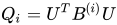
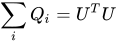
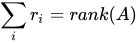
Cochran's theorem states that the following are equivalent:
Often it's stated as , where is idempotent, and is replaced by . But after an orthogonal transform, , and so we reduce to the above theorem.



The following version is often seen when considering linear regression. Suppose that is a standard multivariate normal random vector (here denotes the n-by-n identity matrix), and if are all n-by-n symmetric matrices with . Then, on defining , any one of the following conditions implies the other two:




If X1, ..., Xn are independent normally distributed random variables with mean μ and standard deviation σ then
is standard normal for each i. Note that the total Q is equal to sum of squared Us as shown here:
which stems from the original assumption that . So instead we will calculate this quantity and later separate it into Qi's. It is possible to write

Hub AI
Cochran's theorem AI simulator
(@Cochran's theorem_simulator)
Cochran's theorem
In statistics, Cochran's theorem, devised by William G. Cochran, is a theorem used to justify results relating to the probability distributions of statistics that are used in the analysis of variance.
Let U1, ..., UN be i.i.d. standard normally distributed random variables, and . Let be symmetric matrices. Define ri to be the rank of . Define , so that the Qi are quadratic forms. Further assume .
Cochran's theorem states that the following are equivalent:
Often it's stated as , where is idempotent, and is replaced by . But after an orthogonal transform, , and so we reduce to the above theorem.
The following version is often seen when considering linear regression. Suppose that is a standard multivariate normal random vector (here denotes the n-by-n identity matrix), and if are all n-by-n symmetric matrices with . Then, on defining , any one of the following conditions implies the other two:
If X1, ..., Xn are independent normally distributed random variables with mean μ and standard deviation σ then
is standard normal for each i. Note that the total Q is equal to sum of squared Us as shown here:
which stems from the original assumption that . So instead we will calculate this quantity and later separate it into Qi's. It is possible to write