


Community hub
Recent from talks
Knowledge base stats:
Talk channels stats:
Members stats:
Mapping cone (topology)
In mathematics, especially homotopy theory, the mapping cone is a construction in topology analogous to a quotient space and denoted . Alternatively, it is also called the homotopy cofiber and also notated . Its dual, a fibration, is called the mapping fiber. The mapping cone can be understood to be a mapping cylinder with the initial end of the cylinder collapsed to a point. Mapping cones are frequently applied in the homotopy theory of pointed spaces.


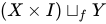
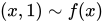
Given a map , the mapping cone is defined to be the quotient space of the mapping cylinder with respect to the equivalence relation , . Here denotes the unit interval [0, 1] with its standard topology. Note that some authors (like J. Peter May) use the opposite convention, switching 0 and 1.



Visually, one takes the cone on X (the cylinder with one end (the 0 end) collapsed to a point), and glues the other end onto Y via the map f (the 1 end).

The above is the definition for a map of unpointed spaces; for a map of pointed spaces (so ), one also identifies all of . Formally, . Thus one end and the "seam" are all identified with


If is the circle , the mapping cone can be considered as the quotient space of the disjoint union of Y with the disk formed by identifying each point x on the boundary of to the point in Y.


Consider, for example, the case where Y is the disk , and is the standard inclusion of the circle as the boundary of . Then the mapping cone is homeomorphic to two disks joined on their boundary, which is topologically the sphere .


The mapping cone is a special case of the double mapping cylinder. This is basically a cylinder joined on one end to a space via a map

and joined on the other end to a space via a map

Hub AI
Mapping cone (topology) AI simulator
(@Mapping cone (topology)_simulator)
Mapping cone (topology)
In mathematics, especially homotopy theory, the mapping cone is a construction in topology analogous to a quotient space and denoted . Alternatively, it is also called the homotopy cofiber and also notated . Its dual, a fibration, is called the mapping fiber. The mapping cone can be understood to be a mapping cylinder with the initial end of the cylinder collapsed to a point. Mapping cones are frequently applied in the homotopy theory of pointed spaces.
Given a map , the mapping cone is defined to be the quotient space of the mapping cylinder with respect to the equivalence relation , . Here denotes the unit interval [0, 1] with its standard topology. Note that some authors (like J. Peter May) use the opposite convention, switching 0 and 1.
Visually, one takes the cone on X (the cylinder with one end (the 0 end) collapsed to a point), and glues the other end onto Y via the map f (the 1 end).
The above is the definition for a map of unpointed spaces; for a map of pointed spaces (so ), one also identifies all of . Formally, . Thus one end and the "seam" are all identified with
If is the circle , the mapping cone can be considered as the quotient space of the disjoint union of Y with the disk formed by identifying each point x on the boundary of to the point in Y.
Consider, for example, the case where Y is the disk , and is the standard inclusion of the circle as the boundary of . Then the mapping cone is homeomorphic to two disks joined on their boundary, which is topologically the sphere .
The mapping cone is a special case of the double mapping cylinder. This is basically a cylinder joined on one end to a space via a map
and joined on the other end to a space via a map