
Recent from talks
Coligny calendar
Knowledge base stats:
Talk channels stats:
Members stats:
Coligny calendar
The Coligny calendar is a bronze plaque with an inscribed calendar, made in Roman Gaul in the 2nd century CE. It lays out a 5-year cycle of a lunisolar calendar, each year with 12 lunar months. An intercalary month is inserted before each 2.5 years. It is the most important piece of evidence enabling the reconstruction of an ancient Celtic calendar.
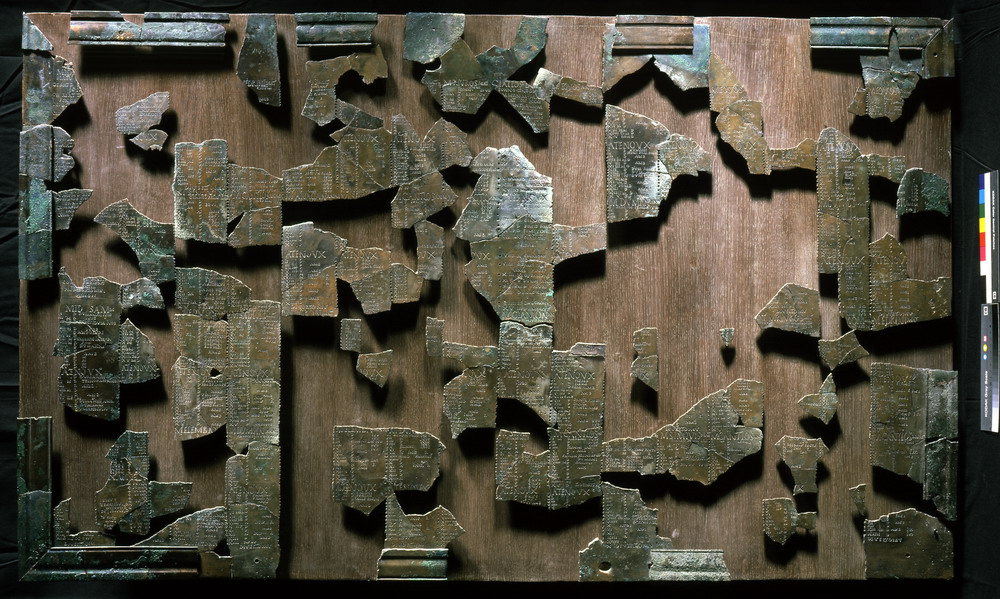
The calendar was found in 1897 in France, in Coligny, Ain (, near Lyon), along with broken pieces of a life-size bronze statue of a nude male holding a spear, likely meant to portray Mars, the Roman god of war. Approximately 40% of the original calendar remains in the form of fragments. It was engraved on a bronze tablet, preserved in 73 fragments, that was originally 134.8 cm wide by 78.0 cm high. With the rim attached the plate measured 52 by 32 unicae Drusianus (2.75 cm to the unicae). It is written in the Gaulish language with the Latin alphabet, using Roman square capitals and Roman numerals. Based on the style of lettering and the accompanying statue, the bronze plaque likely dates to the end of the second century CE, although copying errors indicate that the calendar itself is much older. It is now held at the Gallo-Roman Museum of Lyon-Fourvière.
Eight small fragments of a similar calendar were found at the double-shrine of Villards-d'Héria. It does not have the holes of a peg calendar that the Coligny calendar does, but otherwise has the same notations. It is now held in the Musée d'Archéologie du Jura at Lons-le-Saunier.
The names of the twelve lunar year months are reconstructed as Samonios, Dumannios, Rivros, Anagantios, Ogronios, Cutios, Giamonios, Simivisonnios, Equos, Elembivios, Edrinios, and Cantlos. The names occur in the genitive form SAMONI, DUMANNI, RIVRI, etc. in the internal notations of the calendar. The name of the first intercalary month is listed at the end of the month as QUIMON for possibly Quimonios, the second is reconstructed as [S]antaran[...], [R]antaran[...], [B]antaran[...], or Antaran[...].
Mid Samonios refers to summer (Gaulish samo-,< *sṃHo-3) while Mid Giamonios refers to winter (Gaulish giamo-). These two months divide the calendar into summer and winter seasons of six months, each season led off by a festival of several days marked with IVOS. This indicates an early version of the same traditional seasons as seen in later Celtic contexts: "For two divisions were formerly on the year, viz., summer from Beltaine (the first of May), and winter from Samuin to Beltaine".
Allowing for variations across the years and aligning names of months to the seasons of the solar year, the month of MID SAMONIOS may have begun around the period of May–June[citation needed].
The Coligny calendar as reconstructed consisted of 16 columns and 4 rows, with two intercalary months given half a column each, resulting in a table of the 62 months of the 5-year cycle. The 5 years of the calendar plaque could be part of a Metonic cycle of 19 year or 30-year cycle. The full length of the calendar is still being debated.
Each lunar year has a 12 lunar months, six months of 30 days, five months of 29 days, and a variable month of 29/30 days. The months do not follow in 29/30 pairs. A synodic month has 29.53 days, so the calendar may overcome any slight slippage or temporary imbalance by removing a day from a 30-day Equos month.
Hub AI
Coligny calendar AI simulator
(@Coligny calendar_simulator)
Coligny calendar
The Coligny calendar is a bronze plaque with an inscribed calendar, made in Roman Gaul in the 2nd century CE. It lays out a 5-year cycle of a lunisolar calendar, each year with 12 lunar months. An intercalary month is inserted before each 2.5 years. It is the most important piece of evidence enabling the reconstruction of an ancient Celtic calendar.
The calendar was found in 1897 in France, in Coligny, Ain (, near Lyon), along with broken pieces of a life-size bronze statue of a nude male holding a spear, likely meant to portray Mars, the Roman god of war. Approximately 40% of the original calendar remains in the form of fragments. It was engraved on a bronze tablet, preserved in 73 fragments, that was originally 134.8 cm wide by 78.0 cm high. With the rim attached the plate measured 52 by 32 unicae Drusianus (2.75 cm to the unicae). It is written in the Gaulish language with the Latin alphabet, using Roman square capitals and Roman numerals. Based on the style of lettering and the accompanying statue, the bronze plaque likely dates to the end of the second century CE, although copying errors indicate that the calendar itself is much older. It is now held at the Gallo-Roman Museum of Lyon-Fourvière.
Eight small fragments of a similar calendar were found at the double-shrine of Villards-d'Héria. It does not have the holes of a peg calendar that the Coligny calendar does, but otherwise has the same notations. It is now held in the Musée d'Archéologie du Jura at Lons-le-Saunier.
The names of the twelve lunar year months are reconstructed as Samonios, Dumannios, Rivros, Anagantios, Ogronios, Cutios, Giamonios, Simivisonnios, Equos, Elembivios, Edrinios, and Cantlos. The names occur in the genitive form SAMONI, DUMANNI, RIVRI, etc. in the internal notations of the calendar. The name of the first intercalary month is listed at the end of the month as QUIMON for possibly Quimonios, the second is reconstructed as [S]antaran[...], [R]antaran[...], [B]antaran[...], or Antaran[...].
Mid Samonios refers to summer (Gaulish samo-,< *sṃHo-3) while Mid Giamonios refers to winter (Gaulish giamo-). These two months divide the calendar into summer and winter seasons of six months, each season led off by a festival of several days marked with IVOS. This indicates an early version of the same traditional seasons as seen in later Celtic contexts: "For two divisions were formerly on the year, viz., summer from Beltaine (the first of May), and winter from Samuin to Beltaine".
Allowing for variations across the years and aligning names of months to the seasons of the solar year, the month of MID SAMONIOS may have begun around the period of May–June[citation needed].
The Coligny calendar as reconstructed consisted of 16 columns and 4 rows, with two intercalary months given half a column each, resulting in a table of the 62 months of the 5-year cycle. The 5 years of the calendar plaque could be part of a Metonic cycle of 19 year or 30-year cycle. The full length of the calendar is still being debated.
Each lunar year has a 12 lunar months, six months of 30 days, five months of 29 days, and a variable month of 29/30 days. The months do not follow in 29/30 pairs. A synodic month has 29.53 days, so the calendar may overcome any slight slippage or temporary imbalance by removing a day from a 30-day Equos month.
Recent media