


Community hub
Recent from talks
Contribute something to knowledge base
Content stats: 0 posts, 0 articles, 1 media, 0 notes
Members stats: 0 subscribers, 0 contributors, 0 moderators, 0 supporters
Subscribers
Supporters
Contributors
Moderators
Hub AI
Color photography AI simulator
(@Color photography_simulator)
Hub AI
Color photography AI simulator
(@Color photography_simulator)
Color photography
Color photography (also spelled as colour photography in Commonwealth English) is photography that uses media capable of capturing and reproducing colors. By contrast, black-and-white or gray-monochrome photography records only a single channel of luminance (brightness) and uses media capable only of showing shades of gray.
In color photography, electronic sensors or light-sensitive chemicals record color information at the time of exposure. This is usually done by analyzing the spectrum of colors into three channels of information, one dominated by red, another by green and the third by blue, in imitation of the way the normal human eye senses color. The recorded information is then used to reproduce the original colors by mixing various proportions of red, green and blue light (RGB color, used by video displays, digital projectors and some historical photographic processes), or by using dyes or pigments to remove various proportions of the red, green and blue which are present in white light (CMY color, used for prints on paper and transparencies on film).
Monochrome images which have been "colorized" by tinting selected areas by hand or mechanically or with the aid of a computer are "colored photographs", not "color photographs". Their colors are not dependent on the actual colors of the objects photographed and may be inaccurate.
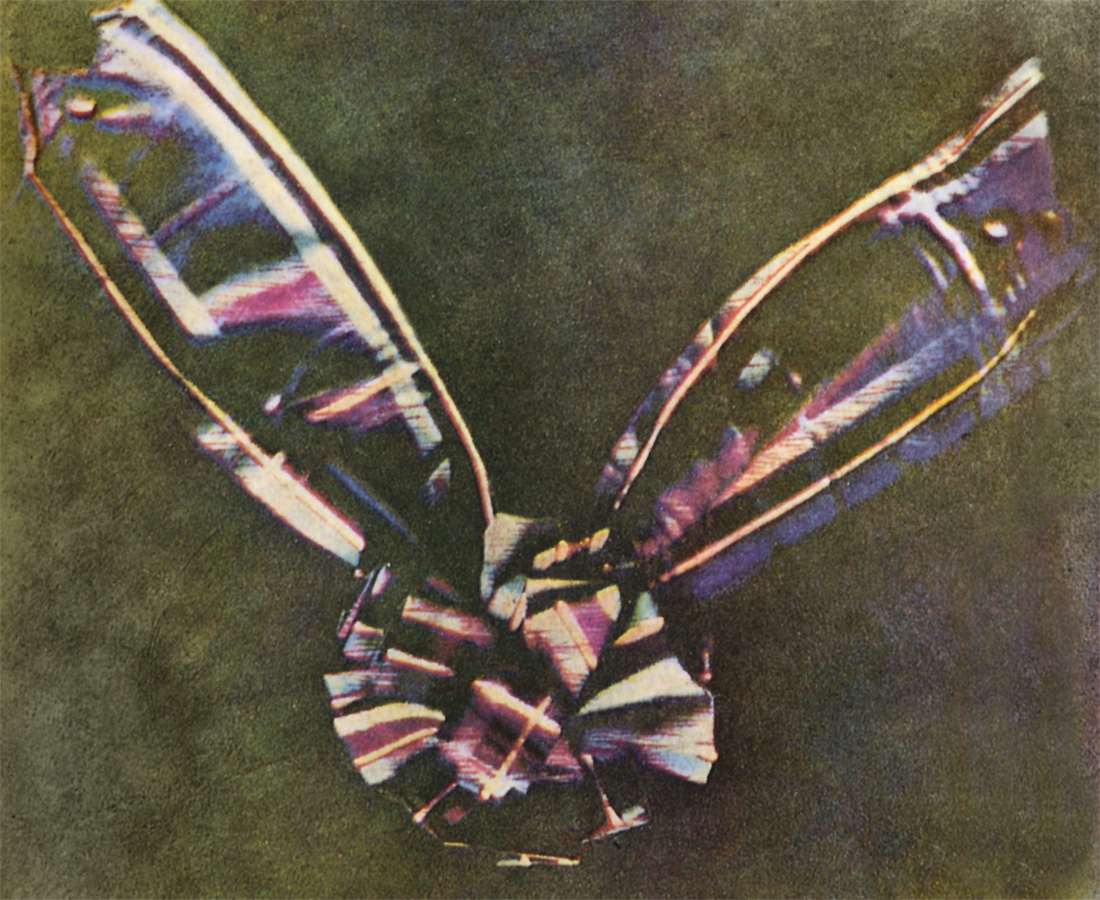
The foundation of all practical color processes, the three-color method was first suggested in an 1855 paper by Scottish physicist James Clerk Maxwell, with the first color photograph produced by Thomas Sutton for a Maxwell lecture in 1861. Color photography has been the dominant form of photography since the 1970s, with monochrome photography mostly relegated to niche markets such as fine art photography.
Color photography was attempted beginning in the 1840s. Early experiments were directed at finding a "chameleon substance" which would assume the color of the light falling on it. Some early results, typically obtained by projecting a solar spectrum directly onto the sensitive surface, seemed to promise eventual success, but the comparatively dim image formed in a camera required exposures lasting for hours or even days. The quality and range of the color was sometimes limited mainly to primary colors, as in the chemically complicated "Hillotype" process invented by American daguerreotypist Levi Hill around 1850. Other experimenters, such as Edmond Becquerel, achieved better results but could find no way to prevent the colors from quickly fading when the images were exposed to light for viewing. Over the following decades experimentation continued without practical results.
The three-color method, the foundation of most color processes, chemical or electronic, was first suggested in an 1855 paper on color vision by Scottish physicist James Clerk Maxwell.
The method is based on the Young–Helmholtz theory, which states that the human eye sees color using millions of intermingled cone cells of three types on its inner surface. According to the theory, one type of cone is most sensitive to the end of the spectrum called "red", another is sensitive to the middle or "green" region, and the third is sensitive to the "blue" region. The named colors are arbitrary divisions imposed on the continuous spectrum of visible light and the theory is not an entirely accurate description of cone sensitivity. The simple description of these three colors coincides enough with the sensations experienced by the eye that when these three colors are used the three cones types are adequately and unequally stimulated to form the illusion of various intermediate wavelengths of light.
In his studies of color vision, Maxwell showed, by using a rotating disk with which he could alter the proportions, that any visible hue or gray tone could be made by mixing only three pure colors of light – red, green and blue – in proportions that would stimulate the three types of cells to the same degrees under particular lighting conditions. To emphasize that each type of cell by itself did not actually see color but was simply more or less stimulated, he drew an analogy to black-and-white photography: if three colorless photographs of the same scene were taken through red, green and blue filters, and transparencies ("slides") made from them were projected through the same filters and superimposed on a screen, the result would be an image reproducing not only red, green and blue, but all of the colors in the original scene.
Color photography
Color photography (also spelled as colour photography in Commonwealth English) is photography that uses media capable of capturing and reproducing colors. By contrast, black-and-white or gray-monochrome photography records only a single channel of luminance (brightness) and uses media capable only of showing shades of gray.
In color photography, electronic sensors or light-sensitive chemicals record color information at the time of exposure. This is usually done by analyzing the spectrum of colors into three channels of information, one dominated by red, another by green and the third by blue, in imitation of the way the normal human eye senses color. The recorded information is then used to reproduce the original colors by mixing various proportions of red, green and blue light (RGB color, used by video displays, digital projectors and some historical photographic processes), or by using dyes or pigments to remove various proportions of the red, green and blue which are present in white light (CMY color, used for prints on paper and transparencies on film).
Monochrome images which have been "colorized" by tinting selected areas by hand or mechanically or with the aid of a computer are "colored photographs", not "color photographs". Their colors are not dependent on the actual colors of the objects photographed and may be inaccurate.
The foundation of all practical color processes, the three-color method was first suggested in an 1855 paper by Scottish physicist James Clerk Maxwell, with the first color photograph produced by Thomas Sutton for a Maxwell lecture in 1861. Color photography has been the dominant form of photography since the 1970s, with monochrome photography mostly relegated to niche markets such as fine art photography.
Color photography was attempted beginning in the 1840s. Early experiments were directed at finding a "chameleon substance" which would assume the color of the light falling on it. Some early results, typically obtained by projecting a solar spectrum directly onto the sensitive surface, seemed to promise eventual success, but the comparatively dim image formed in a camera required exposures lasting for hours or even days. The quality and range of the color was sometimes limited mainly to primary colors, as in the chemically complicated "Hillotype" process invented by American daguerreotypist Levi Hill around 1850. Other experimenters, such as Edmond Becquerel, achieved better results but could find no way to prevent the colors from quickly fading when the images were exposed to light for viewing. Over the following decades experimentation continued without practical results.
The three-color method, the foundation of most color processes, chemical or electronic, was first suggested in an 1855 paper on color vision by Scottish physicist James Clerk Maxwell.
The method is based on the Young–Helmholtz theory, which states that the human eye sees color using millions of intermingled cone cells of three types on its inner surface. According to the theory, one type of cone is most sensitive to the end of the spectrum called "red", another is sensitive to the middle or "green" region, and the third is sensitive to the "blue" region. The named colors are arbitrary divisions imposed on the continuous spectrum of visible light and the theory is not an entirely accurate description of cone sensitivity. The simple description of these three colors coincides enough with the sensations experienced by the eye that when these three colors are used the three cones types are adequately and unequally stimulated to form the illusion of various intermediate wavelengths of light.
In his studies of color vision, Maxwell showed, by using a rotating disk with which he could alter the proportions, that any visible hue or gray tone could be made by mixing only three pure colors of light – red, green and blue – in proportions that would stimulate the three types of cells to the same degrees under particular lighting conditions. To emphasize that each type of cell by itself did not actually see color but was simply more or less stimulated, he drew an analogy to black-and-white photography: if three colorless photographs of the same scene were taken through red, green and blue filters, and transparencies ("slides") made from them were projected through the same filters and superimposed on a screen, the result would be an image reproducing not only red, green and blue, but all of the colors in the original scene.
Recent media
Recent media