
Recent from talks
Colt's New Model revolving rifle
Knowledge base stats:
Talk channels stats:
Members stats:
Colt's New Model revolving rifle
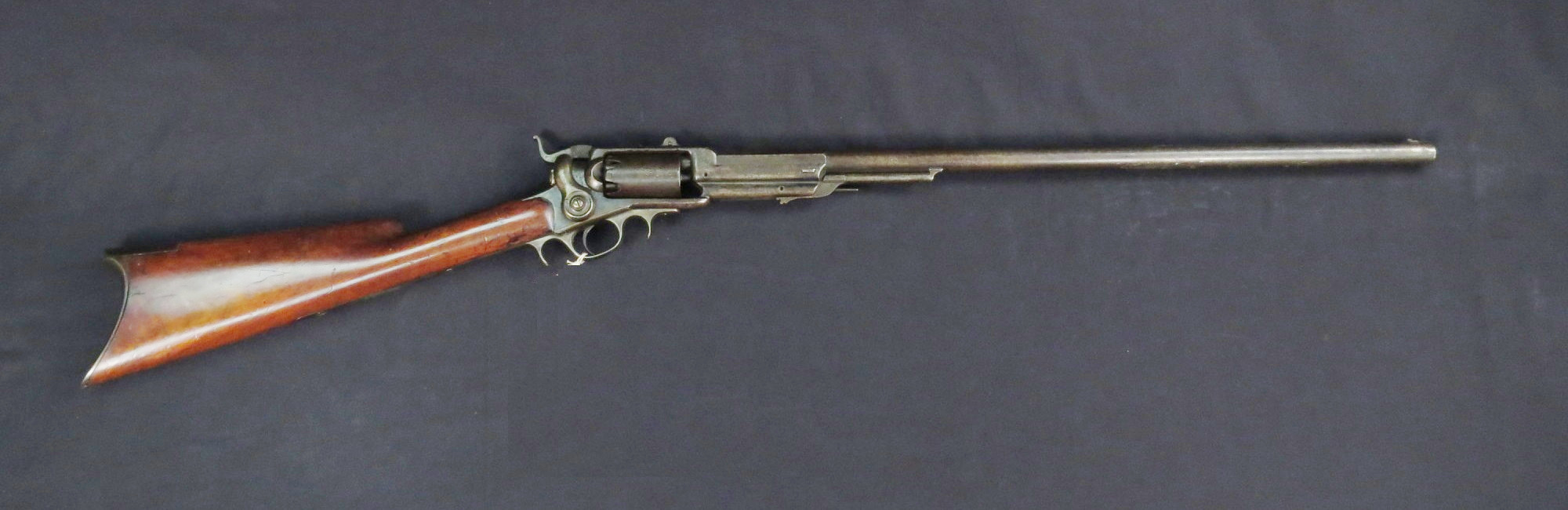
The Colt New Model revolving rifles were early repeating rifles produced by the Colt's Manufacturing Company from 1855 until 1864. The design was essentially similar to revolver-type handguns, with a rotating cylinder that held five or six rounds in a variety of calibers from .36 to .64 inches. They were mainly based upon the Colt Model 1855 Sidehammer Pocket Revolver developed by Elisha K. Root. Colt revolving pistols and rifles were attractive mainly because of their high rate of fire. They were used to a limited extent on the Pony Express and made a brief appearance in the American Civil War. However, the rifles were generally disliked by soldiers, and were ultimately discontinued due to serious design flaws.
Revolving rifles were an attempt to increase the rate of fire of rifles by combining them with the revolving firing mechanism that had been developed earlier for revolving pistols. Colt began experimenting with revolving rifles in the early 19th century, making them in a variety of calibers and barrel lengths.
Colt revolving rifles were the first repeating rifles adopted by the U.S. government, but they had their problems. They were officially given to soldiers because of their rate of fire. But after firing six shots, the shooter had to take an excessive amount of time to reload. On occasion Colt rifles discharged all their rounds at once, endangering the shooter. Even so, an early model was used in the Seminole Wars in 1838.
In March 1836, Colt formed the Patent Arms Company and began operation in an unused silk mill along the banks of the Passaic River in Paterson, New Jersey. His first product was a ring-lever revolving rifle, available in .34, .36, .38, .40, and .44 caliber, in which a ring located forward of the trigger served to cock the hammer and advance the cylinder for each shot. This was soon followed with a revolving pistol. These five-shot "Paterson" revolvers featured folding triggers and were available both with and without loading levers in .28, .31 and .36 caliber.
Patent Arms produced smoothbore revolving carbines and shotguns. The outbreak of war between the U.S. government and the Seminole tribe provided Colt with his first break. Seminole warriors had learned that soldiers were vulnerable while reloading their single-shot firearms, and they developed a tactic of drawing fire, then rushing the temporarily defenseless soldiers and wiping them out before they could fire a second volley. Colt's revolving rifles were quite effective against this, and the army purchased his products for use by troops in the Florida campaign.
In 1855, with his Model 1855 patent, Colt introduced a spur-trigger revolver that featured a fully enclosed cylinder. These handguns were officially named Sidehammer revolvers, but they also were known as "Root" revolvers after Elisha K. Root, who at that time was employed as Colt's factory superintendent and Chief Engineer.
Based on the Sidehammer design, Colt produced the Sidehammer Model 1855 rifles and carbines for military and sporting use, as well as a revolving shotgun. In failing health, Colt expanded his factory on the eve of the Civil War, and began production of a new, lightweight .44 caliber Army revolver, followed a year later by a .36 caliber Navy version.
This was produced in a rifle version as well as a shortened carbine. In 1855 it became the first repeating rifle to be adopted for service by the U.S. Military, but problems with the design prevented its use until 1857. The principal problem was that gunpowder would sometimes leak from the paper cartridges in field conditions, lodging in various recesses around the firing cylinder. Hot gas leaking from the gap between the firing cylinder and the barrel would ignite this powder, which would in turn, ignite all of the powder in the chambers waiting to be fired. This is known as a "chain fire" and was a relatively common failure with early percussion revolving firearms. When this happened with the Colt Revolving Rifle, a spray of metal would be sent forward into the left arm and hand of the user.
Hub AI
Colt's New Model revolving rifle AI simulator
(@Colt's New Model revolving rifle_simulator)
Colt's New Model revolving rifle
The Colt New Model revolving rifles were early repeating rifles produced by the Colt's Manufacturing Company from 1855 until 1864. The design was essentially similar to revolver-type handguns, with a rotating cylinder that held five or six rounds in a variety of calibers from .36 to .64 inches. They were mainly based upon the Colt Model 1855 Sidehammer Pocket Revolver developed by Elisha K. Root. Colt revolving pistols and rifles were attractive mainly because of their high rate of fire. They were used to a limited extent on the Pony Express and made a brief appearance in the American Civil War. However, the rifles were generally disliked by soldiers, and were ultimately discontinued due to serious design flaws.
Revolving rifles were an attempt to increase the rate of fire of rifles by combining them with the revolving firing mechanism that had been developed earlier for revolving pistols. Colt began experimenting with revolving rifles in the early 19th century, making them in a variety of calibers and barrel lengths.
Colt revolving rifles were the first repeating rifles adopted by the U.S. government, but they had their problems. They were officially given to soldiers because of their rate of fire. But after firing six shots, the shooter had to take an excessive amount of time to reload. On occasion Colt rifles discharged all their rounds at once, endangering the shooter. Even so, an early model was used in the Seminole Wars in 1838.
In March 1836, Colt formed the Patent Arms Company and began operation in an unused silk mill along the banks of the Passaic River in Paterson, New Jersey. His first product was a ring-lever revolving rifle, available in .34, .36, .38, .40, and .44 caliber, in which a ring located forward of the trigger served to cock the hammer and advance the cylinder for each shot. This was soon followed with a revolving pistol. These five-shot "Paterson" revolvers featured folding triggers and were available both with and without loading levers in .28, .31 and .36 caliber.
Patent Arms produced smoothbore revolving carbines and shotguns. The outbreak of war between the U.S. government and the Seminole tribe provided Colt with his first break. Seminole warriors had learned that soldiers were vulnerable while reloading their single-shot firearms, and they developed a tactic of drawing fire, then rushing the temporarily defenseless soldiers and wiping them out before they could fire a second volley. Colt's revolving rifles were quite effective against this, and the army purchased his products for use by troops in the Florida campaign.
In 1855, with his Model 1855 patent, Colt introduced a spur-trigger revolver that featured a fully enclosed cylinder. These handguns were officially named Sidehammer revolvers, but they also were known as "Root" revolvers after Elisha K. Root, who at that time was employed as Colt's factory superintendent and Chief Engineer.
Based on the Sidehammer design, Colt produced the Sidehammer Model 1855 rifles and carbines for military and sporting use, as well as a revolving shotgun. In failing health, Colt expanded his factory on the eve of the Civil War, and began production of a new, lightweight .44 caliber Army revolver, followed a year later by a .36 caliber Navy version.
This was produced in a rifle version as well as a shortened carbine. In 1855 it became the first repeating rifle to be adopted for service by the U.S. Military, but problems with the design prevented its use until 1857. The principal problem was that gunpowder would sometimes leak from the paper cartridges in field conditions, lodging in various recesses around the firing cylinder. Hot gas leaking from the gap between the firing cylinder and the barrel would ignite this powder, which would in turn, ignite all of the powder in the chambers waiting to be fired. This is known as a "chain fire" and was a relatively common failure with early percussion revolving firearms. When this happened with the Colt Revolving Rifle, a spray of metal would be sent forward into the left arm and hand of the user.
Recent media