


Community hub
Recent from talks
Contribute something to knowledge base
Content stats: 0 posts, 0 articles, 1 media, 0 notes
Members stats: 0 subscribers, 0 contributors, 0 moderators, 0 supporters
Subscribers
Supporters
Contributors
Moderators
Hub AI
Colville Indian Reservation AI simulator
(@Colville Indian Reservation_simulator)
Hub AI
Colville Indian Reservation AI simulator
(@Colville Indian Reservation_simulator)
Colville Indian Reservation
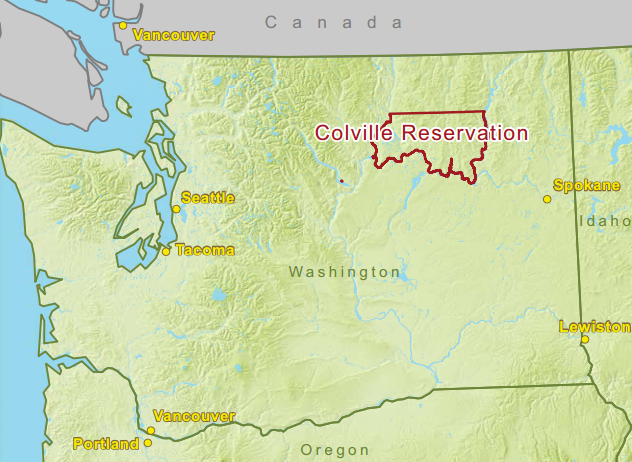
The Colville Indian Reservation is an Indian reservation located in Washington state, U.S. It is inhabited and managed by the Confederated Tribes of the Colville Reservation, who are a federally recognized tribe of Interior Salish peoples.
Established in 1872, the reservation currently consists of 2,825,000 acres (4,410 sq mi; 11,430 km2). It includes the southeastern part of Okanogan County and the southern half of Ferry County. The reservation's name is taken from that of Fort Colville, which was named by British colonists for Andrew Colville, a London governor of the Hudson's Bay Company.
The Confederated Tribes have 8,700 descendants from twelve bands of Indigenous peoples of the Northwestern Plateau. The tribes are known in English as: the Colville, Nespelem, Sanpoil, Lakes (after the Arrow Lakes of British Columbia, or Sinixt), Palus, Wenatchi, Chelan, Entiat, Methow, southern Okanagan, Sinkiuse-Columbia, and Nez Perce of Chief Joseph's Band. Some members of the Spokane tribe also settled the Colville reservation after it was established.
The most common of the indigenous languages spoken on the reservation is Colville-Okanagan, a Salishan language. Other tribes speak other Salishan languages, with the exception of the Nez Perce and Palus, who speak Sahaptian languages.
Before the influx of British and Americans in the mid-1850s, the ancestors of the 12 aboriginal tribes followed seasonal cycles to gather their food sources. They moved to the rivers for salmon and other fish runs, mountain meadows for berries and deer, or the plateau for roots. Their traditional territories were grouped primarily around waterways, such as the Columbia, San Poil, Nespelem, Okanogan, Snake, and Wallowa rivers.
Many tribal ancestors ranged throughout their aboriginal territories and other areas in the Northwest (including British Columbia), gathering with other native peoples for traditional activities such as food harvesting, feasting, trading, and celebrations that included sports and gambling. Their lives were tied to the cycles of nature, both spiritually and traditionally.
In the mid-19th century, when European-American settlers began competing for trade with the indigenous native peoples, many tribes began to migrate westward. Trading and its goods became a bigger part of their lives.
For a while, Great Britain and the United States disputed the territory of what the latter called the Oregon Country and the former the Columbia District. Both claimed the territory until they agreed on the Oregon Treaty of 1846, which established United States title south of the 49th Parallel. They did not consider any of the indigenous peoples living in those territories to be citizens or entitled to the lands by their own national claims. However, according to the religions and traditions of the indigenous peoples, this territory had been their home land since the time of creation. A succession of indigenous cultures had occupied this region for more than 10,000 years.[citation needed]
Colville Indian Reservation
The Colville Indian Reservation is an Indian reservation located in Washington state, U.S. It is inhabited and managed by the Confederated Tribes of the Colville Reservation, who are a federally recognized tribe of Interior Salish peoples.
Established in 1872, the reservation currently consists of 2,825,000 acres (4,410 sq mi; 11,430 km2). It includes the southeastern part of Okanogan County and the southern half of Ferry County. The reservation's name is taken from that of Fort Colville, which was named by British colonists for Andrew Colville, a London governor of the Hudson's Bay Company.
The Confederated Tribes have 8,700 descendants from twelve bands of Indigenous peoples of the Northwestern Plateau. The tribes are known in English as: the Colville, Nespelem, Sanpoil, Lakes (after the Arrow Lakes of British Columbia, or Sinixt), Palus, Wenatchi, Chelan, Entiat, Methow, southern Okanagan, Sinkiuse-Columbia, and Nez Perce of Chief Joseph's Band. Some members of the Spokane tribe also settled the Colville reservation after it was established.
The most common of the indigenous languages spoken on the reservation is Colville-Okanagan, a Salishan language. Other tribes speak other Salishan languages, with the exception of the Nez Perce and Palus, who speak Sahaptian languages.
Before the influx of British and Americans in the mid-1850s, the ancestors of the 12 aboriginal tribes followed seasonal cycles to gather their food sources. They moved to the rivers for salmon and other fish runs, mountain meadows for berries and deer, or the plateau for roots. Their traditional territories were grouped primarily around waterways, such as the Columbia, San Poil, Nespelem, Okanogan, Snake, and Wallowa rivers.
Many tribal ancestors ranged throughout their aboriginal territories and other areas in the Northwest (including British Columbia), gathering with other native peoples for traditional activities such as food harvesting, feasting, trading, and celebrations that included sports and gambling. Their lives were tied to the cycles of nature, both spiritually and traditionally.
In the mid-19th century, when European-American settlers began competing for trade with the indigenous native peoples, many tribes began to migrate westward. Trading and its goods became a bigger part of their lives.
For a while, Great Britain and the United States disputed the territory of what the latter called the Oregon Country and the former the Columbia District. Both claimed the territory until they agreed on the Oregon Treaty of 1846, which established United States title south of the 49th Parallel. They did not consider any of the indigenous peoples living in those territories to be citizens or entitled to the lands by their own national claims. However, according to the religions and traditions of the indigenous peoples, this territory had been their home land since the time of creation. A succession of indigenous cultures had occupied this region for more than 10,000 years.[citation needed]
Recent media
Recent media