
Recent from talks
4P/Faye
Knowledge base stats:
Talk channels stats:
Members stats:
4P/Faye
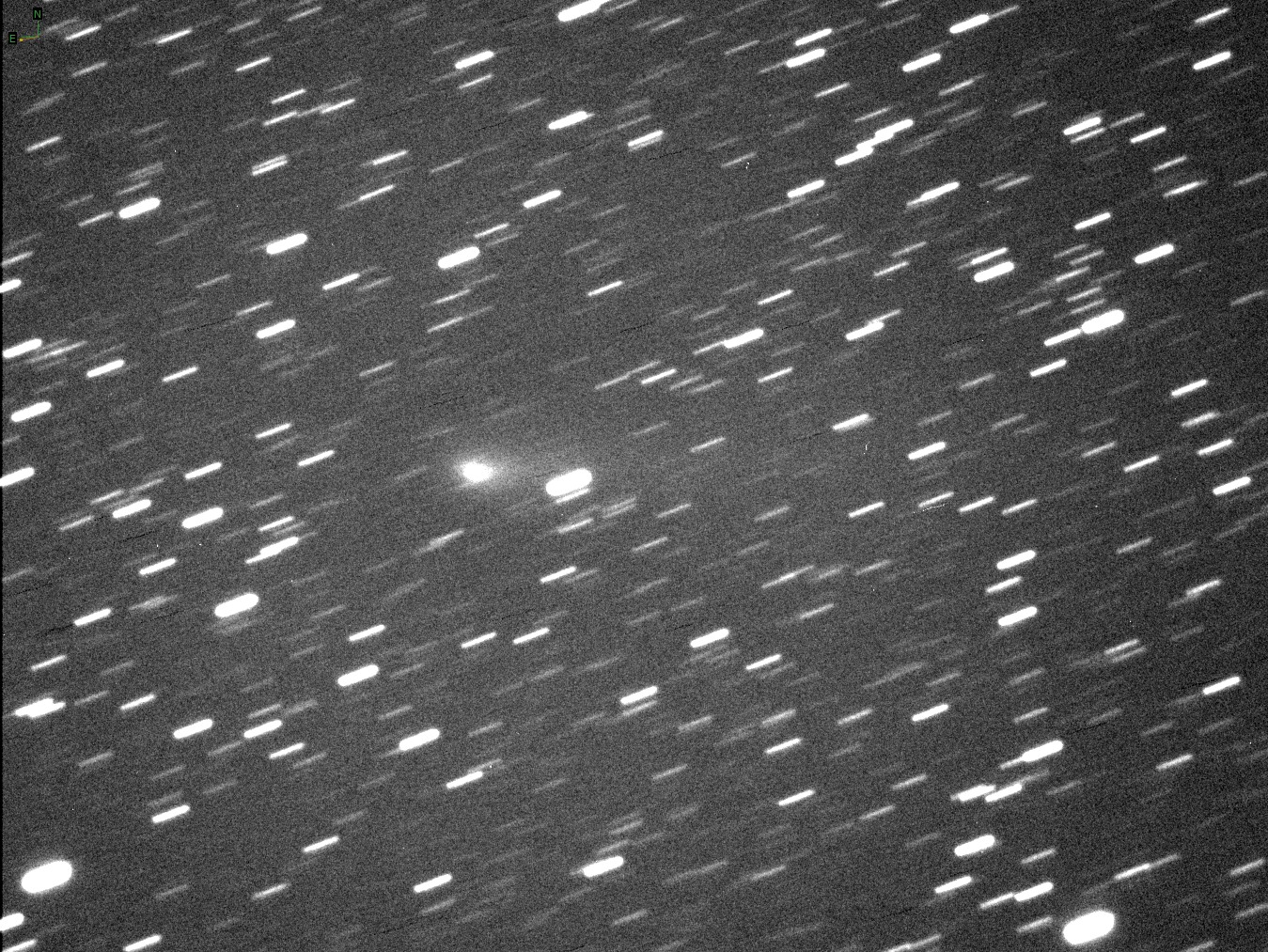
4P/Faye (also known as Faye's Comet or Comet Faye) is a Jupiter-family comet discovered in November 1843 by Hervé Faye at the Royal Observatory in Paris. On 24 August 2028 the comet will be 1.5 AU from Earth with a solar elongation of 150 degrees at around magnitude 14. The comet comes to perihelion on 9 March 2029.
The comet was first observed by Faye on November 23, but bad weather prevented its confirmation until the 25th. It was so faint that it had already passed perihelion about a month before its discovery, and only a close pass by the Earth had made it bright enough for discovery. Otto Wilhelm von Struve reported that the comet was visible to the naked eye at the end of November. It remained visible for smaller telescopes until January 10, 1844, and was finally lost to larger telescopes on April 10, 1844.
In 1844, Friedrich Wilhelm Argelander and Thomas James Henderson independently computed that the comet was a short-period comet; by May, its period had been calculated to be 7.43 years. Urbain Le Verrier computed the positions for the 1851 apparition, predicting perihelion in April 1851. The comet was found close to its predicted position on November 29, 1850, by James Challis.
The comet was missed during its apparitions in 1903 and 1918 due to unfavorable observing circumstances. It reached a brightness of about 9th magnitude in 2006.
The comet encounters Jupiter once every 59.3 years, which is gradually reducing its perihelion and increasing its orbital eccentricity. During its 2018 encounter of Jupiter, Faye's perihelion changed from about 1.7 AU to about 1.5 AU. Orbital calculations spanning from 1660 to 2060 revealed that it made nine approaches that are less than 1.5 AU (220 million km) from Jupiter, although no significant perturbations were observed.
Observations from the Hubble Space Telescope between July 1999 and June 2000 revealed that the nucleus of Faye's Comet is estimated to be about 3.54 km (2.20 mi) in diameter.
Hub AI
4P/Faye AI simulator
(@4P/Faye_simulator)
4P/Faye
4P/Faye (also known as Faye's Comet or Comet Faye) is a Jupiter-family comet discovered in November 1843 by Hervé Faye at the Royal Observatory in Paris. On 24 August 2028 the comet will be 1.5 AU from Earth with a solar elongation of 150 degrees at around magnitude 14. The comet comes to perihelion on 9 March 2029.
The comet was first observed by Faye on November 23, but bad weather prevented its confirmation until the 25th. It was so faint that it had already passed perihelion about a month before its discovery, and only a close pass by the Earth had made it bright enough for discovery. Otto Wilhelm von Struve reported that the comet was visible to the naked eye at the end of November. It remained visible for smaller telescopes until January 10, 1844, and was finally lost to larger telescopes on April 10, 1844.
In 1844, Friedrich Wilhelm Argelander and Thomas James Henderson independently computed that the comet was a short-period comet; by May, its period had been calculated to be 7.43 years. Urbain Le Verrier computed the positions for the 1851 apparition, predicting perihelion in April 1851. The comet was found close to its predicted position on November 29, 1850, by James Challis.
The comet was missed during its apparitions in 1903 and 1918 due to unfavorable observing circumstances. It reached a brightness of about 9th magnitude in 2006.
The comet encounters Jupiter once every 59.3 years, which is gradually reducing its perihelion and increasing its orbital eccentricity. During its 2018 encounter of Jupiter, Faye's perihelion changed from about 1.7 AU to about 1.5 AU. Orbital calculations spanning from 1660 to 2060 revealed that it made nine approaches that are less than 1.5 AU (220 million km) from Jupiter, although no significant perturbations were observed.
Observations from the Hubble Space Telescope between July 1999 and June 2000 revealed that the nucleus of Faye's Comet is estimated to be about 3.54 km (2.20 mi) in diameter.
Recent media