Hubbry Logo
Common Proficiency TestCommon Proficiency TestMain
Open search
Common Proficiency Test
Community hub
Common Proficiency Test
logo
8 pages, 0 posts
0 subscribers
Be the first to start a discussion here.
Common Proficiency Test
from Wikipedia

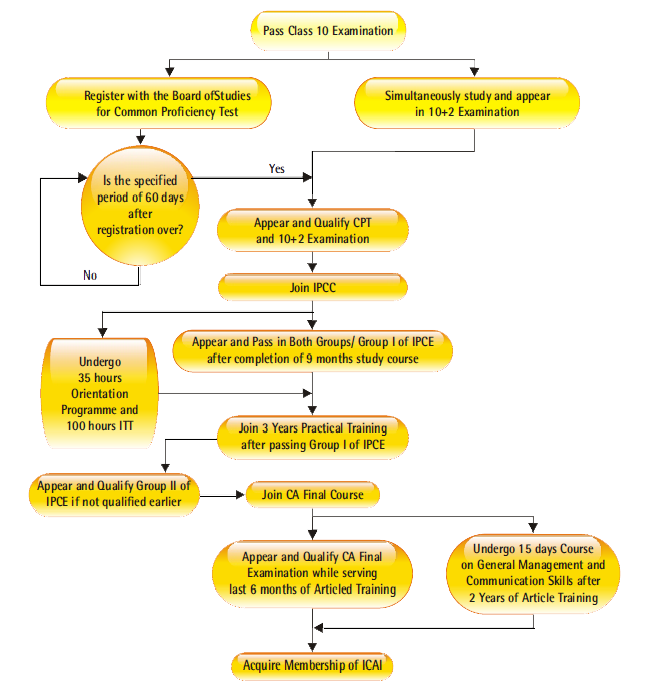
Flowchart on how to become a Chartered Accountant by the Examination route

The CPT or Common Proficiency Test was the first level of Chartered Accountancy examinations in India which has been changed to CA Foundation according to ICAI's revised scheme.[1]

Eligibility

[edit]

A person can register for CPT after completing Grade 10 and take the exam after completing High School (Grade 12) and complete graduation for commerce

Test model

[edit]

It is an objective type examination and consists of 200 multiple choice questions. CPT covers four basic subjects divided into two sections viz.

1.Accounting (60 Marks) + Mercantile Laws (40 Marks)

2.Economics (50 Marks) + Quantitative Aptitude (50 Marks)

Every incorrect answer on the CPT exam carries a 0.25 negative mark. A candidate is required to secure a minimum of 30 per cent marks in each Section and a minimum of 50 per cent marks in aggregate, in all the four Sections to pass the Common Proficiency Test.

Exam dates

[edit]

CPT exams are held in June and December

Result Dates

[edit]

CPT Result is declared in the month of July and January. June exam's result is declared during 12–20 July and December exam's result is declared during 12–20 January.

Exemption

[edit]

But with effect from 3 August 2012, CPT is exempted for the Graduates, Post Graduates and the students having equivalent degrees. Commerce graduates with 55% and other graduates with 60% can take direct admission for IPCC.

See also

[edit]

References

[edit]
Revisions and contributorsEdit on WikipediaRead on Wikipedia
from Grokipedia
The Common Proficiency Test (CPT) was the entry-level examination for admission to the Chartered Accountancy (CA) course in , administered by the Institute of Chartered Accountants of India (ICAI). Introduced in 2006 as a replacement for the earlier Professional Education (Course-I) exam, it evaluated candidates' foundational knowledge through an objective-type format consisting of 200 multiple-choice questions divided into two sessions. The CPT syllabus encompassed four core subjects: Fundamentals of Accounting (60 questions), Mercantile Laws (40 questions), General Economics (50 questions), and Quantitative (50 questions), with a total duration of four hours. Candidates could register after passing Class 10 examinations, but were eligible to appear only after passing or appearing for Class 12, allowing early registration to begin preparatory studies alongside higher . The exam was held biannually in June and December, serving as a gateway to the Integrated Professional Competence Course (IPCC), the next stage in the CA qualification process. Passing required a minimum of 50% aggregate marks, with at least 30% in each section, and results were typically declared within 45 days. Although the CPT facilitated thousands of registrations annually and played a pivotal role in standardizing entry to the CA profession, ICAI discontinued new registrations under the existing scheme effective July 1, 2017, as part of a revised education framework. The final CPT examination occurred in June 2019, after which it was fully replaced by the CA Foundation course, which maintains a similar entry-level purpose but incorporates updated syllabus elements and a mix of objective and subjective question formats. This transition aimed to align the more closely with evolving professional demands in , auditing, and laws.

Overview and Background

Introduction

The Common Proficiency Test (CPT) was the foundational entry-level examination for the Chartered Accountancy (CA) course in , administered by the Institute of Chartered Accountants of India (ICAI) from its in 2006 until its discontinuation in 2017. Introduced as part of a revised CA to streamline the qualification process, the CPT replaced earlier subjective entry assessments and allowed students who had passed Class 10 to register directly, shortening the overall course duration. The primary purpose of the CPT was to evaluate aspiring chartered accountants' fundamental knowledge and aptitude in core areas, including fundamentals of , mercantile laws, general , and quantitative . This objective-type test, consisting of 200 multiple-choice questions divided into two sessions, aimed to standardize the screening process for the rigorous CA program by focusing on conceptual understanding and problem-solving skills rather than rote memorization. Successful completion of the CPT served as the mandatory gateway to the CA Intermediate level, ensuring only qualified candidates proceeded to advanced professional training and articleship. At its peak, the CPT attracted over 200,000 registrations annually across its biannual sessions in and , reflecting the growing popularity of the CA qualification in . Pass rates typically hovered between 20% and 30%, with notable examples including 28.39% in the June 2019 session (the final one for legacy students) and 25.89% in December 2016, underscoring the exam's competitive nature. In 2017, the ICAI discontinued new registrations for the CPT under a new education scheme effective July 1, 2017, replacing it with the to align with evolving professional standards and provide a more integrated learning pathway.

Historical Context and Evolution

The Common Proficiency Test (CPT) was introduced by the Institute of Chartered Accountants of (ICAI) on September 13, 2006, through amendments to the Chartered Accountants Regulations, 1988, as part of a revamped education and training scheme for the Chartered Accountancy course. It replaced the existing Professional Education (Course-I) and Professional Education (Course-II) examinations, which had been the entry-level requirements, by offering a single objective-type test as a more streamlined and accessible gateway for students post-10th grade, thereby broadening access to the profession. The inaugural CPT examination took place on November 12, 2006, marking the formal launch of this entry-level assessment. From its inception, the CPT was held twice annually—in June and December—in a paper-pencil format across multiple centers in and abroad, allowing students to register up to four months prior to the exam date. In 2011, ICAI transitioned the CPT to a computer-based mode, beginning with mock tests in November to familiarize candidates and streamline administration, which enhanced efficiency and reduced logistical challenges. Over the years, the CPT faced scrutiny for consistently low pass rates, often hovering around 20-30% per session, which highlighted the need for reforms to better equip aspirants for evolving professional demands. In response, ICAI approved a revised scheme of education and training in May 2017, effective from July 1, 2017, discontinuing new registrations for CPT after June 30, 2017, with the final examination conducted in June 2019. This shift addressed longstanding calls for modernization, including an updated and more rigorous foundational preparation. The CPT was succeeded by the CA Foundation course, with its first examination in May 2018, introducing features like mandatory self-study (at least 30% of total study hours) and passing criteria of 40% marks per paper alongside a 50% aggregate, while incorporating contemporary topics aligned with international standards such as the (IFRS). During its 11-year run from 2006 to 2017, the CPT significantly boosted enrollment in the CA program, with annual appearances exceeding 100,000 candidates by the mid-2010s, contributing to a surge in overall aspirants and reflecting the test's role in democratizing access to accountancy education.

Eligibility and Registration

Eligibility Criteria

The Common Proficiency Test (CPT), administered by the Institute of Chartered Accountants of (ICAI), required candidates to meet specific educational qualifications for registration and examination appearance during its operational period from 2006 to 2019. Registration for the CPT course was open to students who had passed the Class 10 examination conducted by an examining body constituted by law in or an equivalent examination recognized by the . However, to be eligible to appear for the CPT examination, candidates needed to have either passed the Senior Secondary Examination (Class 12 or ) or an equivalent examination, appeared in the Class 12 examination, or completed two years of higher education including a diploma course after passing Class 10, as conducted by central or state governments or recognized universities. While a commerce stream background was preferred, the test was open to candidates from all academic streams, ensuring broader accessibility to the Chartered Accountancy course. There was no upper age limit for registering or appearing in the CPT, allowing candidates of any age to pursue the qualification provided they met the educational criteria; the minimum age was effectively around 16 years, aligned with typical completion of Class 10. Candidates were also required to complete a minimum study period of four months after registration before becoming eligible to sit for the examination, during which they received study materials and oral tuition from ICAI. Provisional registration was permitted for students who had passed Class 10 but were appearing in Class 12; such candidates could provisionally appear in the CPT provided they submitted proof of passing Class 12 within the stipulated time, failing which their results would be withheld. Working professionals and graduates were eligible to register under the same criteria but had to fulfill the four-month study period requirement, though certain graduates could opt for direct entry to the subsequent level with exemptions subject to separate provisions. Following the revision of the ICAI's education scheme in 2017, effective from , 2017, new registrations for CPT were discontinued after June 30, 2017, and the CPT was replaced by the , which streamlined eligibility by requiring candidates to have passed Class 12 or an equivalent examination directly for appearance, with registration still open after Class 10 but no provisional appearance allowed before passing Class 12. This transition aimed to align the entry-level assessment more closely with higher secondary completion, eliminating the earlier flexibility for pre-result appearances.

Registration Process

The registration for the Common Proficiency Test (CPT) was facilitated through the official website of the Institute of Chartered Accountants of India (ICAI), where candidates could access and submit the application form online. Forms were available throughout the year, allowing prospective students to initiate the process at their convenience, though submission had to adhere to specific cut-off dates to qualify for upcoming exam sessions. The online portal required candidates to create an account, fill in personal and educational details, and complete the submission electronically. Candidates had to prepare and or submit several required documents during the registration , including attested copies of proof of age or date of birth (such as the Class 10 certificate), marksheets of Class 10 and Class 12 (if applicable for eligibility verification), and recent passport-sized photographs affixed as per guidelines. For fee payment, options included online modes through the portal or drawn in favor of "The Secretary, The Institute of Chartered Accountants of India," payable at . Incomplete documentation or mismatched details, such as name or date of birth from the 10th/12th certificates, could lead to rejection, with no changes permitted post-submission. The registration fee for Indian students was ₹6,000, which encompassed the cost of the CPT study material dispatched to the registered address. For students residing abroad or from foreign countries, the fee was higher at approximately ₹9,000, also including study materials; payments in such cases required equivalent foreign currency or specific banking instructions via the ICAI portal. This fee structure was revised in 2009 to reflect operational costs, and it applied uniformly unless exemptions or concessions were notified separately. To be eligible for the CPT examination, candidates had to complete registration by of that year; for the December session, the deadline was October 1. These timelines ensured sufficient preparation time, including any referenced eligibility thresholds such as minimum educational qualifications. Late registrations were not accepted, and candidates missing the cut-off had to wait for the next cycle. Following successful registration and verification, ICAI issued the CPT study material, including textbooks and supplementary resources, to the candidate's provided address, typically within a few weeks. Additionally, while not compulsory for the CPT itself, many students opted for the 100 hours of oral tuition program offered through ICAI-approved centers to build foundational knowledge; completion of such coaching, along with any required certificate, supported progression to subsequent CA levels.

Test Structure

Exam Format

The Common Proficiency Test (CPT) was conducted in a pen-and-paper format. The exam consisted of two sessions lasting 2 hours each, with a 1-hour break between them, during which candidates completed all questions. The test comprised 200 multiple-choice questions (MCQs) in total, divided into two sections of 100 marks each: Section A covering and Mercantile Laws, and Section B covering and . Each question carried 1 mark, making the overall exam worth 200 marks. The marking scheme awarded +1 mark for each correct answer and deducted 0.25 marks for each incorrect answer, with no penalty for unattempted questions. The exam was offered in bilingual format, with questions available in English and . To pass the CPT, candidates had to secure at least 50% marks in aggregate across both sections, along with a minimum of 30% in each individual section from the May 2012 examination onward.

Syllabus and Subjects

The Common Proficiency Test (CPT) syllabus was structured around four key subjects, divided into two sessions of two hours each, totaling 200 multiple-choice questions worth 200 marks. These subjects assessed foundational knowledge essential for aspiring chartered accountants, with the following mark (and question) distribution: (60 marks/questions), Mercantile Laws (40 marks/questions), General Economics (50 marks/questions), and Quantitative Aptitude (50 marks/questions). Fundamentals of Accounting focused on core principles and practices, emphasizing the preparation and of financial records. Key topics included the theoretical framework of , the involving journal entries, posting, and ; bank statements; valuation of inventories; concepts of , amortization, and their methods; accounting for bills of exchange and promissory notes; preparation of for sole proprietors; for not-for-profit organizations; and basics of accounts, such as admission, retirement, and dissolution. Company accounts were introduced at a preliminary level, covering issue of shares and debentures. This subject built conceptual understanding of basic mechanics without delving into advanced standards. Mercantile Laws examined essential commercial legislation in , with an emphasis on contractual obligations and transactions. The curriculum covered the , including formation, performance, breach, and remedies for contracts; the Sale of Goods Act, 1930, addressing formation of sales contracts, conditions and warranties, transfer of property, and rights of unpaid sellers; and the Partnership Act, 1932, which detailed the formation, rights and duties of partners, dissolution of firms, and registration requirements. These topics provided a foundational grasp of legal principles governing dealings. General Economics introduced fundamental economic theories and their application to the Indian context, balancing micro and macro perspectives. Microeconomics topics included economic laws, demand and supply analysis, production and cost theories, and price determination in various market structures like and monopoly. Macroeconomics covered national income concepts, money and banking functions, and economic policies. Indian economy-specific areas encompassed post-independence growth, and issues, infrastructure development, agriculture and industry roles, economic reforms since 1991, and the impact of . This subject prioritized conceptual clarity on economic dynamics over complex modeling. Quantitative Aptitude tested mathematical and analytical skills relevant to applications, focusing on basic computations and reasoning. Core areas included ratios and proportions, indices, logarithms, and equations (linear and quadratic); basic such as sets, relations, functions, sequences, series, permutations, and combinations; simple and , along with annuities; introductory statistics covering measures of , dispersion, , and regression; probability basics; and through number series, coding-decoding, and blood relations. The incorporated elementary concepts of limits and continuity but excluded advanced calculus, ensuring alignment with practical quantitative needs in . Candidates prepared using official study materials provided by the Institute of Chartered Accountants of (ICAI), which included detailed modules, practice questions, and mock tests tailored for objective-type preparation. These resources stressed conceptual mastery and application through multiple-choice formats to simulate exam conditions.

Examination Schedule and Results

Exam Dates and Frequency

The Common Proficiency Test (CPT), introduced by the Institute of Chartered Accountants of (ICAI) in 2006 as part of the revised entry-level examination scheme, was conducted twice annually in and sessions until its final administration in 2019. This biannual frequency allowed aspiring chartered accountants to attempt the exam up to three times in parallel with the emerging CA Foundation during the transition period from 2018 to 2019. Examination notifications were issued by ICAI approximately 4-5 months prior to each session, enabling eligible students to apply online, while admit cards were released about 15 days before the test date to facilitate logistical preparations. The exams took place on Sundays at approximately 250 centers across and select international locations, including (UAE), (UAE), (Nepal), and (Oman), with the morning session running from 10:00 AM to 12:00 PM IST for the first half of the objective-type paper. The December 2017 session marked a pivotal point in the transition, but CPT continued for legacy candidates until the concluding June 16, 2019, exam, after which it was fully supplanted by the starting from the May 2018 session onward. Results for CPT were typically declared about one month post-exam, with detailed evaluation processes covered separately.

Result Declaration and Evaluation

The results of the Common Proficiency Test (CPT) are declared approximately one month after the examination, with June session outcomes typically announced in July and December session results in January. Candidates access their results online through the official ICAI website by entering their roll number and date of birth, while physical result cards are dispatched to all examinees within two weeks of declaration; no separate pass certificate is issued. The Institute also publishes merit lists featuring the top 10 rank holders who achieve at least 60% marks overall, along with merit certificates for these candidates. Evaluation of the CPT, an entirely objective multiple-choice exam, relies on centralized (OMR) scanning of answer sheets at ICAI facilities. Given the automated and objective format, revaluation of answers is not permitted, though candidates may apply for mark verification within one month of result announcement for a fee of Rs. 200 to check for scanning errors. Successful candidates become eligible to register for the and begin practical training (articleship) shortly thereafter, typically within six months to align with study period requirements for subsequent exams. Historical pass rates for the CPT have generally averaged around 25-30%, reflecting the exam's rigor; for instance, the pass percentage stood at 28.39% in one session.

Exemptions and Special Provisions

Exemption Criteria

The Common Proficiency Test (CPT), as the entry-level examination for the Chartered Accountancy course in , allowed exemptions for certain qualified candidates to directly enter the Intermediate (Integrated Professional Competence) stage, bypassing the CPT requirement. This provision was introduced to recognize prior academic and professional achievements, effective from August 1, 2012, under Notification No. 1-CA(7)/145/2012 issued by the Institute of Chartered Accountants of (ICAI). Exemptions were granted on two main bases: academic qualifications and completion of intermediate-level examinations from reciprocal professional bodies. Commerce graduates or postgraduates securing at least 55% aggregate marks (or equivalent grades), having studied at least three specified subjects such as , auditing, mercantile laws, , taxation, or costing (each carrying 100 marks), qualified for exemption under Category A. Non-commerce graduates or postgraduates required a minimum of 60% aggregate marks for the same eligibility, with marks in pass-only subjects excluded from calculation and fractions of 0.5 or higher rounded upwards. Under Category B, candidates who had passed the Intermediate examinations of the Institute of Company Secretaries of (ICSI) or the Institute of Cost Accountants of (ICMAI, formerly ICWAI) were also exempted from CPT. No partial exemptions from specific CPT sections were available, as the test was a single qualifying hurdle; however, standard paper-wise exemptions in the subsequent Intermediate course could apply based on performance therein, not prior qualifications. To claim exemption, eligible candidates applied for direct registration to the Intermediate course at ICAI regional or branch offices, submitting the prescribed application form along with attested copies of mark sheets, degree certificates, or Intermediate pass certificates from ICSI/ICMAI, as applicable. ICAI verified the documents, and provisional registration was permitted for final-year students, who had to provide proof of qualifying marks within six months of the Intermediate examination commencement. Exempted candidates under Category A could commence three-year articleship training after completing the Information Technology Training (ITT) and Orientation Course, while Category B candidates required passing at least one group of Intermediate, followed by ITT and Orientation. Non-graduates or those not meeting the percentage thresholds received no exemptions, ensuring the provision applied solely to demonstrably qualified individuals during the CPT regime (2006–2019). Following the replacement of CPT by the under the revised scheme effective from July 2017, with the final CPT examination in June 2019, similar exemption criteria persist for direct entry to the Intermediate level. Graduates/postgraduates in with 55% marks or other streams with 60% marks, along with ICSI/ICMAI Intermediate passers, can bypass Foundation and register directly for Intermediate, subject to ICAI verification and mandatory training requirements.

Accommodations for Candidates

Candidates with permanent disabilities, such as visual or hearing impairments, are eligible for accommodations in the Common Proficiency Test (CPT), including extra time and the assistance of a . The Institute of Chartered Accountants of (ICAI) grants compensatory time based on the extent of the : candidates with less than 50% receive an additional 30 minutes per session, while those with 50% or more are allotted one hour extra. For visually or hearing impaired candidates, scribes are provided from a designated panel, with an honorarium of Rs. 500 per paper or two CPT sessions, and separate examination venues may be arranged to ensure a conducive environment. Applications for these concessions must be submitted using the prescribed ICAI form, accompanied by a from a civil or equivalent, verifying the permanent nature of the , along with supporting documents like registration letters and photographs. Other provisions cater to specific candidate circumstances during CPT administration. Female candidates benefit from dedicated facilities, including frisking conducted exclusively by female staff to maintain privacy and comfort at examination centers. In cases of medical emergencies, candidates may request rescheduling or exemptions with supporting medical proof, though such requests are evaluated on a case-by-case basis by ICAI and typically require submission prior to the exam date. These measures ensure equitable access while adhering to examination protocols. International candidates appearing for CPT have access to adjusted timings and local examination centers in select overseas locations, such as , , , and , to accommodate differences and travel logistics. Additional fees apply for overseas centers, and candidates must select these options during registration to facilitate arrangements. These provisions transitioned into the , which replaced CPT under the revised scheme, with similar accommodations for disabilities continuing, including extra time and scribe assistance, alongside general enhancements in measures.

References

Add your contribution
Related Hubs
User Avatar
No comments yet.