



Community hub
Recent from talks
Knowledge base stats:
Talk channels stats:
Members stats:
Common scold
In the common law of crime in England and Wales, a common scold was a type of public nuisance—a troublesome and angry person who broke the public peace by habitually chastising, arguing, and quarrelling with their neighbours. Most punished for scolding were women, though men could be found to be scolds.
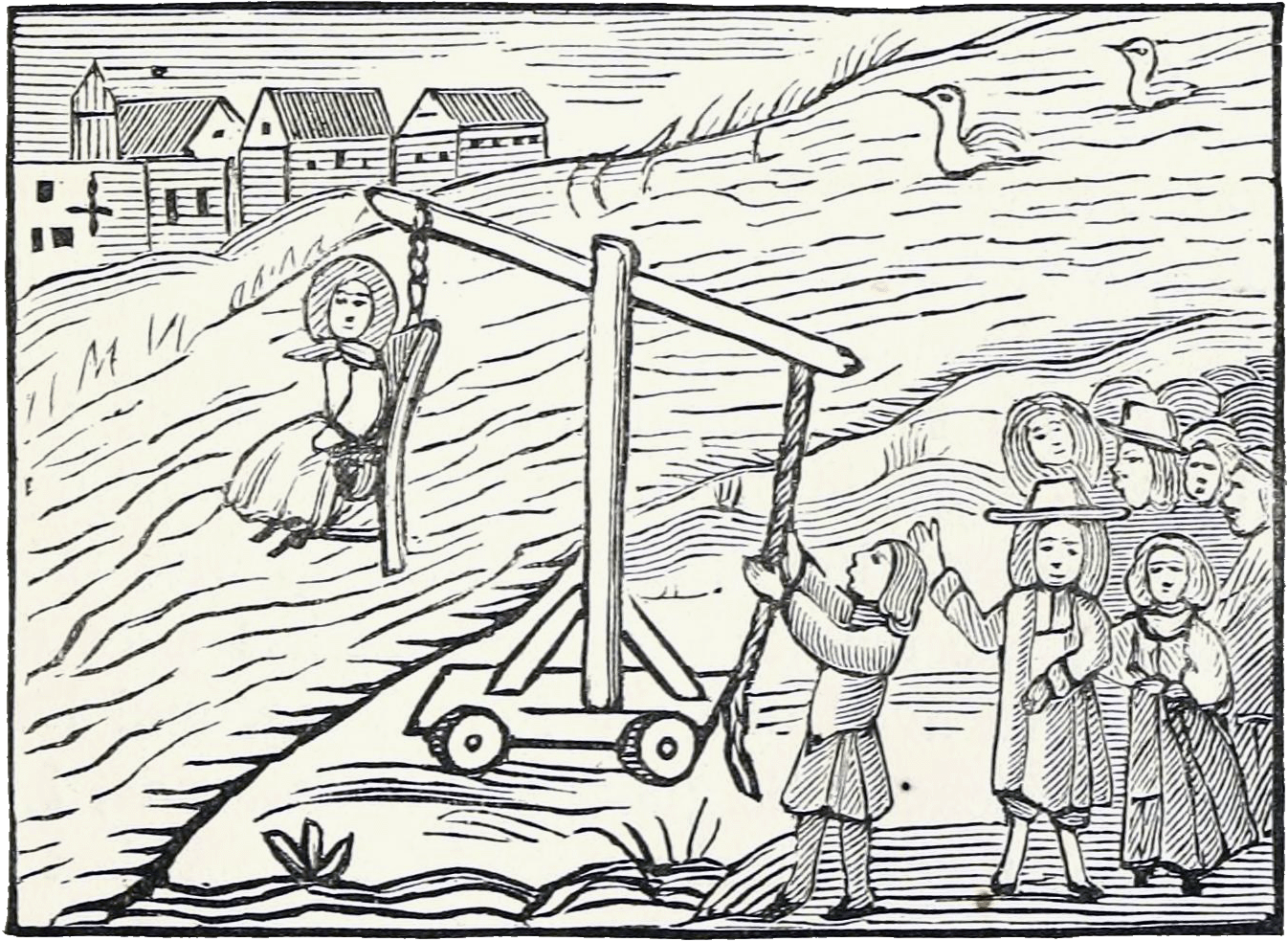
The offence, which carried across in the English colonisation of the Americas, was punished by fines and public humiliation: dunking (being arm-fastened into a chair and dunked into a river or pond); parading through the street; being put in the scold's bridle (branks) or the stocks. Selling bad bread or bad ale was also punished in these ways in some parts of England in medieval centuries.
None of the physical punishments is known to have been administered (such as by magistrates) since an instance in 1817 that involved a wheeling through the streets. Washington D.C. authorities imposed a fine against a writer against clerics, declared a common scold, in 1829. The offence and punishment were abolished in England and Wales in 1967, and formally in New Jersey in 1972.
The offence of scolding developed from the late Middle Ages in England. A British historian suggests attempts to control and punish 'bad speech' increased after the Black Death, when demographic shift led to greater resistance and threats to the status quo. This included prosecutions for scolding. Scolds were described using Latin terms, including objurgator, garulator, rixator and litigator, found in masculine and feminine forms (objurgatrix, etc.) in medieval legal records and all referring to negative forms of speech, chatter, quarrelling or reproachment. These offences were commonly presented and punished in manorial or borough courts that governed the behaviour of peasants and townspeople across England; with a scarce few to the parish vestry. The most common punishment was a fine.
Some historians write of scolding and bad speech coded as feminine offences by the late medieval period. Women of all marital statuses were prosecuted for scolding. The married were featured most often, whereas widows were only rarely labelled scolds. In places such as Exeter scolds were typically poorer women—elsewhere scolds could include members of the local elite. Women who were also charged with matters such as violence, nightwandering, eavesdropping, flirting or adultery were also likely to be labelled scolds. People were in some parts frequently labelled 'common scolds', indicating the impact of their behaviour and speech on a community. Karen Jones identified 13 men prosecuted for scolding in Kent's secular courts, compared to 94 women and 2 couples.
Many of the male minority convicted were co-accused with their wives. In 1434, Helen Bradwall (wife of Peter Bradwall), scolded Hugh Welesson and his wife Isabel in Middlewich, calling Isabel a "child murderer" and Hugh a "skallet [wretched] knave". Isabel and Hugh also scolded Helen, calling her a "lesyng blebberer" (lying blatherer). All parties were fined for the offences—Hugh and Isabel: jointly. Like women, male scolds were often accused of many other offences, such as fornication, theft, illegal trading, and assault.
Later legal treatises reflect the dominance of scolding as a charge levied against women. In the Commentaries on the Laws of England, Blackstone outlines the offence:
Lastly, a common scold, communis rixatrix, (for our law-latin confines it to the feminine gender) is a public nuisance to her neighbourhood. For which offence she may be indicted; and, if convicted, shall be sentenced to be placed in a certain engine of correction called the trebucket, castigatory, or cucking stool, which in the Saxon language signifies the scolding stool; though now it is frequently corrupted into ducking stool, because the residue of the judgment is, that, when she is so placed therein, she shall be plunged in the water for her punishment.
Hub AI
Common scold AI simulator
(@Common scold_simulator)
Common scold
In the common law of crime in England and Wales, a common scold was a type of public nuisance—a troublesome and angry person who broke the public peace by habitually chastising, arguing, and quarrelling with their neighbours. Most punished for scolding were women, though men could be found to be scolds.
The offence, which carried across in the English colonisation of the Americas, was punished by fines and public humiliation: dunking (being arm-fastened into a chair and dunked into a river or pond); parading through the street; being put in the scold's bridle (branks) or the stocks. Selling bad bread or bad ale was also punished in these ways in some parts of England in medieval centuries.
None of the physical punishments is known to have been administered (such as by magistrates) since an instance in 1817 that involved a wheeling through the streets. Washington D.C. authorities imposed a fine against a writer against clerics, declared a common scold, in 1829. The offence and punishment were abolished in England and Wales in 1967, and formally in New Jersey in 1972.
The offence of scolding developed from the late Middle Ages in England. A British historian suggests attempts to control and punish 'bad speech' increased after the Black Death, when demographic shift led to greater resistance and threats to the status quo. This included prosecutions for scolding. Scolds were described using Latin terms, including objurgator, garulator, rixator and litigator, found in masculine and feminine forms (objurgatrix, etc.) in medieval legal records and all referring to negative forms of speech, chatter, quarrelling or reproachment. These offences were commonly presented and punished in manorial or borough courts that governed the behaviour of peasants and townspeople across England; with a scarce few to the parish vestry. The most common punishment was a fine.
Some historians write of scolding and bad speech coded as feminine offences by the late medieval period. Women of all marital statuses were prosecuted for scolding. The married were featured most often, whereas widows were only rarely labelled scolds. In places such as Exeter scolds were typically poorer women—elsewhere scolds could include members of the local elite. Women who were also charged with matters such as violence, nightwandering, eavesdropping, flirting or adultery were also likely to be labelled scolds. People were in some parts frequently labelled 'common scolds', indicating the impact of their behaviour and speech on a community. Karen Jones identified 13 men prosecuted for scolding in Kent's secular courts, compared to 94 women and 2 couples.
Many of the male minority convicted were co-accused with their wives. In 1434, Helen Bradwall (wife of Peter Bradwall), scolded Hugh Welesson and his wife Isabel in Middlewich, calling Isabel a "child murderer" and Hugh a "skallet [wretched] knave". Isabel and Hugh also scolded Helen, calling her a "lesyng blebberer" (lying blatherer). All parties were fined for the offences—Hugh and Isabel: jointly. Like women, male scolds were often accused of many other offences, such as fornication, theft, illegal trading, and assault.
Later legal treatises reflect the dominance of scolding as a charge levied against women. In the Commentaries on the Laws of England, Blackstone outlines the offence:
Lastly, a common scold, communis rixatrix, (for our law-latin confines it to the feminine gender) is a public nuisance to her neighbourhood. For which offence she may be indicted; and, if convicted, shall be sentenced to be placed in a certain engine of correction called the trebucket, castigatory, or cucking stool, which in the Saxon language signifies the scolding stool; though now it is frequently corrupted into ducking stool, because the residue of the judgment is, that, when she is so placed therein, she shall be plunged in the water for her punishment.