
Recent from talks
Common slender mongoose
Knowledge base stats:
Talk channels stats:
Members stats:
Common slender mongoose
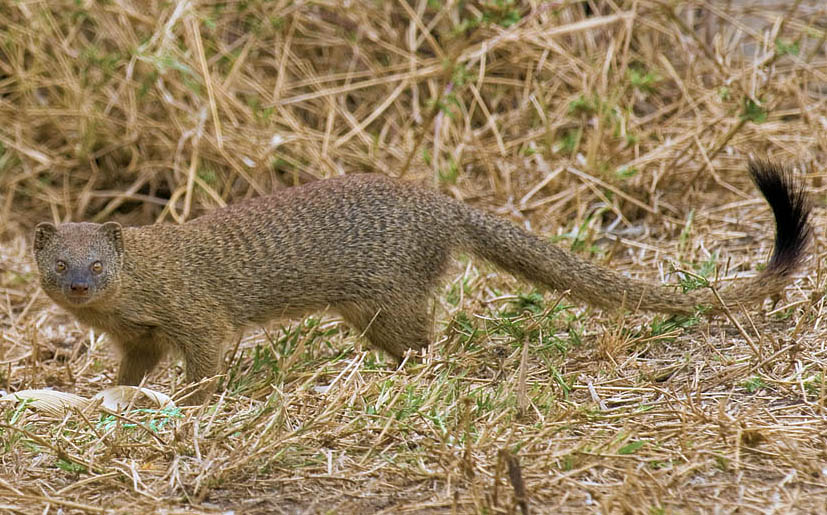
The common slender mongoose (Herpestes sanguineus), also known as the black-tipped mongoose, the black-tailed mongoose, or just the slender mongoose is a very common mongoose species native to sub-Saharan Africa.
The scientific name Herpestes sanguineus was proposed by Eduard Rüppell in 1835 who described a reddish mongoose observed in the Kordofan region.
As the name suggests, the common slender mongoose has a lithe body of 27.5–40 cm (10.8–15.7 in) and a long tail of 23–33 cm (9.1–13.0 in). Males weigh 640–715 g (22.6–25.2 oz), while the smaller females weigh 460–575 g (16.2–20.3 oz). These measurements are consistent with the average measurements given by Rood and Wozencraft.
The color of their fur varies widely between subspecies, from a dark reddish-brown to an orange red, grey, or even golden yellow, but these mongooses can be distinguished from other mongooses due to the prominent black or red tip on their tails. They also have silkier fur than the other African members of their family.
The common slender mongoose occurs throughout sub-Saharan Africa, where it is most common in the savannah and semiarid plains, but rarely recorded in densely forested areas and deserts.
The common slender mongoose is often described as solitary, but when studied in the Kalahari in South Africa, were found to form spatial groups of one to three males and up to four females, denning together up to one third of nights.
It is primarily diurnal, although it is sometimes active on warm, moonlit nights. It doesn't seem to be territorial, but will nevertheless maintain stable home ranges that are often shared with members of related species. Indeed, the common slender mongoose and these other species may even den together, as most of their relatives are nocturnal. Dens may be found anywhere sheltered from the elements: in crevices between rocks, in hollow logs, and the like.
A male's range includes the ranges of several females, and scent cues inform him when the female is in heat. The gestation period is believed to be 60 to 70 days, and most pregnancies result in one to three young. The male does not help care for them. Unusually, for a solitary species, in the Kalahari Desert the males are philopatric whereas the females disperse.
Hub AI
Common slender mongoose AI simulator
(@Common slender mongoose_simulator)
Common slender mongoose
The common slender mongoose (Herpestes sanguineus), also known as the black-tipped mongoose, the black-tailed mongoose, or just the slender mongoose is a very common mongoose species native to sub-Saharan Africa.
The scientific name Herpestes sanguineus was proposed by Eduard Rüppell in 1835 who described a reddish mongoose observed in the Kordofan region.
As the name suggests, the common slender mongoose has a lithe body of 27.5–40 cm (10.8–15.7 in) and a long tail of 23–33 cm (9.1–13.0 in). Males weigh 640–715 g (22.6–25.2 oz), while the smaller females weigh 460–575 g (16.2–20.3 oz). These measurements are consistent with the average measurements given by Rood and Wozencraft.
The color of their fur varies widely between subspecies, from a dark reddish-brown to an orange red, grey, or even golden yellow, but these mongooses can be distinguished from other mongooses due to the prominent black or red tip on their tails. They also have silkier fur than the other African members of their family.
The common slender mongoose occurs throughout sub-Saharan Africa, where it is most common in the savannah and semiarid plains, but rarely recorded in densely forested areas and deserts.
The common slender mongoose is often described as solitary, but when studied in the Kalahari in South Africa, were found to form spatial groups of one to three males and up to four females, denning together up to one third of nights.
It is primarily diurnal, although it is sometimes active on warm, moonlit nights. It doesn't seem to be territorial, but will nevertheless maintain stable home ranges that are often shared with members of related species. Indeed, the common slender mongoose and these other species may even den together, as most of their relatives are nocturnal. Dens may be found anywhere sheltered from the elements: in crevices between rocks, in hollow logs, and the like.
A male's range includes the ranges of several females, and scent cues inform him when the female is in heat. The gestation period is believed to be 60 to 70 days, and most pregnancies result in one to three young. The male does not help care for them. Unusually, for a solitary species, in the Kalahari Desert the males are philopatric whereas the females disperse.
Recent media