Hubbry Logo
Commonwealth of EnglandCommonwealth of EnglandMain
Open search
Commonwealth of England
Community hub
Commonwealth of England
logo
8 pages, 0 posts
0 subscribers
Be the first to start a discussion here.
Commonwealth of England
from Wikipedia

Commonwealth of England
1649–1660
Second English Civil War Stuart Restoration (1660) class-skin-invert-image
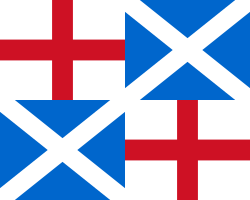
One of the various flags of the Commonwealth
Including
Leaders

The Commonwealth of England, enlarged in 1653 as the Commonwealth of England Scotland and Ireland, was the political structure during the period from 1649 to 1660 when the Kingdom of England was dissolved into a republic after the end of the Second English Civil War and the trial and execution of Charles I. The republic's existence was declared through "An Act declaring England to be a Commonwealth",[1] adopted by the Rump Parliament on 19 May 1649. Power in the early Commonwealth was vested primarily in the Parliament and a Council of State. During the period, fighting continued, particularly in Ireland and Scotland, between the parliamentary forces and those opposed to them, in the Cromwellian conquest of Ireland and the Anglo-Scottish war of 1650–1652.

In 1653, after dissolution of the Rump Parliament, the Army Council adopted the Instrument of Government, by which Oliver Cromwell was made Lord Protector of a united "Commonwealth of England, Scotland and Ireland", inaugurating the period now usually known as the Protectorate. After Cromwell's death, and following a brief period of rule under his son, Richard Cromwell, the Protectorate Parliament was dissolved in 1659 and the Rump Parliament recalled, starting a process that led to the restoration of the monarchy in 1660. The term Commonwealth is sometimes used for the whole of 1649 to 1660 – called by some the Interregnum – although for other historians, the use of the term is limited to the years prior to Cromwell's formal assumption of power in 1653.

In retrospect, the period of republican rule for England was a failure in the short term. During the 11-year period, no stable government was established to rule the English state for longer than a few months at a time. Several administrative structures were tried, and several Parliaments called and seated, but little in the way of meaningful, lasting legislation was passed. The only force keeping it together was the personality of Oliver Cromwell, who exerted control through the military by way of the "Grandees", being the Major-Generals and other senior military leaders of the New Model Army. Not only did Cromwell's regime crumble into near anarchy upon his death and the brief administration of his son, but the monarchy he overthrew was restored in 1660, and its first act was officially to erase all traces of any constitutional reforms of the Republican period. Still, the memory of the Parliamentarian cause, dubbed the Good Old Cause by the soldiers of the New Model Army, lingered on.

The Commonwealth period is better remembered for the military success of Thomas Fairfax, Oliver Cromwell, and the New Model Army. Besides resounding victories in the English Civil War, the reformed Navy under the command of Robert Blake defeated the Dutch in the First Anglo-Dutch War which marked the first step towards England's naval supremacy. In Ireland, the Commonwealth period is remembered for Cromwell's conquest of Ireland, which continued and completed the policies of the Tudor and Stuart periods.

1649–1653

[edit]

Rump Parliament

[edit]

The Rump was created by Pride's Purge of those members of the Long Parliament who did not support the political position of the Grandees in the New Model Army. Just before and after the execution of King Charles I on 30 January 1649, the Rump passed a number of acts of Parliament creating the legal basis for the republic. With the abolition of the monarchy, Privy Council and the House of Lords, it had unchecked executive and legislative power. The English Council of State, which replaced the Privy Council, took over many of the executive functions of the monarchy. It was selected by the Rump, and most of its members were MPs. However, the Rump depended on the support of the Army with which it had a very uneasy relationship. After the execution of Charles I, the House of Commons abolished the monarchy and the House of Lords. It declared the people of England "and of all the Dominions and Territories thereunto belonging" to be henceforth under the governance of a "Commonwealth",[2] effectively a republic.

Structure

[edit]

In Pride's Purge, all members of parliament (including most of the political Presbyterians) who would not accept the need to bring the King to trial had been removed. Thus the Rump never had more than two hundred members (less than half the number of the Commons in the original Long Parliament). They included: supporters of religious independents who did not want an established church and some of whom had sympathies with the Levellers; Presbyterians who were willing to countenance the trial and execution of the King; and later admissions, such as formerly excluded MPs who were prepared to denounce the Newport Treaty negotiations with the King.

Most Rumpers were gentry, though there was a higher proportion of lesser gentry and lawyers than in previous parliaments. Less than one-quarter of them were regicides. This left the Rump as basically a conservative body whose vested interests in the existing land ownership and legal systems made it unlikely to want to reform them.

Issues and achievements

[edit]
A 21st-century edition of the Act Declaring and Constituting the People of England to be a Commonwealth and Free-State enacted on 19 May 1649

For the first two years of the Commonwealth, the Rump faced economic depression and the risk of invasion from Scotland and Ireland. By 1653 Cromwell and the Army had largely eliminated these threats.

There were many disagreements amongst factions of the Rump. Some wanted a republic, but others favoured retaining some type of monarchical government. Most of England's traditional ruling classes regarded the Rump as an illegal government made up of regicides and upstarts. However, they were also aware that the Rump might be all that stood in the way of an outright military dictatorship. High taxes, mainly to pay the Army, were resented by the gentry. Limited reforms were enough to antagonise the ruling class but not enough to satisfy the radicals.

Despite its unpopularity, the Rump was a link with the old constitution and helped to settle England down and make it secure after the biggest upheaval in its history. By 1653, France and Spain had recognised England's new government.

Reforms

[edit]

Though the Church of England was retained, episcopacy was suppressed and the Act of Uniformity 1558 was repealed in September 1650.[3] Mainly on the insistence of the Army, many independent churches were tolerated, although everyone still had to pay tithes to the established church.

Some small improvements were made to law and court procedure; for example, all court proceedings were now conducted in English rather than in Law French or Latin.[4] However, there were no widespread reforms of the common law. This would have upset the gentry, who regarded the common law as reinforcing their status and property rights.

The Rump passed many restrictive laws to regulate people's moral behaviour, such as closing down theatres and requiring strict observance of Sunday. Laws were also passed banning the celebration of Easter and Christmas.[5] This antagonised most of the gentry.

Dismissal

[edit]

Cromwell, aided by Thomas Harrison, forcibly dismissed the Rump on 20 April 1653, for reasons that are unclear. Theories are that he feared the Rump was trying to perpetuate itself as the government, or that the Rump was preparing for an election which could return an anti-Commonwealth majority. Many former members of the Rump continued to regard themselves as England's only legitimate constitutional authority. The Rump had not agreed to its own dissolution; their legal, constitutional view that it was unlawful was based on Charles' concessionary Act prohibiting the dissolution of Parliament without its own consent (on 11 May 1641, leading to the entire Commonwealth being the latter years of the Long Parliament in their majority view).

Barebone's Parliament, July–December 1653

[edit]
A gold Unite from 1653

The dissolution of the Rump was followed by a short period in which Cromwell and the Army ruled alone. Nobody had the constitutional authority to call an election, but Cromwell did not want to impose a military dictatorship. Instead, he ruled through a "nominated assembly" which he believed would be easy for the Army to control since Army officers did the nominating.

Barebone's Parliament was opposed by former Rumpers and ridiculed by many gentries as being an assembly of inferior people. Over 110 of its 140 members were lesser gentry or of higher social status; an exception was Praise-God Barebone, a Baptist merchant after whom the Assembly got its derogatory nickname. Many were well educated.

The assembly reflected the range of views of the officers who nominated it. The Radicals (approximately 40) included a hard core of Fifth Monarchists who wanted to be rid of Common Law and any state control of religion. The Moderates (approximately 60) wanted some improvements within the existing system and might move to either the radical or conservative side depending on the issue. The Conservatives (approximately 40) wanted to keep the status quo, since common law protected the interests of the gentry, and tithes and advowsons were valuable property.

Cromwell saw Barebone's Parliament as a temporary legislative body which he hoped would produce reforms and develop a constitution for the Commonwealth. However, members were divided over key issues, only 25 had previous parliamentary experience, and although many had some legal training, there were no qualified lawyers.

Cromwell seems to have expected this group of amateurs to produce reform without management or direction. When the radicals mustered enough support to defeat a bill which would have preserved the status quo in religion, the conservatives, together with many moderates, surrendered their authority back to Cromwell, who sent soldiers to clear the rest of the Assembly. Barebone's Parliament was over.

Protectorate, 1653–1659

[edit]
Arms of Oliver Cromwell as Lord Protector, used on the great seal from 1655 to 1659.[6]

Throughout 1653, Cromwell and the Army slowly dismantled the machinery of the Commonwealth state. The English Council of State, which had assumed the executive function formerly held by the King and his Privy Council, was forcibly dissolved by Cromwell on 20 April, and in its place a new council, filled with Cromwell's own chosen men, was installed. Three days after Barebone's Parliament dissolved itself, the Instrument of Government was adopted by Cromwell's council and a new state structure, now known historically as The Protectorate, was given its shape. This new constitution granted Cromwell sweeping powers as Lord Protector, an office which ironically had much the same role and powers as the King had under the monarchy, a fact not lost on Cromwell's critics.

On 12 April 1654, under the terms of the Tender of Union, the Ordinance for uniting Scotland into one Commonwealth with England was issued by the Lord Protector and proclaimed in Scotland by the military governor of Scotland, General George Monck, 1st Duke of Albemarle. The ordinance declared that "the people of Scotland should be united with the people of England into one Commonwealth and under one Government" and decreed that a new "Arms of the Commonwealth", incorporating the Saltire, should be placed on "all the public seals, seals of office, and seals of bodies civil or corporate, in Scotland" as "a badge of this Union".[7][8]

First Protectorate Parliament

[edit]

Cromwell and his Council of State spent the first several months of 1654 preparing for the First Protectorate Parliament by drawing up a set of 84 bills for consideration. The Parliament was freely elected (as free as such elections could be in the 17th century) and as such, the Parliament was filled with a wide range of political interests, and as such did not accomplish any of its goals. Having passed none of Cromwell's proposed bills, he dissolved it as soon as law would allow.

Rule of the Major-Generals and Second Protectorate Parliament

[edit]

Having decided that Parliament was not an efficient means of getting his policies enacted, Cromwell instituted a system of direct military rule of England during a period known as the Rule of the Major-Generals; all of England was divided into ten regions, and each was governed directly by one of Cromwell's Major-Generals, who were given sweeping powers to collect taxes and enforce the peace. The Major-Generals were highly unpopular, a fact that they themselves noticed, and many urged Cromwell to call another Parliament to give his rule legitimacy.

Unlike the prior Parliament, which had been open to all eligible males in the Commonwealth, the new elections specifically excluded Catholics and Royalists from running or voting; as a result, it was stocked with members who were more in line with Cromwell's own politics. The first major bill to be brought up for debate was the Militia Bill, which was ultimately voted down by the House. As a result, the authority of the Major-Generals to collect taxes to support their own regimes ended, and the Rule of the Major Generals came to an end. The second piece of major legislation was the passage of the Humble Petition and Advice, a sweeping constitutional reform which had two purposes. The first was to reserve for Parliament certain rights, such as a three-year fixed-term (which the Lord Protector was required to abide by) and to reserve for the Parliament the sole right of taxation. The second, as a concession to Cromwell, was to make the Lord Protector a hereditary position and to convert the title to a formal constitutional Kingship. Cromwell refused the title of King, but accepted the rest of the legislation, which was passed in final form on 25 May 1657.

A second session of the Parliament met in 1658; it allowed previously excluded MPs (who had been not allowed to take their seats because of Catholic and/or Royalist leanings) to take their seats, however, this made the Parliament far less compliant to the wishes of Cromwell and the Major-Generals; it accomplished little in the way of a legislative agenda and was dissolved after a few months.

Richard Cromwell and the Third Protectorate Parliament

[edit]

On the death of Oliver Cromwell in 1658, his son, Richard Cromwell, inherited the title, Lord Protector. Richard had never served in the Army, which meant he lost control over the Major-Generals that had been the source of his own father's power. The Third Protectorate Parliament was summoned in late 1658 and was seated on 27 January 1659. Its first act was to confirm Richard's role as Lord Protector, which it did by a sizeable, but not overwhelming, majority. Quickly, however, it became apparent that Richard had no control over the Army and divisions quickly developed in the Parliament. One faction called for a recall of the Rump Parliament and a return to the constitution of the Commonwealth, while another preferred the existing constitution. As the parties grew increasingly quarrelsome, Richard dissolved it. He was quickly removed from power, and the remaining Army leadership recalled the Rump Parliament, setting the stage for the return of the Monarchy a year later.

1659–1660

[edit]

After the Grandees in the New Model Army removed Richard, they reinstalled the Rump Parliament in May 1659. Charles Fleetwood was appointed a member of the Committee of Safety and of the Council of State, and one of the seven commissioners for the army. On 9 June he was nominated lord-general (commander-in-chief) of the army. However, his power was undermined in parliament, which chose to disregard the army's authority in a similar fashion to the pre–Civil War parliament. On 12 October 1659 the Commons cashiered General John Lambert and other officers, and installed Fleetwood as chief of a military council under the authority of the Speaker. The next day Lambert ordered that the doors of the House be shut and the members kept out. On 26 October a "Committee of Safety" was appointed, of which Fleetwood and Lambert were members. Lambert was appointed major-general of all the forces in England and Scotland, Fleetwood being general. Lambert was now sent, by the Committee of Safety, with a large force to meet George Monck, who was in command of the English forces in Scotland, and either negotiate with him or force him to come to terms.

It was into this atmosphere that General George Monck marched south with his army from Scotland. Lambert's army began to desert him, and he returned to London almost alone. On 21 February 1660, Monck reinstated the Presbyterian members of the Long Parliament "secluded" by Pride, so that they could prepare legislation for a new parliament. Fleetwood was deprived of his command and ordered to appear before parliament to answer for his conduct. On 3 March Lambert was sent to the Tower, from which he escaped a month later. Lambert tried to rekindle the civil war in favour of the Commonwealth by issuing a proclamation calling on all supporters of the "Good Old Cause" to rally on the battlefield of Edgehill. However, he was recaptured by Colonel Richard Ingoldsby, a regicide who hoped to win a pardon by handing Lambert over to the new regime. The Long Parliament dissolved itself on 16 March.

On 4 April 1660, in response to a secret message sent by Monck, Charles II issued the Declaration of Breda, which made known the conditions of his acceptance of the crown of England. Monck organised the Convention Parliament, which met for the first time on 25 April. On 8 May it proclaimed that King Charles II had been the lawful monarch since the execution of Charles I in January 1649.[9] Charles returned from exile on 23 May.[10] He entered London on 29 May, his birthday. To celebrate "his Majesty's Return to his Parliament" 29 May was made a public holiday, popularly known as Oak Apple Day.[11] He was crowned at Westminster Abbey on 23 April 1661.[10]

See also

[edit]

Notes

[edit]

References

[edit]
[edit]
Revisions and contributorsEdit on WikipediaRead on Wikipedia
from Grokipedia

The Commonwealth of England was the republican regime that governed England, Scotland, and Ireland from 1649 to 1660, following the execution of King Charles I and marking the only interruption of monarchical rule in English history between the Norman Conquest and the present day.
Established by the Rump Parliament's Act of 19 May 1649, which abolished the monarchy, the House of Lords, and declared the people a "Commonwealth and Free State," the government initially operated through a Council of State and intermittent parliaments, aiming to reform religious and civil institutions after years of civil war.
Persistent political instability and reliance on military support culminated in 1653 with Oliver Cromwell's dissolution of the Rump Parliament and his installation as Lord Protector under the Instrument of Government, the first codified constitution in English history, which vested executive power in Cromwell while providing for parliamentary oversight—though in practice, it devolved into army-dominated rule.
The Protectorate achieved naval supremacy, colonial expansion, and legal advancements like the reduction of capital crimes, but was marred by authoritarian measures, including the Rule of the Major-Generals, suppression of dissent, and Puritan moral enforcement, which alienated broad segments of society.
Following Cromwell's death in 1658 and the ineffectual tenure of his son Richard, the regime collapsed amid financial strain and factionalism, leading Parliament to invite Charles II's return in 1660 and restore the monarchy.

Background and Establishment

Pride's Purge and Execution of Charles I

On 6 December 1648, following the failure of negotiations with the captive King Charles I after the Second English Civil War, soldiers of the New Model Army under Colonel Thomas Pride physically barred approximately 140 members of the Long Parliament—those deemed sympathetic to Presbyterian interests or inclined toward renewed treaty talks with the king—from entering the House of Commons. Of these, 45 were briefly arrested and detained at nearby inns. Pride, acting on orders from the Army Council dominated by Independents like Oliver Cromwell, consulted a prepared list of "secluded" members compiled by army officers, ensuring the remaining assembly aligned with military demands for accountability against the king for alleged tyranny and war crimes. This purge reduced the effective parliamentary membership to around 80 to 200 active MPs, forming what became known as the Rump Parliament, which proceeded without opposition to radical reforms. The purged Parliament, now under army influence, established the High Court of Justice on 6 January 1649 via an ordinance, comprising 135 commissioners (primarily military officers, lawyers, and MPs) to try Charles I for high treason, though the king was not formally charged under existing law and the court's legitimacy derived solely from parliamentary fiat. Proceedings opened on 20 January 1649 in Westminster Hall, where Charles, escorted by halberdiers, faced accusations of levying war against Parliament and the people since 1642, but he consistently refused to recognize the court's authority, declaring it unlawful and himself answerable only to God and the realm's ancient constitution. Over 11 days of intermittent sessions, attended by fewer than 70 commissioners due to absences and hesitations, prosecutors like John Cook presented evidence of the king's alleged betrayals, including the 1641 Irish rebellion and personal rule; Charles countered by questioning the tribunal's sovereignty and lack of royal assent for its creation. On 27 January 1649, the court pronounced Charles guilty of high treason, sentencing him to death by beheading, with 67 commissioners signing the warrant (including Pride and Cromwell); appeals for mercy were rejected amid army pressure. The execution occurred on 30 January 1649 on a scaffold outside the Banqueting House in Whitehall, where Charles addressed a small crowd, asserting his innocence and divine right before kneeling for the axe; his final words reportedly included a plea that "the people may remember" his steadfastness. The act shocked Europe, prompting condemnations from monarchs like Louis XIV and Philip IV as regicide, while domestically it solidified army control but alienated moderates, paving the way for the republic's declaration.

Declaration of the Commonwealth and Abolition of Institutions

Following the execution of Charles I on 30 January 1649, the Rump Parliament, consisting of purged Presbyterian and Royalist members, moved to dismantle the constitutional framework of monarchy and aristocracy to consolidate republican authority. On 17 March 1649, Parliament passed An Act for the Abolishing the Kingly Office in England, Ireland, and the Dominions thereunto belonging, which declared the office of king "unnecessary, burdensome, and dangerous to the liberty, safety, and public interest of the people" and prohibited any person from assuming the title or exercising its powers. Two days later, on 19 March 1649, An Act for the Abolishing the House of Peers was enacted, asserting that the House of Lords had proven "useless and dangerous to the people of England" through its support for royal policies during the civil wars, thereby vesting all legislative power in the Commons. These abolitions were formalized in the Act Declaring and Constituting the People of England to be a Commonwealth and Free-State, passed on 19 May 1649, which proclaimed that "the People of England, and of all the Dominions and Territories thereunto belonging" were henceforth a republic governed by the Commons in Parliament as the supreme representatives of the people, explicitly confirming the permanent exclusion of kingship and the peerage from governance. The act emphasized that executive functions would derive from parliamentary resolutions, marking the transition to a sovereign legislature without hereditary elements. This legislative sequence aimed to legitimize the post-regicidal order by redefining sovereignty from divine-right monarchy to popular representation through Parliament, though it faced immediate challenges from Leveller agitation for broader electoral reforms and royalist threats abroad.

Rump Parliament Era (1649–1653)

Structure and Composition

The Rump Parliament consisted of approximately 200 members from the House of Commons of the Long Parliament, reduced from an original election of about 470 MPs in 1640 through the exclusions of Pride's Purge on 6–7 December 1648. These members were predominantly Independents—those favoring congregational church governance and religious toleration for Protestants—and allies of the New Model Army, with the purge targeting around 140 Presbyterians who opposed further radicalism or favored negotiation with King Charles I. Active participation remained low throughout the period, with estimates of 75 to 100 members regularly attending sessions, as many eligible MPs either abstained due to disillusionment, provincial commitments, or fear of army reprisals, leading to quorums often barely met and decisions dominated by a core group of radicals. This irregular attendance underscored the body's unrepresentative nature, as no new elections occurred, perpetuating a composition frozen from the 1640s and increasingly detached from broader English opinion. In structure, the Rump functioned as a unicameral legislature following the abolition of the House of Lords on 19 January 1649, which it declared "useless and dangerous," and the execution of Charles I on 30 January, vesting all legislative, judicial, and residual executive powers in the Commons as the supreme authority of the realm. To handle day-to-day governance, it created the Council of State on 14 February 1649, a 41-member executive body elected annually from nominees including MPs, three peers, lawyers such as John Bradshaw, and army officers like Oliver Cromwell, replacing the Privy Council and overseeing foreign policy, naval and military affairs, intelligence, and legal enforcement with a quorum of nine. The Council's composition reflected army influence, with figures like Henry Ireton and Thomas Harrison prominent, though it operated under parliamentary oversight, highlighting the Rump's hybrid republican framework blending legislative supremacy with delegated administration.

Legislative Reforms and Achievements

The Rump Parliament advanced legal reforms through targeted measures and commissions, though comprehensive overhaul proved elusive. In January 1652, it established a 21-member commission under Matthew Hale to scrutinize and simplify the legal framework, resulting in incremental changes such as transferring probate jurisdiction to common-law courts, easing penalties for debtors, eliminating legal immunities for peers and MPs, and permitting English-language proceedings in place of Latin. An act standardizing weights and measures was also enacted to promote equitable trade by reducing discrepancies in commercial transactions. Religious legislation emphasized Puritan discipline while extending limited toleration. The Adultery Act of May 1650 prescribed capital punishment for adultery and fornication, though enforcement remained negligible. The Blasphemy Act of August 1650 restricted radical sectarian excesses to maintain social order. The Toleration Act of September 1650 abolished mandatory attendance at established parish churches, affording protection to Protestant nonconformists but barring Roman Catholics and adherents of episcopal forms. Supporting ordinances for gospel propagation targeted Wales, Ireland, and New England in 1649–1650, aiming to install reformed ministers and dismantle perceived corrupt clergy structures. Economic and colonial initiatives bolstered state revenue and imperial ambitions. From April 1649, sales of sequestered church and crown lands provided fiscal relief amid wartime demands. The Navigation Act of October 1651 barred non-English vessels from transporting goods from English colonies or Europe (except the producing country), fostering domestic shipping, protecting trade routes, and underwriting naval expansion. In Ireland, the Act for the Settling of Ireland (1652) authorized land confiscations from 1641 rebels, delinquents, and royalists for redistribution to adventurers, soldiers, and creditors, consolidating conquest gains. Administrative reforms included the February 1649 creation of the Council of State, a 41-member executive body to enact parliamentary directives, coordinate foreign policy, and safeguard the regime against internal threats. These efforts, while pragmatic, often prioritized stability over radical transformation, reflecting the Rump's conservative leanings amid ongoing conflicts.

Challenges, Conflicts, and Cromwell's Dismissal

The Rump Parliament struggled with legislative inertia, devoting minimal time to core reforms despite initial promises. Efforts to overhaul the legal system, such as the Hale Commission established in 1652, stalled amid opposition from approximately 44 lawyer members who resisted simplifying procedures deemed overly complex and dilatory. Religious initiatives faltered as well, with the assembly failing to renew propagation commissions for gospel spread or define a national church structure, thereby alienating puritan reformers who anticipated a "godly" commonwealth. Electoral proposals resurfaced under army pressure but languished without resolution, reflecting broader procrastination on constitutional settlement. Financial pressures compounded these shortcomings, as unpaid army arrears prompted expansion from 47,000 to 70,000 troops, accruing a deficit of £700,000 by 1650 that strained taxation and sequestration revenues. Allegations of corruption intensified army grievances, with MPs like Sir Arthur Haselrig and John Wildman accused of personal profiteering through offices and land grants, fostering perceptions of oligarchic self-interest over public good. The assembly's social conservatism manifested in suppressing radical elements, including Leveller mutinies at Ware and Burford in 1649, while prioritizing self-preservation amid royalist threats. Conflicts peaked between the Rump and the army, whose growing influence clashed with parliamentary distrust of military dominance. The 1652 General Pardon and Oblivion Act, excluding army radicals from amnesty, provoked outrage among officers seeking broader reconciliation. Divergent aims surfaced in foreign policy, notably the Anglo-Dutch War declared in July 1652 over Navigation Acts and trade monopolies, where army elements emphasized religious solidarity against Catholic powers while the Rump focused on commercial gains. Plans to admit new members or hold elections threatened to dilute army leverage, prompting fears of renewed instability or royalist resurgence. Cromwell, reflecting army discontent, viewed the Rump's four-year tenure as marked by , inefficiency, and of ideals for personal gain, blocking the just he deemed providential. On 1653, he entered the chamber with , upbraided members for "sitting too long for any good you have been doing," and dissolved the assembly, declaring, "Take away that fool's bauble, the mace," before commanding, "In the name of , go!" This forcible ejection, echoing I's 1642 intrusion but justified as providential necessity, ended the Rump's rule and paved the way for the .

Nominated Assembly (1653)

Formation and Radical Composition

The Nominated Assembly, convened in the wake of the Rump Parliament's dissolution on 20 April 1653, emerged from proposals by Major-General Harrison, a prominent Fifth Monarchist, which Cromwell and the of Officers adapted to form a body of nominated "godly" representatives rather than elected . This approach reflected the army leadership's intent to bypass perceived corruption in traditional parliamentary selection while advancing a puritan vision of governance by the pious, with final agreements reached in early June 1653. Warrants for summons were issued thereafter, leading the assembly to convene at Westminster on 4 July 1653, where it formally adopted the title of Parliament of the Commonwealth on 12 July. Members were selected through a process involving recommendations from Independent congregational churches across counties, which nominated individuals deemed spiritually qualified and capable; the Council of Officers then chose from these lists, with approvals by the Council of State ensuring alignment with military priorities. The resulting body comprised approximately 140 delegates—129 from England (including 6 from Wales), 5 from Scotland, and 6 from Ireland—predominantly minor gentry and landowners, with about one-third drawn from established ruling elites such as lawyers and parliamentary veterans. No burgesses represented smaller boroughs except for London, emphasizing county-based piety over urban electoral norms, and figures like Praisegod Barbon, a London leather-seller and radical preacher, exemplified the unconventional inclusions. The assembly's composition leaned radical due to its criterion of selecting those "fearing " from nonconformist circles, incorporating an influential minority of —around 12 members, led by Harrison—who advocated millennial rule by , abolition of tithes, patronage, and institutions like the Chancery, and comprehensive legal codification aligned with precedents. This faction, believing the Commonwealth heralded Christ's thousand-year reign, clashed with moderates over the pace and scope of reforms, fostering internal polarization without formal parties; yet the overall body retained diversity, including army officers and pragmatists wary of unchecked extremism. Such radicalism stemmed causally from the post-civil war puritan ascendancy, where military control enabled prioritization of doctrinal purity over institutional continuity.

Debates, Failures, and Dissolution

The Nominated Assembly, convened on 4 1653, quickly fractured along factional lines between radicals—often sectarians and advocating sweeping religious overhaul—and moderates favoring preservation of established institutions like a and tithes. Debates commenced on tithes as early as 13 , with radicals pushing for their abolition to end state-enforced clerical , while moderates resisted, arguing it threatened and stability. Similarly, discussions on yielded partial successes, such as the 1653 act establishing registrars in parishes and provisions for through special judges, but efforts to dismantle the and codify a comprehensive legal system stalled amid disagreements. These divisions manifested in broader conflicts over the of a state church, where radicals opposed compulsory uniformity and sought to empower congregations, clashing with conservatives who prioritized institutional continuity. Approximately 50 members supported maintaining and universities, underscoring the assembly's ideological split, which inhibited legislative despite its mandate for godly . The body's inefficiency was compounded by its nominated composition of around 140-144 members, selected by officers for rather than parliamentary , leading to procedural chaos and to deliver the anticipated constitutional stability. By early 1653, irreconcilable tensions peaked during a vote on sustaining a state church, prompting moderates to resign en masse on 12 , effectively dissolving the assembly by surrendering its authority back to via a pre-arranged instrument. This self-dissolution, occurring months before the planned November 1654 expiration, highlighted the experiment's core failure: the inability of a religiously selected body to reconcile radical zeal with pragmatic governance, paving the way for Cromwell's assumption of the Protectorate on 16 .

Oliver Cromwell's Protectorate (1653–1658)

Instrument of Government and First Parliament

The , drafted primarily by Major-General John Lambert, was adopted by the of Officers on , 1653, establishing the as England's first codified written . was installed as the following day, , 1653, assuming executive alongside a comprising fifteen members initially selected by the . This vested the with powers to execute laws, command the armed forces, summon and prorogue , and exercise a qualified veto over legislation, while mandating triennial parliaments that could not be dissolved within their first session without consent. Key provisions included a unicameral of at least members for , apportioned by rather than traditional boroughs to reduce and enhance representation; was allotted 30 seats and 20, reflecting recent conquests. The constitution guaranteed religious for Trinitarian Protestants, explicitly excluding Roman Catholicism and Anglican episcopacy, and committed to funding a of up to 20,000 and 30,000 foot, alongside naval maintenance through assessed taxes. Executive ordinances issued prior to parliamentary summons addressed administrative reforms, with over 80 such measures enacted by Cromwell and the Council of State to stabilize governance, including probate courts and legal simplifications. The First Protectorate Parliament convened on September 3, 1654, under Speaker , comprising approximately 460 members elected via expanded excluding royalists and those compromised by the 1640s conflicts. Proceedings quickly devolved into contention, as republican-leaning members, including survivors from the , resisted affirming the Instrument's supremacy and sought to amend it toward a return to Commonwealth ideals without a single executive. Debates centered on constitutional legitimacy, taxation for military upkeep, and foreign policy, including the ongoing Anglo-Dutch War, but factional divisions—between Presbyterians favoring limited monarchy-like structures and Independents pushing radical reforms—prevented consensus. On January 22, 1655, after refused a recognition pledging to the Instrument, Cromwell dissolved the assembly by guard, citing its to legislate productively and its to the settlement's stability. This dissolution, lasting until the next in 1656, underscored the Instrument's reliance on Protectoral over elected bodies, highlighting tensions between -backed executive authority and parliamentary sovereignty that persisted throughout the Protectorate.

Rule of the Major-Generals

The was instituted in response to royalist insurrections, notably Penruddock's Uprising in during 1655, which highlighted vulnerabilities in internal security despite the regime's dominance. To counter such threats, the commissioned officers as Major-Generals on 11 1655, with the policy proclaimed publicly on 31 October. England and Wales were divided into 12 administrative regions, each placed under the authority of one Major-General, who reported to the Lord Protector and Council while coordinating with local civilian commissioners. These officers, drawn from trusted parliamentary veterans such as Charles Fleetwood (for London, Middlesex, and surrounding counties) and William Packer (for the Midlands), were tasked with threefold objectives: identifying and neutralizing royalist sympathizers through disarmament and surveillance, maintaining regional militias for rapid response, and fostering "godly reformation" by suppressing moral vices. The Major-Generals wielded extensive powers, including the oversight of justices of the and the of a decimation —a 10% levy on the annual rental value of royalists' estates, intended to fund 10,000 troops for without burdening the general populace. This , collected rigorously in like under Major-General Kelsey, generated approximately £70,000 by mid-1656 but provoked widespread resentment for its perceived arbitrariness and exemption of compliant enemies. Complementing fiscal measures, the regime emphasized moral and religious discipline: Major-Generals closed alehouses (reducing their number by up to 20% in some areas), prohibited theaters, gambling, and cockfighting, enforced strict Sabbath observance, and promoted preaching and education in Puritan doctrines. In practice, these reforms varied by —Desborough in the West Country aggressively targeted vice, while others like George Monck in Scotland focused more on military stability—but collectively they represented an unprecedented intrusion of central military authority into county governance, often overriding traditional assize courts. Despite initial successes in quelling unrest and raising revenues, the system eroded public support due to its coercive nature, financial exactions, and the quartering of soldiers on households, which strained local economies already recovering from civil war. Petitions from counties like Buckinghamshire decried the Major-Generals as "arbitrary and illegal," reflecting broader elite opposition to what critics termed a "military tyranny." The policy's termination came with the convening of the Second Protectorate Parliament in September 1656; on 29 January 1657, members rejected the Militia Bill, which sought to legalize and fund the regime's continuance, by a vote of 124 to 88, citing its unpopularity and fiscal burdens. This legislative defeat, coupled with Cromwell's reluctance to sustain the experiment amid foreign policy demands, led to the Major-Generals' recall by early 1657, marking a retreat from direct military rule and paving the way for constitutional adjustments via the Humble Petition and Advice. The episode underscored the tensions between security imperatives and civilian liberties, contributing to the Protectorate's instability.

Second Parliament, Humble Petition, and Constitutional Evolution

The Second Protectorate Parliament was summoned on 10 July 1656 and assembled on 17 1656, comprising approximately members elected under the expanded franchise of the , though the excluded over 100 individuals deemed insufficiently reliable, including republicans and , to alignment with the Protectorate's stability. This exclusion reflected Cromwell's administration's prioritization of continuity amid external threats like the Anglo-Spanish War, but it fueled perceptions of authoritarian control. The first session, lasting until 26 1657, focused on financial to fund engagements and debated constitutional reforms amid divisions between conservative royalist sympathizers and republican critics. In early 1657, a faction of moderate MPs, seeking to legitimize the regime and curb the army's influence, drafted the Humble Petition and Advice, a new constitutional instrument presented to Cromwell on 31 March 1657, which proposed vesting executive power in a Lord Protector for life with limited hereditary succession, establishing a bicameral legislature including an appointed upper house ("Other House") with veto powers over the Commons, and requiring parliamentary consent for taxation and declarations of war. The document initially offered Cromwell the crown, framing it as a restoration of settled governance to prevent military dominance, but he refused kingship on 8 May 1657, citing religious scruples and fears of alienating Puritan allies, leading to revisions that retained the Protector's title while affirming parliamentary supremacy in legislation. Cromwell accepted the revised Humble Petition on 25 June 1657, supplanting the Instrument of Government and marking a shift toward a more monarch-like executive balanced by institutional checks, though enforcement relied on Cromwell's personal authority. The Humble Petition's drove constitutional by formalizing a second chamber, nominated by Cromwell and assembled in 1658 with around 70 peers, intended to mirror the ' revising and foster consensus. However, the second parliamentary session, from 20 to 4 1658, exposed fractures: republicans and officers opposed the as an reviving aristocratic privilege, while conservatives resisted further concessions to military rule, leading to on supply bills and petitions challenging the regime's religious policies. Cromwell dissolved on 4 1658, decrying its ingratitude and failure to support the constitution's intent for stable governance, an act that underscored the Humble Petition's fragility without broad consent and presaged the Protectorate's instability. This episode highlighted causal tensions between executive prerogative and parliamentary sovereignty, with the reforms empirically strengthening fiscal and judicial frameworks—such as enhanced treason laws—but failing to resolve underlying republican-military divides.

Richard Cromwell and Terminal Phase (1658–1659)

Succession and Initial Stability

Oliver Cromwell died on 3 September 1658 at Whitehall Palace following a sudden aggravation of kidney stones and other ailments, after having appeared to recover multiple times in the preceding weeks. The Council of State assembled that evening and, in accordance with Oliver's final expressed wishes—conveyed during his last days to key advisors including Secretary Thurloe—resolved to recognize his eldest surviving son, , as his successor in the office of . Although the Instrument of Government of 1653 had not established the Protectorate as hereditary, Oliver's nomination and the Council's prompt endorsement provided the legal and political basis for continuity, averting any immediate contestation. Richard Cromwell was formally proclaimed on 4 1658, with the announcement disseminated through rituals and printed declarations across , , and . He took the before the on 6 and assumed without disruption, retaining the existing administrative , including the itself and commands. Contemporary accounts noted widespread among civil authorities and the populace, who associated stability with the Cromwell name amid war-weariness and of renewed agitation; no overt opposition or factional revolts emerged in the immediate aftermath. To secure financial and legislative support, issued writs for a new on 10 1658, which convened on 27 1659 after for elections and purges under the . The opening session proceeded , with the passing a resolution on 6 February affirming 's title and authority, reflecting initial parliamentary alignment with the regime. This phase of relative calm lasted several months, sustained by 's moderation in conciliating republican civilians and army grandees, though underlying fissures—such as army officers' resentment over civilian fiscal demands—began to surface privately by early spring.

Parliamentary Dissolution and Regime Collapse

Richard Cromwell's , convened on , 1659, quickly devolved into conflict between members seeking greater fiscal oversight and leaders demanding of and retention of influence. The , numbering around members, included moderates and conservatives who criticized the Protectorate's military expenditures amid a national exceeding £2.5 million, with the alone owed £890,000 in back pay. Tensions escalated as moved to investigate officers and assert control over appointments, prompting senior generals, including and John Lambert, to Richard on against these encroachments, effectively issuing an ultimatum. Under mounting pressure, including threats of intervention, Richard dissolved in the early hours of , 1659, issuing a that cited irreconcilable divisions but preserved his nominal as . This act, however, failed to stabilize the ; the army's of Officers assumed control, sidelining Richard's and exacerbating factionalism between republican hardliners and Protectoral loyalists. Financial compounded the , as the regime could not fund ongoing commitments without parliamentary taxation, leading to widespread mutinies and desertions among unpaid troops. The dissolution marked the onset of rapid regime collapse, culminating in Richard's forced resignation on May 7, 1659, after army grandees declared the Protectorate incompatible with republican principles and restored the Rump Parliament's remnants to power. This shift abolished the office of Lord Protector, reverting executive authority to a committee-dominated system that lacked Oliver Cromwell's personal prestige and coercive capacity, thus exposing underlying structural weaknesses: overreliance on military enforcement without consensual governance or economic viability. The ensuing power vacuum, characterized by competing petitions from army factions and civilian republicans, underscored the Protectorate's fragility, as neither Richard's conciliatory approach nor the army's dominance could reconcile elite divisions or secure public allegiance.

Collapse and Restoration (1659–1660)

Recall of the Rump and Anarchy

Following the dissolution of the Third Protectorate Parliament by Richard Cromwell on 22 April 1659 amid army discontent, the Council of Officers resolved on 5 May to recall the surviving members of the Rump Parliament, originally purged during Pride's Purge in December 1648 and forcibly dissolved by Oliver Cromwell on 20 April 1653. Approximately 50 members reassembled on 7 May, seeking to restore republican civilian governance and diminish military dominance. Richard Cromwell formally abdicated on 25 May, ending the Protectorate and nominally transferring authority to the Rump and a revived Council of State. The Rump prioritized reasserting control over the army by appointing aligned officers to key positions and revoking commissions of perceived rivals, including that of General John Lambert, while pledging but failing to enact reforms in legal processes, religious toleration, and administrative efficiency. These efforts provoked military backlash, as officers resented parliamentary encroachments on their autonomy and the Rump's perceived favoritism toward moderate republicans over radical elements. Divisions deepened when the Rump attempted to disband certain regiments and regulate army pay, exacerbating tensions with commanders like Lambert and Charles Fleetwood. On 13 October 1659, troops under Lambert's command excluded the Rump from its chamber by , dissolving it for the second time and installing an army-dominated on 26 October to administer the . This , comprising 23 members mostly from ranks, proved ineffective, facing immediate challenges from regional commanders such as George Monck in , who refused allegiance and mobilized against it. The precipitated a phase of profound from late 1659, marked by splintered factions, , and economic distress including inflated prices, disruptions, and widespread taxpayer refusals that crippled for troops and civil functions. Rival military councils vied for control, fostering fears of renewed civil war, as the absence of centralized authority exposed the fragility of the republican structure without Oliver Cromwell's unifying command. Public disillusionment grew amid reports of disorderly soldiers exacerbating local unrest, underscoring the regime's inability to reconcile parliamentary sovereignty with military necessities.

Convention Parliament and Monarchical Restoration

Following the dissolution of the on 16 1660, which had briefly been recalled under George Monck's influence to restore order amid and political , writs were issued for elections to a new assembly. This body, known as the Convention Parliament, convened on 25 1660 with members of both the and the , marking the first bicameral since the Commonwealth's . The Commons elected Sir Harbottle Grimston as Speaker on the opening day, reflecting a shift toward royalist-leaning sentiments driven by widespread disillusionment with republican governance and Cromwellian rule. On 1 May 1660, both houses unanimously resolved that "government by King, Lords and Commons" was the most desirable form, prompting the dispatch of a deputation to Charles II in The Hague to negotiate terms. This followed Charles's Declaration of Breda on 4 April 1660, in which he pledged religious toleration, amnesty for former rebels (with parliamentary exceptions), payment of army arrears, and confirmation of land grants made under the Commonwealth. On 8 May, the Convention declared Charles II the lawful king from the moment of his father's execution on 30 January 1649, retroactively legitimizing his claim and nullifying the interregnum's legal foundations. These resolutions effectively invited Charles to return, addressing the regime's collapse by restoring monarchical authority without bloodshed, as military factions under Monck prioritized stability over continued republican experiments. Charles II landed at Dover on 25 May 1660, greeted by Monck, and processed to London on 29 May—his thirtieth birthday—amid public jubilation that underscored the republic's eroded legitimacy after years of fiscal strain, military purges, and failed constitutional innovations. The Convention's subsequent acts included a general pardon excluding 33 regicides, restoration of Crown and Church lands seized since 1641, disbandment of the New Model Army in favor of royal forces, and grants totaling £1,200,000 for royal needs (falling short by £300,000). It also established a post office monopoly and designated 29 May as an annual day of thanksgiving for the Restoration. Efforts at religious settlement faltered amid Presbyterian and Anglican divides, deferring broader reforms. The Convention Parliament dissolved on 29 December 1660 after enacting the necessary statutes to embed the Restoration, paving the way for the Cavalier Parliament's convening in 1661 under restored royal prerogative. This assembly's actions reversed the Commonwealth's abolition of monarchy, episcopacy, and the Lords, reverting to pre-1640 parliamentary practices while granting Scotland and Ireland separate assemblies. The Restoration thus concluded eleven years of experimental governance, yielding to monarchical continuity amid evident institutional fatigue and societal preference for hereditary rule over elective or military dictatorships.

Governance Structures Across the Period

Council of State and Executive Functions

The Council of State was instituted by the Rump Parliament on 14 February 1649 through "An Act Erecting and Constituting a Council of State for the Commonwealth of England," comprising 41 members nominated annually by Parliament to exercise executive powers in lieu of the abolished monarchy and Privy Council. Its membership included prominent figures such as John Bradshaw (initial president), Oliver Cromwell, Henry Marten, and Bulstrode Whitelocke, with 31 elected from Parliament and 10 others co-opted for expertise in law, military, and diplomacy; the president rotated monthly to prevent entrenchment of power. Subordinate to Parliament's sovereignty, the Council implemented legislative directives while possessing operational autonomy in routine governance, reflecting a deliberate shift toward republican executive coordination without a singular head. Executive functions encompassed directing , naval and operations, gathering, and domestic administration, including oversight of the , , and via state publications like the Mercurius Politicus. The operated through 12 specialized committees—covering areas such as examinations ( and trials), the , admiralty, and —chaired by members and meeting frequently to handle granular tasks, such as suppressing mutinies or negotiating treaties. For instance, it authorized Cromwell's campaigns (1649) and (1650–1651), coordinated the 1651 Navigation Ordinance precursors, and managed diplomatic overtures to Dutch and French republics amid ongoing Anglo-Dutch tensions. Throughout the (), the Council's evolved amid constitutional : under the (1653), it retained continuity despite assembly disruptions, but the (1653) subordinated it to the , reducing its independent initiative while expanding its advisory scope on vetoes and ordinances. By 1657's , further reforms integrated privy council-like elements, yet the body persisted in executing Protectoral decrees until Cromwell's in 1659, after which factional eroded its . Critics, including royalists and like the , decried its perceived oligarchic tendencies and influence, as evidenced by its in crushing the 1649 , though it avoided unchecked absolutism by parliamentary renewal. This underscored the Commonwealth's experimental balance between parliamentary supremacy and executive pragmatism, averting immediate anarchy but exposing tensions between civilian oversight and military imperatives. The Rump Parliament initiated several judicial measures aimed at streamlining legal processes and reducing . In the wake of abolishing the and on 19 1649, it reorganized the judiciary by retaining select judges, such as Henry Rolle as Chief Justice of the King's Bench until 1655 and Matthew Hale on the Common Pleas bench. A key innovation was the establishment of fixed salaries for judges, supplanting the prior fee-based to curb financial incentives for delay or favoritism. Additionally, proceedings and in courts were mandated to use the English language and common handwriting, except in the Admiralty, promoting accessibility over Latin and archaic scripts. On 30 January 1652, the Rump appointed the Hale Commission, chaired by Matthew Hale, to systemic issues like procedural delays, excessive costs, and the multiplicity of laws. The commission's inquiries yielded proposals for consolidating statutes, simplifying pleadings, and expediting trials, though implementation remained amid political ; its work influenced later reforms but achieved no major enactments during the Commonwealth. Barebone's Parliament in 1653 advanced targeted changes, including clarifying the of Admiralty's , which endured post-Restoration, and proposing abolition of feudal mechanisms like fines and recoveries in favor of straightforward deeds. It also advocated a national register of titles, small claims procedures via county courts, and adjustments such as permitting defense in capital cases and curtailing peine forte et dure—harsh pressings for those refusing to plead—yet these largely lapsed without passage. Under the Protectorate, prioritized legal aligned with Puritan , commissioning Sheppard as a principal reformer from 1654. Sheppard's England's Balme (1656) outlined ambitious overhauls, including unified law-equity courts, registries for conveyances, reduced capital offenses, and salaried local officials to supplant corrupt constables. The Chancery Ordinance of 21 1654, partly drafted by Sheppard, integrated common lawyers onto the equity bench to accelerate decisions and lower fees, though it proved and was suspended by subsequent parliaments. Other enactments included the Ordinance (1654) standardizing high crimes prosecutions, an outlawing of duelling (29 1654), and a 1657 timber preservation act for the , reflecting economic-legal intersections; however, comprehensive judicial faltered against resistance from entrenched lawyers and parliamentary gridlock, with Protectorate assemblies debating but rarely codifying Sheppard’s visions. These efforts, while innovative in intent, yielded piecemeal results, many reversed at the 1660 Restoration, underscoring the era's tension between radical redesign and practical constraints.

Religious and Social Policies

Puritan Ascendancy and Moral Enforcement

The Puritan faction, comprising Independents and other radical Protestants aligned with the New Model Army, achieved dominance in the Rump Parliament after Pride's Purge in December 1648, enabling a concerted effort to impose moral discipline as a foundational element of the republican regime. This ascendancy reflected the belief among Puritan leaders, including Oliver Cromwell, that national stability and divine favor required purging England of vice and idolatry, drawing on biblical precedents for theocratic governance. The Rump's legislative agenda prioritized suppressing behaviors deemed sinful, such as profane swearing, drunkenness, and Sabbath-breaking, through ordinances that expanded ecclesiastical courts' jurisdiction into secular matters. Key enactments included the and of the ordinance closing all theaters, which prohibited stage plays as morally corrupting influences fostering idleness and licentiousness, with structures left to decay until the Restoration. In May , the Rump passed the Act for Suppressing the Detestable Sins of , and , classifying as a capital punishable by , alongside for , though executions under this proved rare to evidentiary challenges and prosecutorial reluctance. Complementing these, the Act targeted "atheistical, blasphemous and execrable opinions" derogatory to God, imposing or corporal punishment for denying core Christian doctrines like the Trinity or Christ's divinity, with some high-profile convictions, such as that of the Ranter preacher Joseph Salmon. Additionally, a June 1647 ordinance abolished festive observances like Christmas, reclassifying them as popish remnants to be replaced by days of fasting and humiliation, prohibiting markets, plays, and communal revels on those dates. Enforcement intensified under , particularly through the established in 1655, when Cromwell appointed approximately 12 to 15 officers to oversee 10-12 covering , tasking them with suppressing vice via local commissions of Triers and Ejectors. These officials targeted profanation—such as trading, , or —alongside bear-baiting, cock-fighting, and alehouse excesses, fining or imprisoning offenders to foster "reformation of manners" and prevent royalist conspiracies. While some saw increased prosecutions for swearing and , reflecting Puritan zeal for causal between societal and national calamity, overall compliance remained uneven, hampered by local resistance and limits. This moral regime, while rooted in sincere theological conviction, alienated broader populations through perceived intrusions on traditional customs and personal freedoms, contributing to the Protectorate's domestic unpopularity by 1657, as evidenced by parliamentary opposition leading to the Major-Generals' dissolution in January 1657. Puritan apologists justified the measures as essential for averting divine judgment, citing precedents like Old Testament theocracies, yet empirical outcomes showed limited long-term cultural transformation, with many practices resurfacing post-Restoration.

Persecutions, Toleration Limits, and Sectarian Conflicts

The under the and later the extended a measure of religious to Protestant nonconformists, including Independents, , and other sects, as part of efforts to consolidate support amid civil strife, but this was sharply circumscribed for groups deemed disruptive to order or orthodox . The Act of targeted "atheistical, blasphemous and execrable opinions" destructive to , prescribing punishments like for denying God's or Christ's upon second , though proved inconsistent and patchy, applied mainly to radicals like whose antinomian views challenged norms. Quakers, emerging in the early , faced severe repression for practices such as refusing oaths, disrupting services, and rejecting tithes, leading to thousands of imprisonments and whippings across by 1660. The most notorious case involved , a leader, who on , 1656, entered on a in a symbolic reenactment of Christ's Palm Sunday arrival, accompanied by followers singing "Holy, holy, holy," prompting charges of blasphemy and sedition. Tried by Parliament in December 1656, Nayler was convicted and sentenced to whipping through London streets, pillorying, tongue boring, branding on the forehead with "B," and two years' solitary confinement with hard labor, reflecting fears that such acts undermined civil authority and invited chaos. Roman Catholics endured ongoing exclusion and penalties, rooted in perceptions of loyalty to the over the state; an 1649 act mandated banishment and forfeiture of for and recusants, with sporadic under Cromwell resulting in property seizures but only one documented execution of a who provoked it. explicitly excluded "popery and prelacy," as reaffirmed in the 1653 , due to Catholics' association with royalist rebellion and foreign threats. Sectarian tensions persisted between Presbyterians, who sought a national with coercive uniformity, and Independents, who favored congregational and broader Protestant , fracturing alliances in Parliament and the from the late 1640s onward. These divides fueled like the 1647 Army-Presbyterian clashes and later suppressions of , whose millenarian uprisings in 1657 threatened republican stability. Amid this, Cromwell's informal readmission of in 1656—following the convened December 1655—marked a pragmatic exception, allowing Sephardic merchants from Amsterdam to reside and worship privately for economic benefits, without formal parliamentary sanction, though opposed by clergy and merchants fearing competition and idolatry. Such limits underscored the regime's prioritization of order over unqualified pluralism, viewing unchecked diversity as a vector for anarchy.

Military, Foreign Policy, and Conquests

Anglo-Dutch Wars and Naval Expansion

The Navigation Act of 1651, enacted by the on , 1651, mandated that goods imported to or its colonies be carried either in English-built ships owned by English or in ships of the country producing the goods, explicitly targeting the Dutch dominance in the carrying . This mercantilist aimed to bolster English shipping and naval power by excluding Dutch intermediaries, exacerbating longstanding commercial rivalries rooted in the Dutch Republic's superior merchant marine, which handled much of Europe's bulk despite 's growing colonial ambitions. Dutch non-compliance, including incidents where they refused to lower their flags in salute to English warships in British waters—a customary assertion of sovereignty—further inflamed tensions, leading to naval skirmishes as early as May 1652. These provocations ignited the First Anglo-Dutch War on July 28, 1652, when English forces under Robert Blake ambushed a Dutch convoy off Dover, marking the formal outbreak of hostilities. The conflict, fought almost entirely at sea, pitted England's qualitatively superior but numerically inferior fleet—bolstered by recent reforms—against the larger Dutch navy commanded by Maarten Tromp and later Michiel de Ruyter. Key engagements included English victories at the Battle of Portland (February 18–20, 1653), where Blake repelled a Dutch attempt to break the blockade, and the Battle of the Gabbard (June 2–3, 1653), securing control of the English Channel; however, the Dutch inflicted heavy losses in the Battle of Scheveningen (August 31, 1653), where Tromp was killed. Despite tactical Dutch successes, England's strategic blockade of Dutch ports and capture of over 1,000 prizes crippled the Republic's economy, forcing negotiations. The war concluded with the Treaty of Westminster on April 15, 1654, under which the Dutch acknowledged the Navigation Act, agreed to salute the English flag in British waters, and conceded fishing rights in the North Sea, though without territorial cessions. This outcome validated England's mercantilist assertions but sowed seeds for future conflicts, as underlying trade frictions persisted. Parallel to wartime demands, the and pursued aggressive naval expansion to and secure routes, with , as from 1653, prioritizing fleet modernization amid fiscal strains from . By 1652, the English had grown to approximately 86 ships through new constructions and refits, emphasizing heavier armament and better compared to the Dutch emphasis on . Cromwell's policies included commissioning iron-sided vessels for , standardizing pay to retain skilled sailors, and integrating officers like Blake and George Monck into naval command, fostering a professionalized capable of sustained operations. This buildup, funded by taxes and exceeding £500,000 from captured Dutch ships, not only enabled victories in the Anglo-Dutch War but also supported broader expeditions, such as the 1654 fleet dispatched to the Mediterranean against Barbary corsairs, demonstrating England's emerging blue-water capability. The era's innovations laid foundational precedents for later Royal Navy dominance, though at the cost of diverting resources from domestic stability.

Campaigns in Ireland, Scotland, and Caribbean

In August 1649, arrived at with approximately 12,000 troops of the to reassert English control over , where Confederate Catholics and Royalists had allied against following the 1641 rebellion. The campaign targeted key strongholds; at the from to 11, 1649, Cromwell's forces stormed the town after breaching the walls, executing the garrison of about 2,800 soldiers and an estimated 700-1,200 civilians in a deliberate of to deter resistance, resulting in 2,000 to 4,000 total deaths. Similarly, at Wexford on October 11, 1649, troops entered during surrender negotiations, sacking the town and killing around 2,000 defenders and 1,500 civilians amid widespread destruction. Cromwell departed in May 1650 after securing the east, leaving Henry Ireton to complete the conquest by 1653, which incorporated into the through military occupation and land confiscations. To counter Scottish who had proclaimed Charles II as in 1650, Cromwell invaded with 15,000-16,000 men, culminating in the Battle of Dunbar on September 3, 1650, where his forces a larger Scottish army of 20,000-23,000, inflicting around 3,000 Scottish deaths and capturing 10,000 prisoners with minimal English losses of fewer than 100. This enabled the advance southward; Charles II's subsequent of ended at the on September 3, 1651, where Cromwell's 28,000 Parliamentarians overwhelmed 14,000-16,000 Royalists, killing approximately 3,000 and capturing 10,000, with English casualties around 200. The defeats led to 's military occupation and union with under the Commonwealth in 1652, enforced by garrisons and the Tender of Union. Under Cromwell's Protectorate, the expedition of 1654-1655 aimed to seize Spanish colonies to expand English influence and disrupt Iberian trade. A fleet of 38 ships carrying about 2,500 soldiers under Generals and Venables departed in 1654, failed to capture in 1655 due to disease and resistance, but redirected to , landing on , 1655. The lightly defended island fell quickly by after Spanish forces under Governor Don Juan Ramírez de Arellano dispersed into the interior, with minimal combat losses but high English deaths from fever exceeding 1,000; Jamaica's capture provided a strategic base, formalized by the 1670 Treaty of Madrid.

Economic Policies and Impacts

The of 1651, enacted by the on , 1651, represented a of mercantilist during the period, designed to curtail Dutch dominance in European carrying and bolster English shipping interests. This mandated that no or commodities from , , or America could be imported into or its territories except in English-owned ships, ships built in , or vessels belonging to the producing country and its inhabitants; European goods faced similar restrictions unless transported directly from their port of origin in ships of that nation. The Act targeted "enumerated" colonial commodities such as tobacco, sugar, and cotton, requiring them to be shipped exclusively to or its possessions in English vessels, thereby aiming to channel colonial revenues through English ports and reduce reliance on Dutch intermediaries who profited from re-exporting goods via their entrepôts. This policy emerged amid intensifying commercial rivalry with the Dutch, whose superior fleet controlled much of the bulk in the and beyond, prompting Commonwealth leaders to view unrestricted foreign shipping as a to national economic . began immediately, with naval patrols seizing Dutch vessels suspected of violating , which escalated tensions and contributed directly to the outbreak of the in 1652; by 1653, the Commonwealth's had captured or destroyed dozens of Dutch ships, demonstrating the Act's in asserting maritime through means. Economically, the measure sought to expand the English marine—estimated at around 700 ships in 1650, compared to the Dutch fleet's 16,000—and foster domestic industry by reserving colonial markets for English carriers, though initial implementation faced resistance from colonial traders accustomed to Dutch efficiency. While the 1651 Act laid the groundwork for sustained protectionism, subsequent wartime ordinances during the Anglo-Dutch conflicts, such as the 1652 prohibition on Dutch fishing in British waters, extended these barriers to ancillary sectors like herring trade, reflecting a broader strategy to monopolize North Sea resources. The policy's impacts included a modest growth in English tonnage—rising by approximately 50% by the war's end in 1654—but also smuggling proliferation and higher costs for consumers, as Dutch exclusion inflated freight rates; critics, including some Parliamentarians, argued it prioritized naval power over free exchange, yet it aligned with the regime's emphasis on state-directed commerce to fund military endeavors. Overall, these measures entrenched a protectionist framework that prioritized national self-sufficiency and imperial cohesion, influencing trade patterns long after the Commonwealth's dissolution in 1660.

Taxation, Finance, and Social Discontent

The Commonwealth's fiscal policies centered on duties and assessments to sustain a costly and foreign campaigns, marking an intensification of wartime innovations from the 1640s. taxes on domestic like , , and hides, expanded under , became a of , with collection centralized through commissions that emphasized despite administrative challenges. These duties, yielding of thousands of pounds annually, funded naval expansion and conquests but were criticized for their regressive impact on lower classes through inflated prices. Direct taxation via monthly or quarterly assessments on and quotas apportioned to counties provided the regime's primary means of financing, often totaling around £900,000 yearly in the mid-1650s to cover pay and debts from . Ordinances like the 1654 assessment act enforced collection through commissioners, supplemented by of sequestered and church , which raised over £2 million by 1655 but depleted long-term assets. revenues from , bolstered by early protectionist measures, added to the mix but proved volatile amid Dutch conflicts. Social discontent arose from the perceived inequity and intrusiveness of these levies, particularly the excise's enforcement by agents who seized goods for non-payment, sparking localized resistance and petitions decrying economic hardship. The 1655 decimation tax, a ten percent levy on estates to support the major-generals' regional militias, exacerbated grievances by targeting political opponents without parliamentary consent, generating funds estimated at £40,000 monthly but alienating moderates and fueling propaganda. Parliament's refusal to renew this tax and the major-generals' authority in January 1657 reflected broader backlash, as high assessments for Irish and Scottish garrisons—peaking at £60,000 monthly in some years—burdened agrarian communities already recovering from devastation. This fiscal strain, coupled with corruption allegations in tax farming and unequal exemptions favoring allies, contributed to widespread petitions and mutinies, underscoring causal tensions between military imperatives and civilian endurance that eroded public support for the regime.

Controversies and Criticisms

Authoritarian Drift vs. Republican Pretensions

The Commonwealth of England, established on May 19, 1649, following the execution of Charles I, proclaimed itself a republic free from monarchical or aristocratic rule, vesting sovereignty in the people through parliamentary representation. However, from inception, military influence undermined these pretensions, as the New Model Army, purged of royalist sympathizers during Pride's Purge in December 1648, held veto power over parliamentary decisions and controlled key appointments. Tensions escalated by 1653, with the —reduced to about 200 members after purges—failing to enact promised reforms such as electoral redistribution, army pay arrears clearance, and legal simplification, while pursuing self-perpetuation through measures like delaying new elections. On April 20, 1653, , backed by armed soldiers, forcibly dissolved the Rump, denouncing its members as "corrupt" and "offensive to God" for obstructing the "Good Old Cause" of parliamentary liberty. This act, mirroring Charles I's attempted arrest of MPs in 1642, marked a decisive shift from civilian republican governance to army-dominated rule, as Cromwell justified it on grounds of and necessity against parliamentary corruption. Subsequent experiments, including the Nominated Assembly (Barebone's Parliament) from July to December 1653, collapsed amid radical reforms threatening property and church lands, leading to its self-dissolution and paving the way for the Protectorate. Under the , adopted December 16, 1653, Cromwell became , with a written ostensibly balancing executive, legislative, and judicial powers, yet granting him authority to summon and dissolve parliaments, appoint officers, and legislation—powers exercised to maintain army supremacy. The regime's authoritarian drift intensified in 1655 following the Penruddock uprising, prompting Cromwell to impose the , dividing into 10-12 military districts governed by officers tasked with suppressing royalists, enforcing moral codes, collecting taxes (including a decimation tax on former royalists at 10% of ), and maintaining order without parliamentary oversight. This system, lasting until 1657, exemplified military over republican ideals, as major-generals wielded quasi-judicial powers, suppressed dissent, and funded the through unpopular exactions, fostering widespread despite claims of protecting the from "malignants." While republican rhetoric persisted—evident in the rejection of Cromwell's kingship offer in 1657 under the —the Protectorate's reliance on army councils for policy, exclusion of and other radicals, and Cromwell's contradicted pretensions of distributed sovereignty, revealing a causal chain where civil war necessities birthed a dictatorship sustained by martial force rather than consensual governance. Historians note this as a failure of the "Good Old Cause," where initial anti-tyrannical zeal devolved into the very it opposed, due to the army's indispensable role in regime survival amid unresolved constitutional questions.

Massacres and Atrocities in Conquered Territories

During the (1649–1653), English Commonwealth forces under committed mass killings at several besieged towns, primarily to deter prolonged resistance and exact retribution for the 1641 Irish rebellion, in which thousands of Protestant settlers had been slain. The campaign began with Cromwell's landing at on 13 August 1649, followed by rapid advances against Irish Confederate and Royalist defenders. These actions, while militarily effective in suppressing opposition, involved the slaughter of combatants and non-combatants alike, with estimates of total Irish civilian and military deaths during the full conquest exceeding 200,000 from battle, disease, and famine, though direct massacres were concentrated in key sieges. The siege of , concluding on 11 September 1649, exemplified the brutality, as Cromwell's parliamentarian troops stormed the town after a ten-day and refused quarter to the approximately 2,800-strong garrison under Sir Arthur Aston. Following the breach, soldiers systematically killed defenders, including those who surrendered, and extended the violence to civilians sheltering in churches and homes; contemporary accounts, including from Cromwell's Hugh Peters, record 3,552 total deaths, with many women and children among the victims burned or hacked to death. Cromwell justified the act in a letter to as necessary divine vengeance for Irish atrocities against Protestants in 1641, claiming it prevented greater bloodshed by intimidating other garrisons into swift submission. English losses numbered around 150. Similar violence occurred at Wexford on 11 October 1649, where Cromwell's forces exploited a breach in the walls amid failed surrender negotiations with the Irish garrison of about 2,000, led by General David Sinnot. Troops poured in, slaying most defenders and civilians in the and adjoining structures, with at least 2,000 killed outright, including and townsfolk; looters set fires that consumed parts of the town. Cromwell later attributed the breakdown to Irish duplicity but acknowledged the killings in his dispatches, framing them as for the garrison's prior executions of English prisoners. These events prompted several subsequent towns, such as Trim and Ross, to capitulate without fight, though sporadic atrocities continued under subordinate commanders like after Cromwell's departure in May 1650. In Scotland, the 1650–1651 conquest involved harsh suppression of Royalist but lacked equivalent massacres; battles like (3 September 1650) and Worcester (3 September 1651) resulted in heavy casualties—around 4,000 Scots dead at alone—but followed conventional warfare norms without systematic civilian slaughter. Occupation policies included fines, sequestrations, and executions for , contributing to resentment, yet no sieges mirrored Ireland's scale of indiscriminate killing. The 1655 Western Design expedition to the Caribbean, targeting Spanish possessions, saw brutal combat during the failed assault on Hispaniola (January–April 1655), with English forces suffering 1,400 deaths from battle and disease amid ambushes by defenders, but Spanish casualties were lower and not framed as deliberate massacres. The subsequent unopposed seizure of Jamaica involved the execution of a small Spanish garrison and some indigenous Taíno killings, though these were limited compared to Irish events and more akin to standard colonial conquest violence. The fiscal demands of the Commonwealth and subsequent Protectorate regimes imposed substantial economic strains on England's population, primarily to sustain a large , naval operations, and conquests in Ireland and . Revenue reliance centered on excises—taxes on goods like ale, , , and hides, which had been introduced in 1643 and yielded approximately £300,000 annually by the early —alongside duties and monthly land assessments that could reach £90,000 per month during peak wartime needs. These levies, equivalent to roughly 5-7% of national income in some years, compounded hardships from war debts exceeding £2 million and inflationary pressures from debased coinage. In 1655, the decimation tax—a 10% surcharge on the rental value of estates—was enacted to the Major-Generals' districts, where military governors enforced collections alongside moral reforms, further alienating and commoners through intrusive seizures and fines. This , intended to suppress royalist threats, instead amplified perceptions of arbitrary extraction, as collectors faced routine evasion and violence. Popular resistance to these burdens took forms including riots targeting excise officers, which escalated amid the 1647-1650 harvest crises and persisted into the 1650s as symbols of over-taxation on essentials amid dearth and trade disruptions. In London and provincial markets, crowds assaulted tax gatherers, reflecting widespread grievance over excises that disproportionately hit artisans, victuallers, and small traders. Parliamentary opposition peaked in late 1656 when the second Protectorate rejected a Militia Bill to extend the Major-Generals' powers and permanentize the decimation tax, citing public outcry and fiscal overreach that strained compliance and fueled sympathies. This legislative backlash, combined with petitions from counties decrying "intolerable" impositions, underscored how economic pressures eroded support for republican governance, hastening its collapse.

Legacy and Historiographical Assessment

Short-Term Failures and Long-Term Lessons

The Commonwealth's short-term failures stemmed primarily from its inability to establish enduring political institutions amid pervasive military dominance and societal divisions. Established on May 19, 1649, following the , the regime under the quickly devolved into factionalism, culminating in Oliver Cromwell's dissolution of the Rump on April 20, 1653, due to its perceived corruption and ineffectiveness in addressing arrears owed to soldiers. The subsequent Nominated Assembly, or , convened in July 1653 but collapsed by December after radical proposals alienated moderates, exposing the regime's lack of broad elite consensus. The , enacted December 16, 1653, installed Cromwell as , yet this quasi-constitutional framework faltered under persistent parliamentary opposition, as evidenced by the failure of the first Protectorate Parliament in 1654-1655 to pass the recognition bill, leading to purges and prorogations. Economic strains exacerbated these institutional weaknesses, with ongoing wars—against the Dutch (1652-1654, 1657-1658) and in the —imposing heavy taxation and disrupting , while domestic discontent arose from enclosures and tithes that burdened smallholders without delivering promised reforms. Religious policies, enforcing Puritan moral codes via major-generals from 1655, alienated Anglicans and toleration's limits fueled dissent among sects like and , undermining the "Good Old Cause" of liberty. Cromwell's death on September 3, 1658, exposed the regime's fragility; his son , sworn Protector on September 17, lacked military backing and resigned by May 1659 amid army intrigues, paving the way for General George Monck's intervention and the Restoration on May 25, 1660. Long-term lessons from the highlight the causal primacy of legitimacy and in sustaining , revealing that military force alone cannot supplant traditional institutions without widespread acceptance. Historians note its validation of monarchical stability, as the regime's demonstrated public preference for hereditary rule over experimental republics, with Restoration surveys indicating minimal resistance to Charles II's return. The era underscored the perils of army-dominated politics, where coups like those of and 1653 eroded , a pattern echoed in later analyses of . Economically, it illustrated protectionist policies' double-edged sword: the of 1651 bolstered naval power but strained finances, teaching that require fiscal resilience absent in the Protectorate's £2 million annual deficits by 1657. Historiographical assessments balance modest achievements—like legal reforms and foreign alliances—with systemic flaws, cautioning against over-idealizing ; as one analysis posits, the Protectorate's "frailties" originated in its coercive foundations, informing Enlightenment thinkers on the need for balanced powers rather than radical upheaval. The failure to reconcile Puritan zeal with pragmatic yielded a lesson in ideological overreach, where enforced virtue alienated the populace, reinforcing causal realism that thrives on pragmatic adaptation over ideological purity. Ultimately, the Commonwealth's brevity affirmed monarchy's cultural entrenchment in , influencing subsequent constitutional evolutions by highlighting the instability of rule without a unifying figure.

Influence on Constitutional Thought and Monarchical Validation

The Instrument of Government, enacted on December 16, 1653, marked the first written constitution in English history, outlining a republican framework with the Lord Protector holding executive veto power over Parliament, a Council of State for administration, and provisions for triennial parliamentary sessions lasting at least five months. This document introduced mechanisms for distributing authority, including religious toleration for non-Anglican Protestants and limits on parliamentary overreach, influencing later debates on codified governance and executive independence. Such innovations prompted reflections on constitutional design amid the regime's instabilities, as seen in the frequent parliamentary dissolutions—such as the first end in January 1655 after fewer than four months due to disputes over religious and taxation. Thinkers like , writing Leviathan in 1651 amid the preceding and early chaos, argued for undivided sovereignty to avert , a perspective shaped by the evident fragilities of divided republican authority. The experiment thus contributed to broader discourse on the perils of unchecked assemblies, foreshadowing preferences for balanced institutions in post-Restoration . The Protectorate's evolution toward monarchical trappings further underscored these tensions, particularly through the of May 1657, which sought to curtail the Council of State's influence and explicitly offered the crown as king—a proposal he rejected on religious grounds but accepted in revised form, establishing a second chamber of 40 to 70 members nominated by the Protector and approved by Commons, mirroring the . This near-restoration of kingship within a revealed republican governance's inherent gravitation toward hereditary-like executive stability for legitimacy and continuity. The regime's dissolution after Cromwell's death on September 3, 1658, and Richard Cromwell's brief, ineffective tenure—ending with military intervention and parliamentary recall in 1659—culminated in the monarchy's restoration on May 29, 1660, when General George Monck's forces invited Charles II to return amid widespread disillusionment with republican instability. This outcome empirically validated monarchy's role in providing enduring authority, as the absence of a unifying sovereign figure exacerbated factionalism, army dominance, and governance breakdowns, reinforcing among elites and populace the causal link between monarchical institutions and national cohesion absent in the prior decade's upheavals.

References

Add your contribution
Related Hubs
User Avatar
No comments yet.