



Community hub
Recent from talks
Knowledge base stats:
Talk channels stats:
Members stats:
Coordination complex
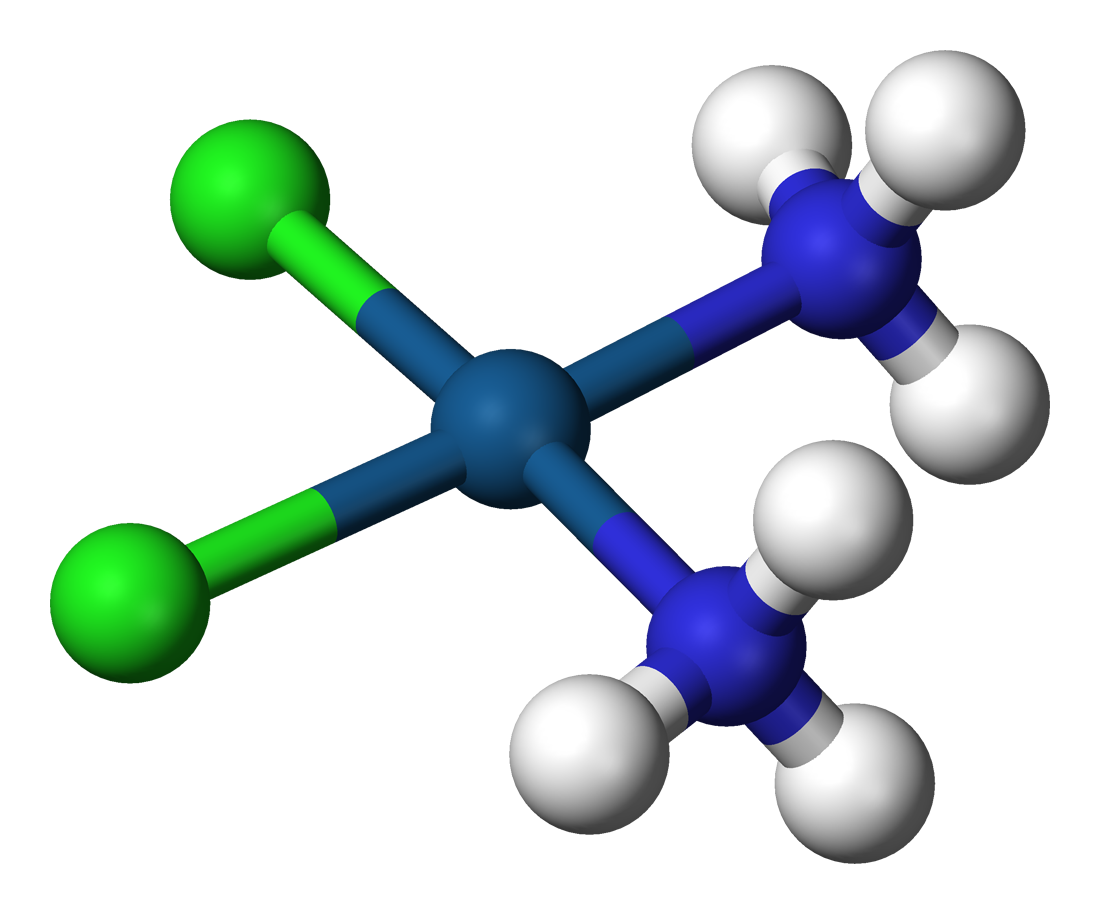
A coordination complex is a chemical compound consisting of a central atom or ion, which is usually metallic and is called the coordination centre, and a surrounding array of bound molecules or ions, that are in turn known as ligands or complexing agents. Many metal-containing compounds, especially those that include transition metals (elements like titanium that belong to the periodic table's d-block), are coordination complexes.
Coordination complexes are so pervasive that their structures and reactions are described in many ways, sometimes confusingly. The atom within a ligand that is bonded to the central metal atom or ion is called the donor atom. In a typical complex, a metal ion is bonded to several donor atoms, which can be the same or different. A polydentate (multiple bonded) ligand is a molecule or ion that bonds to the central atom through several of the ligand's atoms; ligands with 2, 3, 4 or even 6 bonds to the central atom are common. These complexes are called chelate complexes; the formation of such complexes is called chelation, complexation, and coordination.
The central atom or ion, together with all ligands, comprise the coordination sphere. The central atoms or ion and the donor atoms comprise the first coordination sphere.
Coordination refers to the "coordinate covalent bonds" (dipolar bonds) between the ligands and the central atom. Originally, a complex implied a reversible association of molecules, atoms, or ions through such weak chemical bonds. As applied to coordination chemistry, this meaning has evolved. Some metal complexes are formed virtually irreversibly and many are bound together by bonds that are quite strong.
The number of donor atoms attached to the central atom or ion is called the coordination number. The most common coordination numbers are 2, 4, and especially 6. A hydrated ion is one kind of a complex ion (or simply a complex), a species formed between a central metal ion and one or more surrounding ligands, molecules or ions that contain at least one lone pair of electrons.
If all the ligands are monodentate, then the number of donor atoms equals the number of ligands. For example, the cobalt(II) hexahydrate ion or the hexaaquacobalt(II) ion [Co(H2O)6]2+ is a hydrated-complex ion that consists of six water molecules attached to a metal ion Co. The oxidation state and the coordination number reflect the number of bonds formed between the metal ion and the ligands in the complex ion. However, the coordination number of Pt(en)2+
2 is 4 (rather than 2) since it has two bidentate ligands, which contain four donor atoms in total.
Any donor atom will give a pair of electrons. There are some donor atoms or groups which can offer more than one pair of electrons. Such are called bidentate (offers two pairs of electrons) or polydentate (offers more than two pairs of electrons). In some cases an atom or a group offers a pair of electrons to two similar or different central metal atoms or acceptors—by division of the electron pair—into a three-center two-electron bond. These are called bridging ligands.
Coordination complexes have been known since the beginning of modern chemistry. Early well-known coordination complexes include dyes such as Prussian blue. Their properties were first well understood in the late 1800s, following the 1869 work of Christian Wilhelm Blomstrand. Blomstrand developed what has come to be known as the complex ion chain theory. In considering metal amine complexes, he theorized that the ammonia molecules compensated for the charge of the ion by forming chains of the type [(NH3)X]X+, where X is the coordination number of the metal ion. He compared his theoretical ammonia chains to hydrocarbons of the form (CH2)X.
Hub AI
Coordination complex AI simulator
(@Coordination complex_simulator)
Coordination complex
A coordination complex is a chemical compound consisting of a central atom or ion, which is usually metallic and is called the coordination centre, and a surrounding array of bound molecules or ions, that are in turn known as ligands or complexing agents. Many metal-containing compounds, especially those that include transition metals (elements like titanium that belong to the periodic table's d-block), are coordination complexes.
Coordination complexes are so pervasive that their structures and reactions are described in many ways, sometimes confusingly. The atom within a ligand that is bonded to the central metal atom or ion is called the donor atom. In a typical complex, a metal ion is bonded to several donor atoms, which can be the same or different. A polydentate (multiple bonded) ligand is a molecule or ion that bonds to the central atom through several of the ligand's atoms; ligands with 2, 3, 4 or even 6 bonds to the central atom are common. These complexes are called chelate complexes; the formation of such complexes is called chelation, complexation, and coordination.
The central atom or ion, together with all ligands, comprise the coordination sphere. The central atoms or ion and the donor atoms comprise the first coordination sphere.
Coordination refers to the "coordinate covalent bonds" (dipolar bonds) between the ligands and the central atom. Originally, a complex implied a reversible association of molecules, atoms, or ions through such weak chemical bonds. As applied to coordination chemistry, this meaning has evolved. Some metal complexes are formed virtually irreversibly and many are bound together by bonds that are quite strong.
The number of donor atoms attached to the central atom or ion is called the coordination number. The most common coordination numbers are 2, 4, and especially 6. A hydrated ion is one kind of a complex ion (or simply a complex), a species formed between a central metal ion and one or more surrounding ligands, molecules or ions that contain at least one lone pair of electrons.
If all the ligands are monodentate, then the number of donor atoms equals the number of ligands. For example, the cobalt(II) hexahydrate ion or the hexaaquacobalt(II) ion [Co(H2O)6]2+ is a hydrated-complex ion that consists of six water molecules attached to a metal ion Co. The oxidation state and the coordination number reflect the number of bonds formed between the metal ion and the ligands in the complex ion. However, the coordination number of Pt(en)2+
2 is 4 (rather than 2) since it has two bidentate ligands, which contain four donor atoms in total.
Any donor atom will give a pair of electrons. There are some donor atoms or groups which can offer more than one pair of electrons. Such are called bidentate (offers two pairs of electrons) or polydentate (offers more than two pairs of electrons). In some cases an atom or a group offers a pair of electrons to two similar or different central metal atoms or acceptors—by division of the electron pair—into a three-center two-electron bond. These are called bridging ligands.
Coordination complexes have been known since the beginning of modern chemistry. Early well-known coordination complexes include dyes such as Prussian blue. Their properties were first well understood in the late 1800s, following the 1869 work of Christian Wilhelm Blomstrand. Blomstrand developed what has come to be known as the complex ion chain theory. In considering metal amine complexes, he theorized that the ammonia molecules compensated for the charge of the ion by forming chains of the type [(NH3)X]X+, where X is the coordination number of the metal ion. He compared his theoretical ammonia chains to hydrocarbons of the form (CH2)X.