


Community hub
Recent from talks
Contribute something to knowledge base
Content stats: 0 posts, 0 articles, 1 media, 0 notes
Members stats: 0 subscribers, 0 contributors, 0 moderators, 0 supporters
Subscribers
Supporters
Contributors
Moderators
Hub AI
Compound steam engine AI simulator
(@Compound steam engine_simulator)
Hub AI
Compound steam engine AI simulator
(@Compound steam engine_simulator)
Compound steam engine
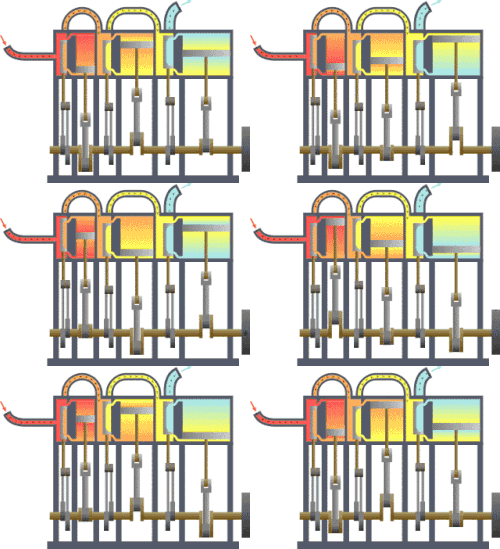
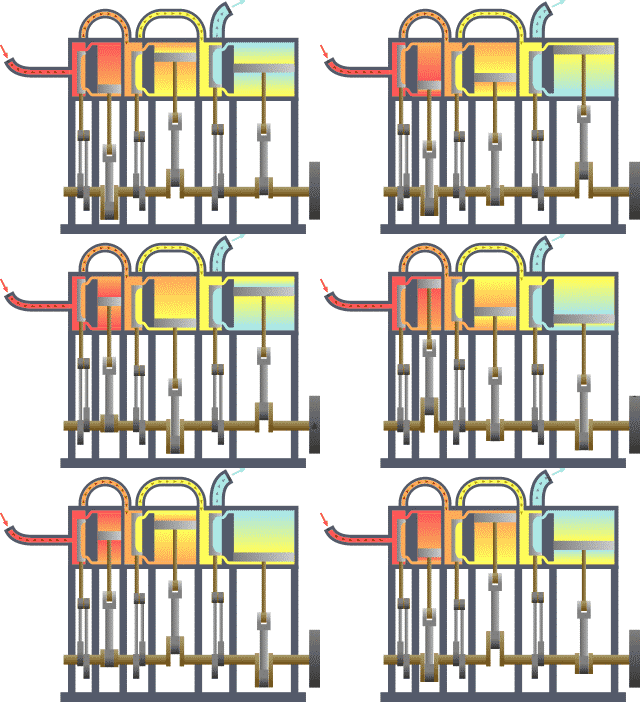
A compound steam engine unit is a type of steam engine where steam is expanded in two or more stages. A typical arrangement for a compound engine is that the steam is first expanded in a high-pressure (HP) cylinder, then having given up heat and losing pressure, it exhausts directly into one or more larger-volume low-pressure (LP) cylinders. Multiple-expansion engines employ additional cylinders, of progressively lower pressure, to extract further energy from the steam.
Invented in 1781, this technique was first employed on a Cornish beam engine in 1804. Around 1850, compound engines were first introduced into Lancashire textile mills.
There are many compound systems and configurations, but there are two basic types, according to how HP and LP piston strokes are phased and hence whether the HP exhaust is able to pass directly from HP to LP (Woolf compounds) or whether pressure fluctuation necessitates an intermediate "buffer" space in the form of a steam chest or pipe known as a receiver (receiver compounds).
In a single-expansion (or 'simple') steam engine, the high-pressure steam enters the cylinder at boiler pressure through an inlet valve. The steam pressure forces the piston down the cylinder, until the valve shuts (e.g. after 25% of the piston's stroke). After the steam supply is cut off the trapped steam continues to expand, pushing the piston to the end of its stroke, where the exhaust valve opens and expels the partially depleted steam to the atmosphere, or to a condenser. This "cut-off" allows much more work to be extracted, since the expansion of the steam is doing additional work beyond that done by the steam at boiler pressure.
An earlier cut-off increases the expansion ratio, which in principle allows more energy to be extracted and increases efficiency. Ideally, the steam would expand adiabatically, and the temperature would drop corresponding to the volume increase. However, in practice the material of the surrounding cylinder acts as a heat reservoir, cooling the steam in the earlier part of the expansion and heating it in the later part. These irreversible heat flows decrease the efficiency of the process, so that beyond a certain point, further increasing the expansion ratio would actually decrease efficiency, in addition to decreasing the mean effective pressure and thus the power of the engine.
A solution to the dilemma was invented in 1804 by British engineer Arthur Woolf, who patented his Woolf high pressure compound engine in 1805. In the compound engine, high-pressure steam from the boiler first expands in a high-pressure (HP) cylinder and then enters one or more subsequent lower pressure (LP) cylinders. The complete expansion of the steam occurs across multiple cylinders and, as there is less expansion in each cylinder, the steam cools less in each cylinder, making higher expansion ratios practical and increasing the efficiency of the engine.
There are other advantages: as the temperature range is smaller, cylinder condensation is reduced. Loss due to condensation is restricted to the LP cylinder. Pressure difference is less in each cylinder so there is less steam leakage at the piston and valves. The turning moment is more uniform, so balancing is easier and a smaller flywheel may be used. Only the smaller HP cylinder needs to be built to withstand the highest pressure, which reduces the overall weight. Similarly, components are subject to less strain, so they can be lighter. The reciprocating parts of the engine are lighter, reducing the engine vibrations. The compound could be started at any point in the cycle, and in the event of mechanical failure the compound could be reset to act as a simple, and thus keep running.
To derive equal work from lower-pressure steam requires a larger cylinder volume as this steam occupies a greater volume. Therefore, the bore, and in rare cases the stroke as well, are increased in low-pressure cylinders, resulting in larger cylinders.
Compound steam engine
A compound steam engine unit is a type of steam engine where steam is expanded in two or more stages. A typical arrangement for a compound engine is that the steam is first expanded in a high-pressure (HP) cylinder, then having given up heat and losing pressure, it exhausts directly into one or more larger-volume low-pressure (LP) cylinders. Multiple-expansion engines employ additional cylinders, of progressively lower pressure, to extract further energy from the steam.
Invented in 1781, this technique was first employed on a Cornish beam engine in 1804. Around 1850, compound engines were first introduced into Lancashire textile mills.
There are many compound systems and configurations, but there are two basic types, according to how HP and LP piston strokes are phased and hence whether the HP exhaust is able to pass directly from HP to LP (Woolf compounds) or whether pressure fluctuation necessitates an intermediate "buffer" space in the form of a steam chest or pipe known as a receiver (receiver compounds).
In a single-expansion (or 'simple') steam engine, the high-pressure steam enters the cylinder at boiler pressure through an inlet valve. The steam pressure forces the piston down the cylinder, until the valve shuts (e.g. after 25% of the piston's stroke). After the steam supply is cut off the trapped steam continues to expand, pushing the piston to the end of its stroke, where the exhaust valve opens and expels the partially depleted steam to the atmosphere, or to a condenser. This "cut-off" allows much more work to be extracted, since the expansion of the steam is doing additional work beyond that done by the steam at boiler pressure.
An earlier cut-off increases the expansion ratio, which in principle allows more energy to be extracted and increases efficiency. Ideally, the steam would expand adiabatically, and the temperature would drop corresponding to the volume increase. However, in practice the material of the surrounding cylinder acts as a heat reservoir, cooling the steam in the earlier part of the expansion and heating it in the later part. These irreversible heat flows decrease the efficiency of the process, so that beyond a certain point, further increasing the expansion ratio would actually decrease efficiency, in addition to decreasing the mean effective pressure and thus the power of the engine.
A solution to the dilemma was invented in 1804 by British engineer Arthur Woolf, who patented his Woolf high pressure compound engine in 1805. In the compound engine, high-pressure steam from the boiler first expands in a high-pressure (HP) cylinder and then enters one or more subsequent lower pressure (LP) cylinders. The complete expansion of the steam occurs across multiple cylinders and, as there is less expansion in each cylinder, the steam cools less in each cylinder, making higher expansion ratios practical and increasing the efficiency of the engine.
There are other advantages: as the temperature range is smaller, cylinder condensation is reduced. Loss due to condensation is restricted to the LP cylinder. Pressure difference is less in each cylinder so there is less steam leakage at the piston and valves. The turning moment is more uniform, so balancing is easier and a smaller flywheel may be used. Only the smaller HP cylinder needs to be built to withstand the highest pressure, which reduces the overall weight. Similarly, components are subject to less strain, so they can be lighter. The reciprocating parts of the engine are lighter, reducing the engine vibrations. The compound could be started at any point in the cycle, and in the event of mechanical failure the compound could be reset to act as a simple, and thus keep running.
To derive equal work from lower-pressure steam requires a larger cylinder volume as this steam occupies a greater volume. Therefore, the bore, and in rare cases the stroke as well, are increased in low-pressure cylinders, resulting in larger cylinders.
Recent media
Recent media