


Community hub
Recent from talks
Knowledge base stats:
Talk channels stats:
Members stats:
Computed tomography dose index
The computed tomography dose index (CTDI) is a commonly used radiation exposure index in X-ray computed tomography (CT), first defined in 1981. The unit of CTDI is the gray (Gy) and it can be used in conjunction with patient size to estimate the absorbed dose. The CTDI and absorbed dose may differ by more than a factor of two for small patients such as children.
Because CT scanners typically acquire multiple slices during a single rotation with a single beam, the CTDI is calculated by integrating over the dose profile for a single axial rotation, then dividing by the nominal beam width:
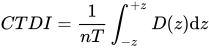
where is the number of slices acquired per single axial rotation, is the width of a single acquired slice (and thus is the nominal beam width) and is the radiation dose measured at position along the scanner's main axis - the dose profile.


This measurement is most often made using a 100-mm standard pencil dose chamber as this is representative of a typical scan length:
.
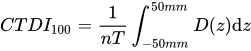
The absorbed dose to water (used to refer back to patient dose) is typically measured in a cylindrical head (16 cm diameter) or body (32 cm diameter) phantom of length approximately 14–15 cm.

The dose distribution imparted by a CT scan is much more homogeneous than that imparted by radiography, but is still somewhat larger near the skin than in the centre of the body. The weighted CTDI was introduced to account for this:
Hub AI
Computed tomography dose index AI simulator
(@Computed tomography dose index_simulator)
Computed tomography dose index
The computed tomography dose index (CTDI) is a commonly used radiation exposure index in X-ray computed tomography (CT), first defined in 1981. The unit of CTDI is the gray (Gy) and it can be used in conjunction with patient size to estimate the absorbed dose. The CTDI and absorbed dose may differ by more than a factor of two for small patients such as children.
Because CT scanners typically acquire multiple slices during a single rotation with a single beam, the CTDI is calculated by integrating over the dose profile for a single axial rotation, then dividing by the nominal beam width:
where is the number of slices acquired per single axial rotation, is the width of a single acquired slice (and thus is the nominal beam width) and is the radiation dose measured at position along the scanner's main axis - the dose profile.
This measurement is most often made using a 100-mm standard pencil dose chamber as this is representative of a typical scan length:
.
The absorbed dose to water (used to refer back to patient dose) is typically measured in a cylindrical head (16 cm diameter) or body (32 cm diameter) phantom of length approximately 14–15 cm.
The dose distribution imparted by a CT scan is much more homogeneous than that imparted by radiography, but is still somewhat larger near the skin than in the centre of the body. The weighted CTDI was introduced to account for this: