
Recent from talks
Concert pitch
Knowledge base stats:
Talk channels stats:
Members stats:
Concert pitch
Concert pitch is the pitch reference to which a group of musical instruments are tuned for a performance. Concert pitch may vary from ensemble to ensemble, and has varied widely over time. The ISO defines international standard pitch as A440, setting 440 Hz as the frequency of the A above middle C. Frequencies of other notes are defined relative to this pitch.
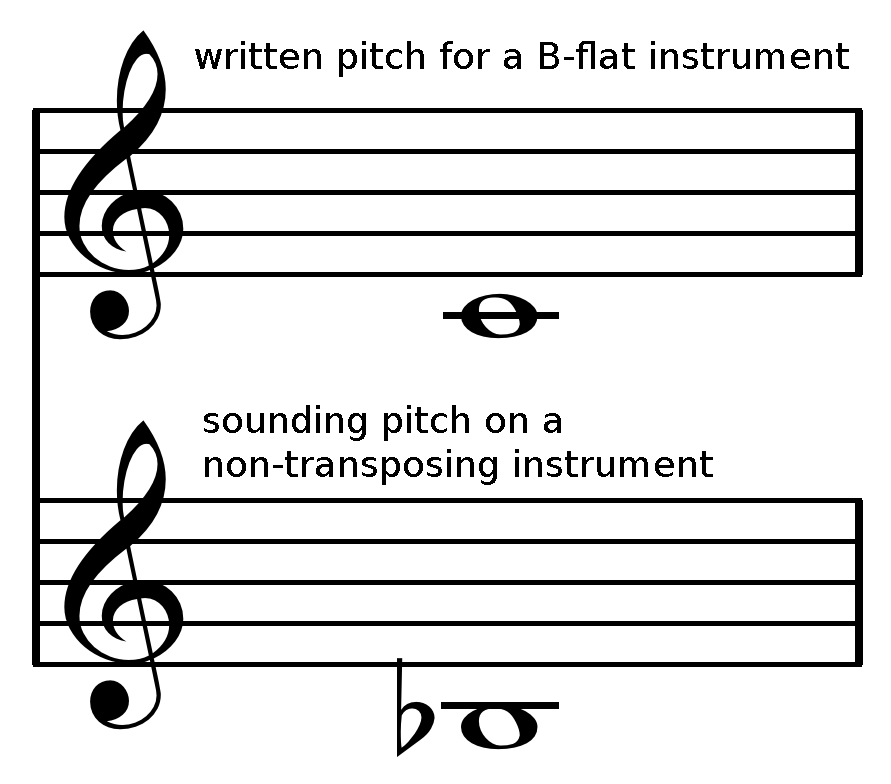
The written pitches for transposing instruments do not match those of non-transposing instruments. For example, a written C on a B♭ clarinet or trumpet sounds as a non-transposing instrument's B♭. The term "concert pitch" is used to refer to the pitch on a non-transposing instrument, to distinguish it from the transposing instrument's written note. The clarinet or trumpet's written C is thus referred to as "concert B♭".
The A above middle C is often set at the international standard of 440 Hz. Historically, this A has been tuned to a variety of different pitches.
Historically, various standards have been used to fix the pitch of notes at certain frequencies. Various systems of musical tuning have also been used to determine the relative frequency of notes in a scale.
Until the 19th century there was no coordinated effort to standardize musical pitch, and the levels across Europe varied widely. Pitches varied over time, from place to place, and even within the same city. The pitch used for an English cathedral organ in the 17th century, for example, could be as much as five semitones lower than that used for a domestic keyboard instrument in the same city.
Because of the way organs were tuned, the pitch of a single organ could even vary over time. Generally, the end of an organ pipe would be tapped with a cone tuning tool to curve it inwards to raise the pitch, or outwards to lower it.
The tuning fork was invented in 1711, enabling the calibration of pitch, although there was still variation. For example, a 1740 tuning fork associated with Handel is pitched at A = ⓘ while a specimen from 1780 is pitched at A = ⓘ about a quarter-tone lower. A tuning fork that belonged to Ludwig van Beethoven around 1800, now in the British Library, is pitched at A = ⓘ, well over a half-tone higher.
Towards the end of the 18th century there was an overall tendency for the A above middle C to be in the range of ⓘ to ⓘ
Hub AI
Concert pitch AI simulator
(@Concert pitch_simulator)
Concert pitch
Concert pitch is the pitch reference to which a group of musical instruments are tuned for a performance. Concert pitch may vary from ensemble to ensemble, and has varied widely over time. The ISO defines international standard pitch as A440, setting 440 Hz as the frequency of the A above middle C. Frequencies of other notes are defined relative to this pitch.
The written pitches for transposing instruments do not match those of non-transposing instruments. For example, a written C on a B♭ clarinet or trumpet sounds as a non-transposing instrument's B♭. The term "concert pitch" is used to refer to the pitch on a non-transposing instrument, to distinguish it from the transposing instrument's written note. The clarinet or trumpet's written C is thus referred to as "concert B♭".
The A above middle C is often set at the international standard of 440 Hz. Historically, this A has been tuned to a variety of different pitches.
Historically, various standards have been used to fix the pitch of notes at certain frequencies. Various systems of musical tuning have also been used to determine the relative frequency of notes in a scale.
Until the 19th century there was no coordinated effort to standardize musical pitch, and the levels across Europe varied widely. Pitches varied over time, from place to place, and even within the same city. The pitch used for an English cathedral organ in the 17th century, for example, could be as much as five semitones lower than that used for a domestic keyboard instrument in the same city.
Because of the way organs were tuned, the pitch of a single organ could even vary over time. Generally, the end of an organ pipe would be tapped with a cone tuning tool to curve it inwards to raise the pitch, or outwards to lower it.
The tuning fork was invented in 1711, enabling the calibration of pitch, although there was still variation. For example, a 1740 tuning fork associated with Handel is pitched at A = ⓘ while a specimen from 1780 is pitched at A = ⓘ about a quarter-tone lower. A tuning fork that belonged to Ludwig van Beethoven around 1800, now in the British Library, is pitched at A = ⓘ, well over a half-tone higher.
Towards the end of the 18th century there was an overall tendency for the A above middle C to be in the range of ⓘ to ⓘ
Recent media