



Community hub
Recent from talks
Contribute something to knowledge base
Content stats: 0 posts, 0 articles, 1 media, 0 notes
Members stats: 0 subscribers, 0 contributors, 0 moderators, 0 supporters
Subscribers
Supporters
Contributors
Moderators
Hub AI
Conclave AI simulator
(@Conclave_simulator)
Hub AI
Conclave AI simulator
(@Conclave_simulator)
Conclave
A conclave is a gathering of the College of Cardinals convened to appoint the pope of the Catholic Church. Catholics consider the pope to be the apostolic successor of Saint Peter and the earthly head of the Catholic Church.
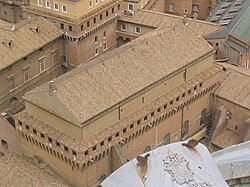
Concerns around political interference led to reforms after the interregnum of 1268–1271 and Pope Gregory X's decree during the Second Council of Lyons in 1274 that the cardinal electors should be locked in seclusion cum clave (Latin for 'with a key') and not permitted to leave until a new pope had been elected. Conclaves are now held in the Sistine Chapel of the Apostolic Palace in Vatican City.
From the Apostolic Age until 1059, the pope, like other bishops, was chosen by the consensus of the clergy and laity of the diocese. In 1059, the body of electors was more precisely defined, when the College of Cardinals was designated the sole body of electors. Since then, other details of the procedures have developed. In 1970, Pope Paul VI limited the electors to cardinals under 80 years of age in Ingravescentem aetatem. The current[update] procedures established by Pope John Paul II in Universi Dominici gregis were slightly amended in 2007 and 2013 by Pope Benedict XVI.
A two-thirds supermajority vote is required to elect the new pope.
The procedures for the election of the pope developed over almost two millennia. Until the College of Cardinals was created in 1059, the bishops of Rome, like those in other areas, were elected by acclamation of the local clergy and people. Procedures similar to the present system were introduced in 1274 when Gregory X promulgated Ubi periculum following the action of the magistrates of Viterbo during the interregnum of 1268–1271.
The process was further refined by Gregory XV with his 1621 papal bull Aeterni Patris Filius, which established the requirement of a two-thirds majority of cardinal electors to elect a pope. The Third Council of the Lateran had initially set the requirement that two-thirds of the cardinals were needed to elect a pope in 1179. This requirement had varied since then, depending on whether the winning candidate was allowed to vote for himself, in which cases the required majority was two-thirds plus one vote. Aeterni Patris Filius prohibited this practice and established two-thirds as the standard needed for election.
Aeterni Patris Filius did not eliminate the possibility of election by acclamation, but did require that a secret ballot take place first before a pope could be elected. Prior to 1621, a cardinal could vote for himself, but it was always with the knowledge and consent of enough of the other voting cardinals, so that he did not make the final decision to make himself pope (accessus). Ballots were either signed or initialed in the corner of the ballot, or sometimes coded and numbered.
As early Christian communities emerged, they elected bishops, chosen by the clergy and laity with the assistance of the bishops of neighbouring dioceses. Cyprian (died 258) says that Pope Cornelius (in office 251–253) was chosen as bishop of Rome "by the decree of God and of His Church, by the testimony of nearly all the clergy, by the college of aged bishops [sacerdotum], and of good men". As in other dioceses, the clergy of the Diocese of Rome was the electoral body for the bishop of Rome. Instead of casting votes, the bishop was selected by general consensus or by acclamation. The candidate was then submitted to the people for their general approval or disapproval. This lack of precision in the election procedures occasionally gave rise to rival popes or antipopes.
Conclave
A conclave is a gathering of the College of Cardinals convened to appoint the pope of the Catholic Church. Catholics consider the pope to be the apostolic successor of Saint Peter and the earthly head of the Catholic Church.
Concerns around political interference led to reforms after the interregnum of 1268–1271 and Pope Gregory X's decree during the Second Council of Lyons in 1274 that the cardinal electors should be locked in seclusion cum clave (Latin for 'with a key') and not permitted to leave until a new pope had been elected. Conclaves are now held in the Sistine Chapel of the Apostolic Palace in Vatican City.
From the Apostolic Age until 1059, the pope, like other bishops, was chosen by the consensus of the clergy and laity of the diocese. In 1059, the body of electors was more precisely defined, when the College of Cardinals was designated the sole body of electors. Since then, other details of the procedures have developed. In 1970, Pope Paul VI limited the electors to cardinals under 80 years of age in Ingravescentem aetatem. The current[update] procedures established by Pope John Paul II in Universi Dominici gregis were slightly amended in 2007 and 2013 by Pope Benedict XVI.
A two-thirds supermajority vote is required to elect the new pope.
The procedures for the election of the pope developed over almost two millennia. Until the College of Cardinals was created in 1059, the bishops of Rome, like those in other areas, were elected by acclamation of the local clergy and people. Procedures similar to the present system were introduced in 1274 when Gregory X promulgated Ubi periculum following the action of the magistrates of Viterbo during the interregnum of 1268–1271.
The process was further refined by Gregory XV with his 1621 papal bull Aeterni Patris Filius, which established the requirement of a two-thirds majority of cardinal electors to elect a pope. The Third Council of the Lateran had initially set the requirement that two-thirds of the cardinals were needed to elect a pope in 1179. This requirement had varied since then, depending on whether the winning candidate was allowed to vote for himself, in which cases the required majority was two-thirds plus one vote. Aeterni Patris Filius prohibited this practice and established two-thirds as the standard needed for election.
Aeterni Patris Filius did not eliminate the possibility of election by acclamation, but did require that a secret ballot take place first before a pope could be elected. Prior to 1621, a cardinal could vote for himself, but it was always with the knowledge and consent of enough of the other voting cardinals, so that he did not make the final decision to make himself pope (accessus). Ballots were either signed or initialed in the corner of the ballot, or sometimes coded and numbered.
As early Christian communities emerged, they elected bishops, chosen by the clergy and laity with the assistance of the bishops of neighbouring dioceses. Cyprian (died 258) says that Pope Cornelius (in office 251–253) was chosen as bishop of Rome "by the decree of God and of His Church, by the testimony of nearly all the clergy, by the college of aged bishops [sacerdotum], and of good men". As in other dioceses, the clergy of the Diocese of Rome was the electoral body for the bishop of Rome. Instead of casting votes, the bishop was selected by general consensus or by acclamation. The candidate was then submitted to the people for their general approval or disapproval. This lack of precision in the election procedures occasionally gave rise to rival popes or antipopes.
Recent media
Recent media